
I’d like you to imagine two people (Person A and Person B). Both receive an unsolicited direct marketing call to their personal mobile phone, in which the caller says the recipient’s name (e.g. “am I speaking to Jon Baines?”) Both are registered with the Telephone Preference Service. Both are aggrieved at receiving the unlawful call.
Person A knows nothing much about electronic marketing laws, and nothing much about data protection law. But, to them, quite reasonably, the call would seem to offend their data protection rights (the caller has their name, and their number). They do know that the Information Commissioner enforces the data protection laws.
Person B knows a lot about electronic marketing and data protection law. They know that the unsolicited direct marketing call was not just an infringement of the Privacy and Electronic Communications (EC Directive) Regulations 2003, but also involved the processing of their personal data, thus engaging the UK GDPR.
Both decide to complain to the Information Commissioner’s Office (ICO). Both see this page on the ICO website
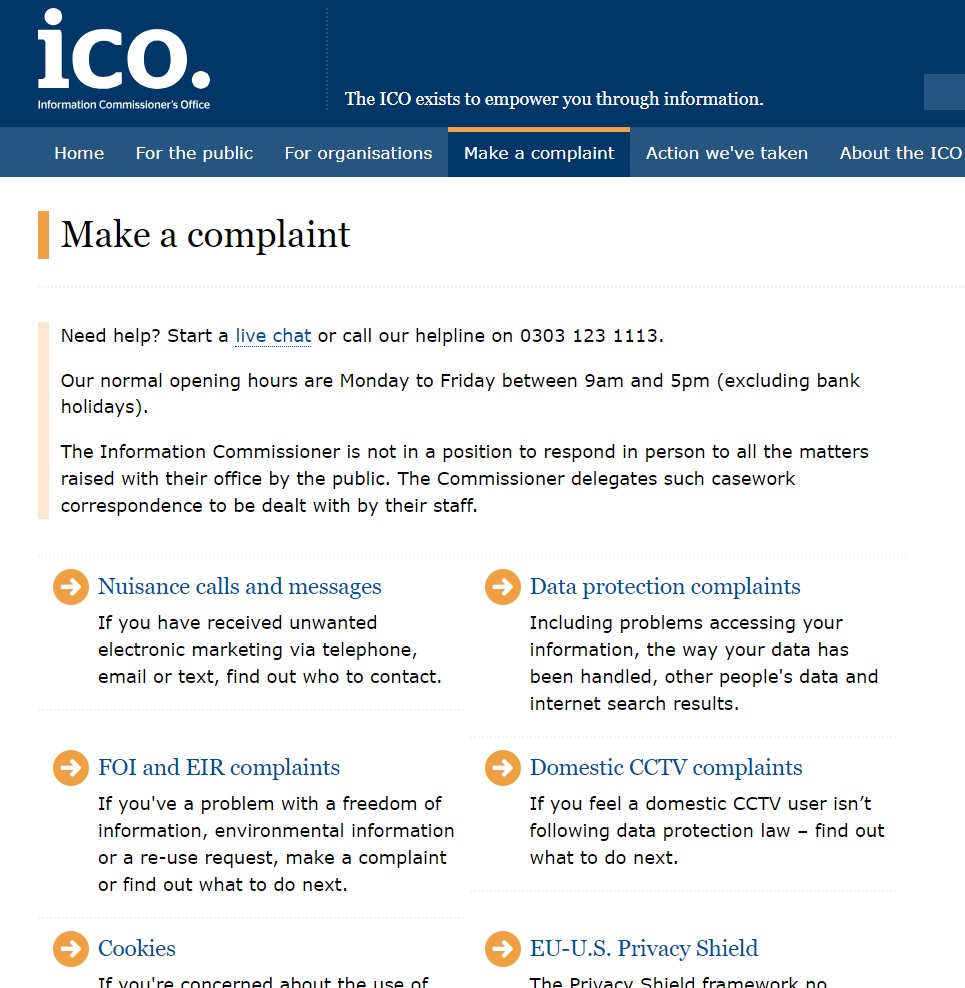
They see a page for reporting Nuisance calls and messages, and, so, fill in the form on that page.
And never hear anything more.
Why? Because, as the subsequent page says “We will use the information you provide to help us investigate and take action against those responsible. We don’t respond to complaints individually” (emphasis added).
But isn’t this a problem? If Person A’s and Person B’s complaints are (as they seem to be) “hybrid” PECR and UK GDPR complaints, then Article 57(1)(f) of the latter requires the ICO to
handle complaints lodged by a data subject…and investigate, to the extent appropriate, the subject matter of the complaint and inform the complainant of the progress and the outcome of the investigation within a reasonable period (emphasis added)
What Article 57(1)(f) and the words “investigate, to the extent appropriate” mean, has been the subject of quite a bit of litigation in recent years (the basic summary of which is that the ICO has broad discretion as to how to investigate, and even a mere decision to cease handling a complaint will be likely to suffice (see Killock & Veale & others v Information Commissioner (GI/113/2021 & others)).
But nowhere has anyone suggested that ICO can simply decide not to “inform the complainant of the progress and the outcome of the investigation”, in hybrid complaints like the Person A’s and Person B’s would be.
Yet that is what undoubtedly happens in many cases. And – it strikes me – it has happened to me countless times (I have complained about many, many unsolicited calls over the years, but never heard anything of the progress and outcome). Maybe you might say that I (who, after all, have found time to think about and write this post) can’t play the innocent. But I strongly believe that there are lots of Person As (and a fair few Person Bs) who would, if they knew that – to the extent theirs is a UK GDPR complaint – the law obliges the ICO to investigate and inform them of the progress and the outcome of that investigation, rightly feel aggrieved to have heard nothing.
This isn’t just academic: unsolicited direct marketing is the one area that the ICO still sees as worthy of fines (all but two of the twenty-three fines in the last year have been under that regime). So a complaint about such a practice is potentially a serious matter. Sometimes, a single complaint about such marketing has resulted in a large fine for the miscreant, yet – to the extent that the issue is also a UK GDPR one – the complainant themselves often never hears directly about the complaint.
In addition to the Killock & Veale case, there have been a number of cases looking at the limits to (and discretion regarding) ICO’s investigation of complaints. As far as I know no one has actually yet raised what seems to be a plain failure to investigate and inform in these “hybrid” PECR and UK GDPR cases.
The views in this post (and indeed most posts on this blog) are my personal ones, and do not represent the views of any organisation I am involved with.

 informationrightsandwrongs