This is a helpful short Court of Appeal judgment on the appropriate forum for a data protection of relatively low value and limited complexity (spoiler: it’s the County Court, folks).
The claimant had originally incorrectly issued his claim as a High Court media and communications claim in the Cardiff District Registry (if data protection claims are to be issued in the High Court, they must be issued in the King’s Bench Division at the Royal Courts of Justice). The judge in the High Court in Cardiff transferred the claim to the County Court but his order arguably contained insufficient reasons, and did not explain that either party could apply to have it set aside or varied (as required by CPR 3.3(5)(b). The claimant tried to make representations, by way of an email, as to why the High Court was the appropriate forum, but this was rejected on the basis that it had been filed in the wrong court. By that stage, the transfer to the County Court had taken effect. Accordingly, the matters arising could only be determined by way of appeal.
In its determination, the CoA found that the case (involving disclosure, in separate proceedings, of medical information by a court security guard to an usher and a solicitor for a third party) did not appear to involve any factual or legal complexity, and the claimed sum of £30,000 was clearly within the ambit of the County Court.
(I interject here to observe that, on the brief facts as recorded in the judgment, there might have been some legal complexity – it seems likely that the disclosure would have been made orally by the security guard, so was there “processing” involved?)
The Soil Association Ltd, is a company limited by guarantee and a not-for-profit registered charity. It is not a public authority for the purposes of the Freedom of Information Act 2000 (FOIA), nor, I think, has anyone proposed that it is a public authority for the purposes of the Environmental Information Regulations 2004 (EIR). Yet the Information Commissioner’s Office, in a decision now upheld by the Information Tribunal, has determined that a subsidiary company of the Soil Association – SA Certification Limited – is a public authority for the purposes of the EIR. I think this is probably the correct position, and the judgment of the Tribunal is helpful in explaining why.
A body is a public authority for the purposes of FOIA primarily by way of designation or ownership (if the body is listed in Schedule One of FOIA, or designated by Order, or is wholly owned by one or more other public authorities, then it falls under the regime). The EIR are different: a body is determined to be an EIR public authority if it is a FOIA one, but it might also be one by virtue of what it does or is empowered to do. Under regulation 2(2)(c) if the body is a “natural or legal [person] having public responsibilities or functions, or providing public services, in relation to the environment, under the control of a body or person [who is a public authority]” then it will be a public authority for the purposes of the EIR.
The case law has established that one of the core tests for this is whether the body has been vested with “special powers” of a public nature, “beyond those which result from the normal rules applicable in relations between persons governed by private law’” (C-297/12 Fish Legal v Information Commissioner).
SA Certification Ltd is an accredited certification body for the delivery of certification under a number of regulations and standards, and is designated by DEFRA as a “control body” for the purposes of its “control system” for the labelling of organic products. This, held the Tribunal, confers a special power on SA Certification to certify as organic and to suspend or terminate certification, and this was sufficient to render it a public authority for the purposes of the EIR.
The views in this post (and indeed most posts on blog) are my personal ones, and do not represent the views of any organisation I am involved with.
For those interested in the general question of what is a “publicly owned company” for the purposes of sections 3 and 6 of the Freedom of Information Act 2000 (FOIA), and the specific question of whether the Russell Group is a public authority for the purposes of the FOIA, the Information Tribunal judgment in Farfan v Information Commissioner & Anor [2026] UKFTT 48 (GRC) will make fascinating reading. For the remaining 69.2 million people in the UK, it will be impenetrable.
A company will be a publicly owned company for the purposes of section 3(1)(b) of FOIA if all of its members are themselves public authorities listed in schedule 1 of FOIA.
So, in short, the answer to the second question is “no”, because a) 22 of the 24 members of the Russell Group are university institutions, not the governing bodies of those institutions (and it is the latter which are listed in schedule 1), b) in any case, even if the Tribunal had decided that there was no distinction between the university institutions and their governing bodies, the remaining two members of the Russell Group are the Universities of Glasgow and Edinburgh, and they are not listed in schedule 1 of FOIA (rather, they are public authorities for the purposes of the Freedom of Information (Scotland) Act 2002).
Get reading, you crazy FOIA (and FOISA) nerds.
The views in this post (and indeed most posts on blog) are my personal ones, and do not represent the views of any organisation I am involved with.
If anyone who deals with data subject access requests, or disclosure exercises in general, wants to read a horror story, they should look at the recent judgment in Forsters LLP v Uddin [2025] EWHC 3255 (KB).
This was an application for an interim injunction for breach of confidence, seeking delivery up by the defendant of confidential and privileged documents. Forsters, a law firm, act for Mr and Mrs Alloatti, who are in a dispute with their neighbour, Mr Uddin. No doubt in an attempt to advance his case, Mr Uddin made a DSAR directly to Forsters. But instead of disclosing Mr Uddin’s personal data to him, Forsters disclosed the entire contents of the file containing information responsive to a systems search for the name “Uddin”. This resulted not only in the disclosure of personal data of people unconnected to the dispute, but also in disclosure of around 95% (3,000+ pages) of the Alloatti client file, much of it confidential and privileged.
where a party to litigation discloses documents to the opposing party which are confidential and privileged and the court is satisfied that it is a case of ‘obvious mistake’, which was either known to or ought to have been known to the receiving party, the Court will intervene by injunction to, so far as possible, put the parties back into the position they would have been had the error not occurred. This will usually involve granting an injunction that requires the recipient to deliver up the documents, to destroy any copies he has made of them and which restrains him from making any use of the information contained in the documents.
Further proof that this was a mistake lay in the fact that Mr Uddin, on receiving the disclosure, immediately notified Forsters of the breaches of confidence and GDPR. Although he later sought to row back on this in order to retain and use the information in his dispute with the Alloattis, his argument that the disclosure was lawful as a DSAR response was doomed.
One argument that found greater favour with the judge was that the “erroneous disclosure to him has undermined the confidentiality and privilege in the information he has seen”. But although the judge accepted that Mr Uddin could not “un-know” some of what he had seen he held that
Nonetheless, the court can help the Claimant to regain control over the 3,300 documents themselves and over the way in which information from those documents is deployed in the two claims. In this way, the court can remedy most of the mischief which this inadvertent disclosure has caused
Accordingly, in addition to delivery up and deletion, he was injuncted from using any of the documents, or information from them, in the underlying claim or in a separate claim in harassment against two Forsters employees.
The views in this post (and indeed most posts on blog) are my personal ones, and do not represent the views of any organisation I am involved with.
I’ve been known to criticise First-tier Tribunal (FTT) judgments in the freedom of information jurisdiction. By contrast, this one is superb.
In it, the FTT dismantle the argument (and the decision notice) of the Information Commissioner’s Office that Bolton NHS Foundation Trust were entitled to “neither confirm nor deny” (NCND) holding reviews, including a review by PWC, into the Trust’s governance and management. The PWC review was the subject of an article in the Health Service Journal, and the requester was the journalist, Lawrence Dunhill.
Firstly, the FTT noted that the ICO “case begins with an elementary error of fact. It treats the Trust as having given an NCND response to the entirety of the Request when it did no such thing” (the Trust had only applied NCND in respect of the request for a PWC report, but had confirmed it held other reviews). Oddly, the Trust, in its submissions for the appeal, simply ignored this error (the FTT chose not to speculate on “whether that omission was accidental or tactical”).
Secondly, and notably, the FTT found a fundamental error of law in the ICO’s approach (and, by implication, in its guidance) to NCND in the context of personal data. Section 2(3)(fa) of FOIA provides that section 40(2) is an absolute exemption (therefore not subject to a public interest test). But section 2(3) does not include section 40(5B) (the personal data NCND provision) in the list of absolute exemptions. As far as I know, the ICO has always taken the view, however, that it is an absolute exemption – certainly its current guidance says this).
That approach, held the FTT, is “simply wrong…the exemption under FOIA, s40(5B)(a)(i) is qualified and the public interest balancing test applies”. And but for that error, they said, the ICO might have reached a different conclusion.
As it was, the FTT held that the legitimate interests balancing test under Article 6(1)(f) of the UK GDPR was sufficient to determine the issue: merely confirming or denying whether the PWC review was held would not cause unwarranted prejudice to a named individual when balanced against the requester’s legitimate interests.
It will be interesting to see if the ICO appeal this. Given the strength of the criticism it would perhaps be bold to do so, but it might be that the only alternative will be to have to rewrite their guidance on s40(5), and rethink their long-held view on it.
The views in this post (and indeed most posts on blog) are my personal ones, and do not represent the views of any organisation I am involved with.
The Court of Appeal has handed down an extraordinary judgment (Buzzard-Quashie v Chief Constable of Northamptonshire Police [2025] EWCA Civ 1397) in which the Chief Constable of Northamptonshire was forced to admit civil contempt of court, after camera footage, which the police force had repeatedly insisted, including before the lower courts, and also in response to an express order of the county court, did not exist, was found to exist just before the appeal hearing.
The appellant/applicant, Ms Buzzard-Quashie, had been arrested and initially charged with an offence in 2021. The arrest had involved three officers, all of whom had deployed body-worn-video cameras. Ms Buzzard-Quashie had complained about the arrest very shortly afterwards, and had sought copies of the footage. Although the charge was dropped, the force made only “piecemeal” disclosure, before determining that there was no further footage, or what there had been, had been destroyed.
At that point, she complained to the Information Commissioner’s Office, who told her that it had told the force “to revisit the way it handled your request and provide you with a comprehensive disclosure of the personal data to which you would be entitled as soon as possible”. (Here, the court – I believe – slightly misrepresents this as an “order” by the ICO. The ICO has the power to make an order, by way of an enforcement notice, but it does not appear to have issued a notice (and it would be highly unusual for it to do so in a case like this).)
The force did not do what the ICO had told it to do, so Ms Buzzard-Quashie issued proceedings in the Brentford County Court and obtained an order requiring the force to deliver up to her any footage in its possession or, if none was available or disclosable, to provide a statement from an officer “of a rank no lower than Inspector” explaining why it could not. It also required the force to pay her costs.
Remarkably, the force did not comply with any element of this order. This failure led to Ms Buzzard-Quashie initiating contempt proceedings in the High Court. At that hearing the Chief Constable, in evidence, maintained that that a full search had already been performed; all the footage had been produced; no other footage existed; and he was not in contempt. The judge found that Ms Buzzard-Quashie had not succeeded in establishing to the criminal standard that the Chief Constable was in contempt.
Upon appeal, and just before the hearing, primarily through the efforts of Ms Buzzard-Quashie and her lawyers (acting pro bono), the force was compelled to admit that footage did still exist: its searches had been manifestly inadequate.
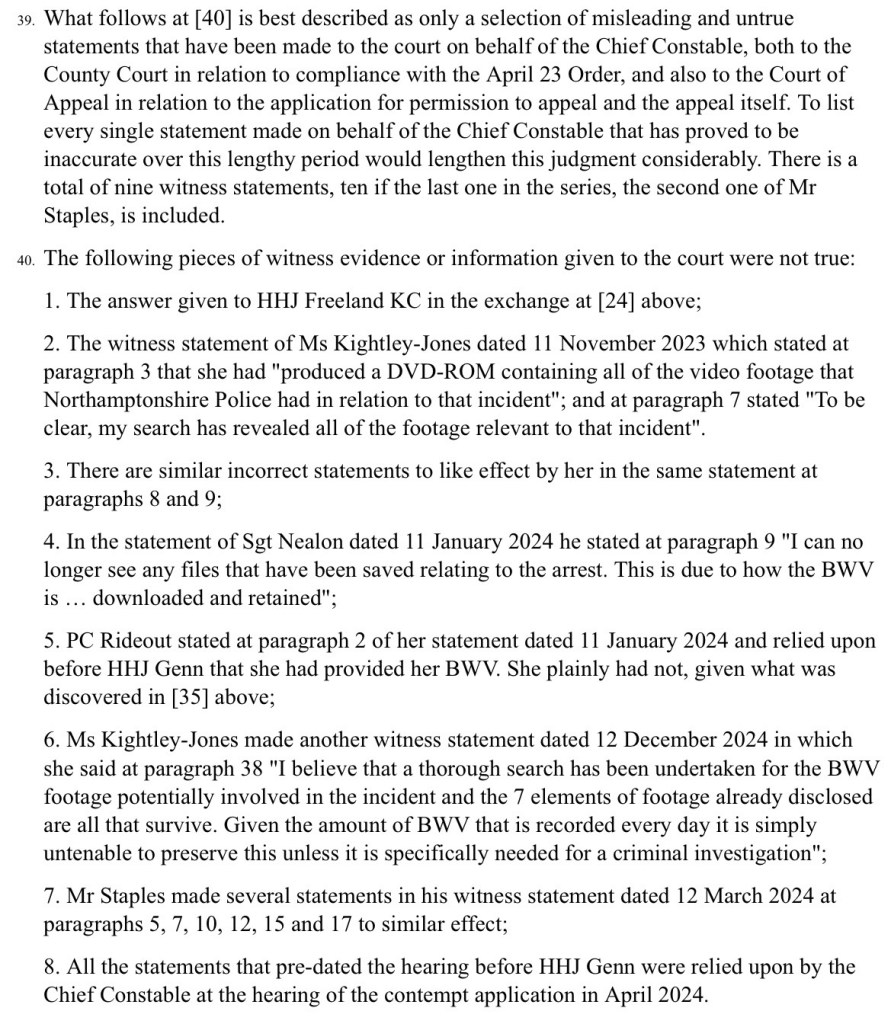
The CoA found that eight pieces of information and evidence (and this was “only a selection”) had not been true, and that “the Chief Constable had not only failed to comply with the [County Court] Order in both substance and form, but had advanced a wholly erroneous factual case before that court, and before this court as well”. Ms Buzzard-Quashie clearly succeeded in her appeal.
The judgment records that the issue of sanction for the contempt found “must wait until the next round of the process”, which presumably will be a further (or perhaps remitted) hearing.
There are any number of issues arising from this. It is, for example, notable that the data protection officer for the force was involved in the searches (and, indeed, she gave the initial statement that the County Court had ordered be given by an Inspector or above).
But a standout point for me is how incredibly difficult it was for Ms Buzzard-Quashie to vindicate her rights: the police force, for whatever reason, felt able to disregard both the statutory regulator and an order of a court. She and her pro bono lawyers showed admirable tenacity and skill, but those features (and that pro bono support) are not available to everyone. One welcomes the fact that all three judges noted her efforts and those of the lawyers.
The force has referred itself to the Independent Office of Police Conduct, and the Court of Appeal has reinforced that by making the referral part of its own order.
In this post I’ve tried to summarise the judgment, but I would strongly encourage its reading. The screenshot here is merely part of the damning findings.
The views in this post (and indeed most posts on blog) are my personal ones, and do not represent the views of any organisation I am involved with.
Response to FOI request says it would take 237 hours to find out. How can ICO have confidence lessons have been learnt?
Anyone who’s ever had been responsible for compiling or overseeing a data breach log will know that one of the commonest incidents is the inadvertent disclosure of personal data. And since the time spreadsheets could first be sent via, or uploaded to, the internet people have mistakenly left personal data in them which should have been removed or otherwise masked. It’s not a new phenomenon: as long ago as 2013 I wrote for the Guardian about the risks, and what I perceived then as a lack of urgency by the Information Commissioner’s Office in addressing, and educating about, those risks.
So it might be found surprising that, two years after the most catastrophic data breach in UK history, in which the information of thousands of Afghan citizens was mistakenly disclosed, putting many lives directly at risk, the Ministry of Defence appears to have no process for identifying when or whether there have been recurrences of the issue.
Section 12 of the Freedom of Information Act 2000 permits a government department not to comply with a request where locating and retrieving any information held would take more than 24 hours. It’s not uncommon for it to be invoked where requests are formulated in too general a manner.
But when I made a request to the MoD for
the number of personal data breaches recorded between April 2023 to date which involved: a) disclosure of personal data to the wrong recipient; b) inadvertent disclosure of personal data contained in a spreadsheet
I imagined that this would be relatively easily located and extracted. Most data breach logs I’ve seen would be categorised in such a way as to enable this. However, the MoD instead informed me that it would take over 237 hours to do so.
Helpfully, the MoD said that if I restricted my request just to the first part (“disclosure of personal data to the wrong recipient”) they might be able to comply. But what this appears to indicate is that no, or no clear, record is being taken of whether there have been repeats of the spreadsheet error involving Afghan citizens.
MoD has briefed us on the measures it has adopted since the breach, which seek to mitigate risk of such an incident occurring in future
But if the MoD cannot say (without it taking more than 237 hours) whether there have been further such incidents, how can they reassure themselves that the risk has been indicated?
And perhaps more pertinently, how can the ICO be satisfied of this?
The views in this post (and indeed most posts on blog) are my personal ones, and do not represent the views of any organisation I am involved with.
The question of whether a body is a public authority for the purposes of the Freedom of Information Act 2000 (FOIA) is determined by asking (up to) three questions:
1: is it listed in Schedule 1 to FOIA? 2: has it been designated as a public authority by order by the Secretary of State or Minister for the Cabinet Office? 3: is it a company wholly owned by the wider public sector, or by the Crown (or by both of those)?
If the answer to all of those is “no”, then the body is not a public authority, and it is not obliged to comply with FOIA, no matter how much it might seem or look like a public authority.
These issues arose in a recent case in the First-tier Tribunal, following a decision by the Information Commissioner’s Office that the Conference of Colleges of the University of Oxford (the “Conference”) – an unincorporated association – was not a FOIA public authority.
It is accepted that the University of Oxford is a public authority, as is each of the colleges of the University (see paragraph 53 of Schedule 1 FOIA). The appeal to the Tribunal was based on argument by the appellant (“The Association Of Precarious Postdoctoral Researchers Ltd”) that the Conference, being a body created by the constituent colleges, met the definition of a “company” wholly owned by those colleges. Although FOIA does not define “company”, certain other legislative provisions do, including section 1121 of the Corporation Tax Act 2010, pursuant to which it is defined as meaning “any body corporate or unincorporated association…”.
That argument, however – held the Tribunal – actually counted against the appellant, because in the absence of clear legislative intent to broaden the term for the purposes of FOIA, it should take its ordinary English use: “unincorporated associations are not considered to be caught by the normal definition of a ‘company’ and…Parliament will make express provision to include them where it intends to do”.
The views in this post (and indeed most posts on blog) are my personal ones, and do not represent the views of any organisation I am involved with.
It is a principle of parliamentary sovereignty that Parliament’s law making powers are not subject to any restriction, and therefore Parliament cannot bind its successors (see e.g. Dicey: “Parliament has, under the English [sic] constitution, the right to make or unmake any law whatever; and, further, that no person or body is recognised by the law of England [sic] as having a right to override or set aside the legislation of Parliament.”)
It follows that where two Acts of Parliament are inconsistent with each other, the courts will take the most recent one to be authoritative, through a doctrine of “implied repeal”.
However, in recent years, it has become accepted that certain statutes have, or have assumed, constitutional status, such that they are immune from implied repeal – examples being including: Magna Carta 1297, the Bill of Rights 1688, the Human Rights Act 1998 (notably, the European Communities Act 1972 was also felt to be one such, which opens up a whole new debate). Lord Justice Laws’ judgement [what a great set of words there] in Thoburn v Sunderland City Council [2002] EWHC 195 (Admin) is sometimes taken to be the definitive explanation of this.
What I’d missed, during the passage of the Data (Use and Access) Bill through Parliament, was the report of the Select Committee on the Constitution, which gave its opinion that the insertion of new section 183A into the Data Protection Act 2018 conferred constitutional statute status on that Act.
Section 183A provides that
A relevant enactment or rule of law which imposes a duty, or confers a power, to process personal data does not override a requirement under the main data protection legislation relating to the processing of personal data [except where] a relevant enactment [forms] part of the main data protection legislation [or] an enactment makes express provision to the contrary referring to this section or to the main data protection legislation (or a provision of that legislation)
(so, unless a further enactment is part of the data protection legislation, or expressly repeals a provision of the existing data protection legislation, the latter is immune from implied repeal).
What the Committee says is this
the courts have generally considered certain acts of Parliament to be of such constitutional significance that they should be treated as ‘constitutional statutes’ and protected from implied repeal. Clause 105 in effect seeks to bestow a status equivalent to that of a ‘constitutional statute’ on the Data Protection Act 2018. We draw this to the attention of the House.
I’ve not seen much discussion of this, and I don’t recall it coming up in the parliamentary debates. But it strikes me as interesting, at least.
The views in this post (and indeed most posts on blog) are my personal ones, and do not represent the views of any organisation I am involved with.
In his inaugural speech as Information Commissioner, in 2022, John Edwards said
my focus is on bringing certainty in what the law requires of you and your organisations, and in how the regulator acts
It’s a message he’s sought to convey on many occasions since. No surprise: it’s one of the Commissioner’s tasks under the Regulators’ Code to
improve confidence in compliance for those they regulate, by providing greater certainty
This isn’t the place or the time for a broad analysis of how well the ICO has measured up to those standards, but I want to look at one particular example of where there appears to be some uncertainty.
In March 2024, the ICO fined the Central YMCA £7500 for serious contraventions of the UK GDPR. In announcing the fine, the ICO said that it would have been £300,000 but that “this was subsequently reduced in line with the ICO’s public sector approach” (the policy decision whereby “fines for public sector bodies are reduced where appropriate”). When questioned why a charity benefited from the public sector approach, the ICO stated that
Central YMCA is a charity that does a lot of good work, they engaged with us in good faith after the incident happened, recognised their mistake immediately and have made amends to their processing activities…the fine is in line with the spirit of our public sector approach
So the charity sector might have reasonably drawn from this that, in the event that another charity doing a “lot of good work” seriously contravened the UK GDPR, but engaged in good faith with the ICO and made amends to its processing activities, it would also benefit from the public sector approach, with a similar reduction of around 97.5% in any fine.
However, on 28 July, the Scottish charity Birthlink was fined £18,000 by the ICO for serious contraventions of the UK GDPR but the ICO did not apply the public sector approach. When I questioned why, the answer merely confirmed that it had not been applied, but that they had applied their Fining Guidance. Admittedly, Birthlink did not recognise the seriousness of its contraventions for around two years, but that was not mentioned in the ICO’s answer.
I was also referred to the consultation on continuing the public sector approach, which ran earlier this year. That consultation explained that the proposal was not to apply the public sector approach to charities in the future, because the ICO would have regard to the definition of “public authority” and “public body” at section 7 of the Data Protection Act 2018, which, for obvious reasons, doesn’t include charities.
However, the outcome of that consultation has not been announced yet, and the ICO site says
In the meantime, we will continue to apply the approach outlined by the Commissioner in his June 2022 open letter.
As that current approach is the one under which the ICO applied great leniency to the Central YMCA, the question therefore remains – why did Birthlink not also benefit from it?
And there’s a wider question: the definition of a public body/authority at section 7 of the Data Protection Act 2018 has been in effect since 2018. Why did the ICO think, in 2024, that section 7 was not relevant, and that a (wealthy) charity should qualify for the public sector approach, but then decide that another (much less wealthy) charity shouldn’t, when facing a fine only a few months later?
The answers are far from certain.
The views in this post (and indeed most posts on blog) are my personal ones, and do not represent the views of any organisation I am involved with.


 informationrightsandwrongs