Category Archives: Privacy

Sale of patient data – time for an independent review?

The Sunday Times reports that a billion patient records have been sold to a marketing consultancy. Is it time for an independent review of these highly questionable data sharing practices?

In 2012, at the behest of the then Secretary of State for Health, Andrew Lansley (driver of the Health and Social Care Act 2012), Dame Fiona Caldicott chaired a review of information governance in the NHS. Her report, which focused on the issue of sharing of information, was published in April 2013. At the time a statement in it, referring to the Information Commissioner’s Office (ICO) stood out to me, and it stands out even more now, but for different reasons. It says

The ICO told the Review Panel that no civil monetary penalties have been served for a breach of the Data Protection Act due to formal data sharing between data controllers in any organisation for any purpose

At the time, I thought “Well duh” – of course the ICO is not going to take enforcement action where there has been a formal data sharing agreement, because, clearly, the parties entering into such an agreement are going to make sure they do so lawfully, and with regard to the ICO guidance on data sharing – lawful and proportionate data sharing is, er, lawful, so the ICO wouldn’t be able to take action.

But now, with the frequent and worrying stories emerging of apparent data sharing arrangements between the NHS Information Centre (NHSIC), and its successor, the Health and Social Care Information Centre (HSCIC), I start to think the ICO’s comments are remarkable for what they might reveal about them looking in the wrong direction, when they should have been paying more attention to the lawfulness of huge scale data sharing arrangements between the NHS and private bodies. And now, The Sunday Times reports that

A BILLION NHS records containing details of patients’ hospital admissions and operations have been sold to a marketing consultancy working for some of the world’s biggest drug companies

I think it is time for a wholesale review, properly funded, by the ICO as independent regulator, of these “formal data sharing” arrangements. They appear to have a questionable legal basis, based to a large extent on questionable assumptions and assurances that pseudonymisation equates to anonymisation (which anyone who looks into will realise is nonsense).

And I think the review should also consider how and why these arrangements appear to have deliberately been taking place behind the backs of the patients whose data has been “shared”.

Leave a comment

Filed under care.data, Data Protection, data sharing, Information Commissioner, monetary penalty notice, NHS, Privacy

Hospital records sold to insurance companies – in breach of the Data Protection Act?

I’ve asked the ICO to assess whether the sale of millions of health records to insurance companies so that they could “refine” their premiums was compliant with the law

I’m about to disclose some sensitive personal data: I have been to hospital a few times over recent years…along with 47 million other people, whose records from these visits, according to reports in the media, were sold to an actuarial society for insurance premium purposes. The Telegraph reports

a report by a major UK insurance society discloses that it was able to obtain 13 years of hospital data – covering 47 million patients – in order to help companies “refine” their premiums.

As a result they recommended an increase in the costs of policies for thousands of customers last year. The report by the Staple Inn Actuarial Society – a major organisation for UK insurers – details how it was able to use NHS data covering all hospital in-patient stays between 1997 and 2010 to track the medical histories of patients, identified by date of birth and postcode.

I don’t know if this use of my sensitive personal data (if it was indeed my personal data) was in compliance with the Data Protection Act 1998 (DPA), although sadly I suspect that it was, but section 42 of the DPA allows a data subject to request the Information Commissioner to make an assessment as to whether it is likely or unlikely that the processing has been or is being carried out in compliance with the provisions of the DPA. So that’s what I’ve done:

Hi

As a data subject with a number of hospital episodes over recent years I am disturbed to hear that the Hospital Episode Statistics (HES) of potentially 47 million patients were disclosed to Staple Inn Actuarial Society (SIAS), apparently for the purposes of helping insurance companies “refine” their premiums. I became aware of this through reports in the media (e.g. http://www.telegraph.co.uk/health/healthnews/10656893/Hospital-records-of-all-NHS-patients-sold-to-insurers.html). I am asking, pursuant to my right under section 42 of the Data Protection Act 1998, the ICO to assess whether various parts of this process were in compliance with the relevant data controllers’ obligations under the DPA:

1) I was not aware, until relatively recently, that HESs were provided to the HSCIC – was this disclosure by hospitals compliant with their DPA obligations?

2) Was the general processing (e.g. retention, manipulation, anonymisation, pseudonymisation) of this personal data compliant with HSCIC’s or, to the extent that HSCIC is a data processor to NHS England’s data controller, NHS England’s DPA obligations?

3) Was the disclosure of what appears to have been sensitive personal data (I note the broad definition of “personal data”, and your own guidance on anonymisation) to SIAS compliant with HSCIC’s (or NHS England’s) DPA obligations

4) Was SIAS’s subsequent processing of this sensitive personal data compliant with its DPA obligations?

You will appreciate that I do not have access to some information, so it may be that when I refer to HSCIC or NHS England or SIAS I should refer to predecessor organisations.

Please let me know if you need any further information to make this assessment.

with best wishes, Jon Baines

We’ve been told on a number of occasions recently that we shouldn’t be worried about our GP records being uploaded to HSCIC under the care.data initiative, because our hospital records have been used in this way for so long. Clare Gerada, former Chair of the Council of the Royal College of General Practitioners wrote in the BMJ that

for 25 years, hospital data have been handled securely with a suite of legal safeguards to protect confidentiality—the exact same safeguards that will continue to be applied when primary care data are added

Well, it seems to me that those legal safeguards might have failed to prevent (indeed, might have actively permitted) a breach involving 47 million records. I’m very interested to know what the Information Commissioner’s assessment will be.

UPDATE: 24 February 2014

An ICO spokesperson later said:

“We’re aware of this story, and will be gathering more information – specifically around whether the information had been anonymised – before deciding what action to take.”

UPDATE: 25 February 2014

At the Health Select Committee hearing into the care.data initiative HSCIC and NHS England representatives appeared not to know much about what data was disclosed, and in what circumstances, and effectively blamed NHSIC as a predecessor organisation. This echoed the statement from HSCIC the previous evening

The HSCIC believes greater scrutiny should have been applied by our predecessor body prior to an instance where data was shared with an actuarial society

UPDATE: 27 February 2014

GP and Clinical Lecturer Anne Marie Cunningham has an excellent post on what types of data were apparently disclosed by NHSIC (or HSCIC), and subsequently processed by, or on behalf, of SIAS. I would recommend reading the comments as well. It does seems to me that we may still be talking about pseudonymised personal data, which would mean that the relevant data controllers still had obligations under the DPA, and the ICO would have jurisdiction to investigate, and, if necessary, take regulatory action.

See also Tony Hirst’s blog posts on the subject . These are extremely complex issues, but, at a time when the future of the sharing and linking of health and other data is being hotly debated, and when the ICO is seeking feedback on its Anonymisation Code of Practice, they are profoundly important ones.

UPDATE: 14 March 2014

The ICO has kindly acknowledged receipt of my request for assessment, saying it has been passed to their health sector team for “further detailed consideration”.

UPDATE: 24 May 2014

Er, there is no real update. There was a slight hiccup, when the ICO told me it was not making an assessment because “[it] is already aware of this issue and is investigating them accordingly. Given that we do not necessarily require individual complaints to take consider taking further action your case is closed”. After I queried the legal basis for failing to make a section 42 assessment as requested, the position was “clarified”:

…we will make an assessment in relation to this case, however we are unable to do so at this present time…This is because the office is currently investigating whether, as alleged in the media, actual personal data has been shared by the HSCIC to various other organisations including Staple Inn, PA consulting and Google

I don’t criticise the ICO for taking its time to investigate: it involves a complicated assessment of whether the data disclosed was personal data. In a piece I wrote recently for the Society of Computers and Law I described the question of whether data is anonymous or not as a “profound debate”. And it is also highly complex. But what this delay, in assessing just one aspect of health data disclosure, does show, is that the arbitrary six-month delay to the implementation of care.data was never going to be sufficient to deal with all the issues, and sufficiently assure the public, and medical practitioners, to enable it to proceed. A vote on 23 May by the BMA’s Local Medical Committee’s conference emphatically illustrates this.

13 Comments

Filed under care.data, Confidentiality, Data Protection, data sharing, Information Commissioner, NHS, Privacy

Big Pharma and care.data

Patients’ identifiable medical data will end up in the hands of large pharmaceutical companies, under the care.data initiative. With “Big Pharma” beholden to shareholders, and its abysmal record on transparency, is this another reason to consider opting out?

We are often told by those publicly defending the care.data programme (I’m thinking particularly of NHS Chief Data Officer Geraint Lewis, and NHS National Director for Patients and Information Tim Kelsey, who at least are prepared to engage with critics – although the latter has a habit of resorting to personal attacks at times) that patients’ identifiable/amber/pseudonymised data will not be made available to commercial organisations to use for their own purposes. So, we are told, it cannot be used for the purposes of selling or administering any kind of insurance, or for marketing purposes. As the pdf of FAQs, to which we are often referred (by Geraint in particular) says

Potentially identifiable data – these data do not include identifiers but may be considered identifiable (e.g. due to a patient in an area having a rare disease or a rare combination of characteristics). There are strict controls around the limited release of such data. For example, there must be a contract in place, the data are only released to approved organisations, and restricted to a specific purposes that will benefit the health and social care system
Let’s ignore for now the awkward question of how these restrictions can effectively be enforced. Let’s also ignore the fact that this data will not simply be “released” – organisations will pay for it, and a commercial organisation, with fiduciary obligations to its owners or shareholders, is not going to pay for something unless there is potential financial benefit.
What I wanted to highlight is that purposes that will benefit the health and social care system will generally boil down to two things: commissioning of services, and research. Regarding the latter, as the NHS Health Research Authority says this can take many forms, and be undertaken by many different bodies, but it will be no big revelation if I point out that vast amounts of research are conducted by, or under the control of, huge pharmaceutical companies – Big Pharma. Doctor and journalist Ben Goldacre has been campaigning for a number of years, following up the lead of others such as Iain Chalmers to expose the fact that an enormous amount of data and results from research – specifcally, admittedly, of clinical trials – is withheld by Big Pharma. This led to the setting-up of the AllTrials campaign. As Ben said, on the publication of a damning report by the Public Accounts Committee into the withholding of trial results for Tamiflu
[the] report is a complete vindication of AllTrials’ call for all the results, of all the trials, on all the uses of all currently prescribed treatments. None of the proposed new legislation or codes of conduct come anywhere close to this simple, vital ask. Industry has claimed it is on the verge of delivering transparency for over two decades. While obfuscating and delaying, ever more results have been withheld. Some in industry now claim that results from even a decade ago may be lost and inaccessible. This is both implausible and unacceptable…We cannot make informed decisions about which treatment is best when vitally important information is routinely and legally kept secret. Future generations will look back at this absurd situation in the same way that we look back on mediaeval bloodletting
This is the same industry which will be able to purchase patients’ identifiable medical data, uploaded from their GP records for research purposes. Will the NHS ever see the results of this research if, for instance, those results could have a potentially adverse effect on the companies’ share prices? Will there be any legal or contractual mechanisms in place to ensure that we don’t see similar obfuscating and delaying, and withholding of results?
Is it really the insurance and marketing companies we need to worry about?

Leave a comment

Filed under care.data, Confidentiality, data sharing, NHS, Privacy

The care.data leaflet campaign – legally necessary?

Readers of this blog [sometimes I imagine them1] may well be fed up with posts about care.data (see here, here and here). But this is my blog and I’ll cry if I want to. So…

Doyen of information rights bloggers, Tim Turner, has written in customary analytic detail on how the current NHS care.data leafleting campaign was not necessitated by data protection law, and on how, despite some indications to the contrary, GPs will not be in the Information Commissioner’s firing line if they fail adequately to inform patients about what will be happening to their medical data.

He’s right, of course: where a data controller is subject to a legal obligation to disclose personal data (other than under a contract) then it is not obliged, pace the otherwise very informative blogpost by the Information Commissioner’s Dawn Monaghan, to give data subjects a privacy, or fair processing notice.

(In passing, and in an attempt to outnerd the unoutnerdable, I would point out that Tim omits that, by virtue of The Data Protection (Conditions under Paragraph 3 of Part II of Schedule 1) Order 2000, if a data subject properly requests a privacy notice in circumstances where a data controller is subject to a legal obligation to disclose personal data (other than under a contract) and would, thus, otherwise not be required to issue one, the data controller must comply2.)

Tim says, though

The leaflet drop is no way to inform people about such a significant step, but I don’t think it is required

That appears to be true, under data protection law, but, under broader obligations imposed on the relevant authorities under Article 8 of the European Convention on Human Rights (ECHR), as incorporated in domestic law in the Human Rights Act 1998, it might not be so (and here, unlike with data protection law, we don’t have to consider the rigid controller/processor dichotomy in order to decide who the relevant, and liable, public authority is, and I would suggest that NHS England (as the “owner of the care.data programme” in Dawn Monaghan’s words) seems the obvious candidate, but GPs might also be caught).

In 1997 the European Court of Human Rights addressed the very-long-standing concept of the confidentiality of doctor-patient relations, in the context of personal medical data, in Z v Finland (1997) 25 EHRR 371, and said

the Court will take into account that the protection of personal data, not least medical data, is of fundamental importance to a person’s enjoyment of his or her right to respect for private and family life as guaranteed by Article 8 of the Convention (art. 8). Respecting the confidentiality of health data is a vital principle in the legal systems of all the Contracting Parties to the Convention. It is crucial not only to respect the sense of privacy of a patient but also to preserve his or her confidence in the medical profession and in the health services in general…Without such protection, those in need of medical assistance may be deterred from revealing such information of a personal and intimate nature as may be necessary in order to receive appropriate treatment and, even, from seeking such assistance, thereby endangering their own health and, in the case of transmissible diseases, that of the community

This, I think, nicely encapsulates why so many good and deep-thinking people have fundamental concerns about care.data.

Now, I am not a lawyer, let alone a human rights lawyer, but it does occur to me that a failure to inform patients about what would be happening with their confidential medical records when GP’s were required to upload them, and a failure to allow them to opt-out, would have potentially infringed patients’ Article 8 rights. We should not forget that, initially, there was no intention to inform patients at all (there had no attempt to inform patients about the similar upload of hospital medical data, which has been going on for over twenty years). It is, surely, possible therefore, that NHS England is not just “helping” GPs to inform patients without having any responsibility to do so (as Dawn Monaghan suggests), but that it recognises its potential vulnerability to an Article 8 challenge, and is trying to avoid or mitigate this. Whether the leaflets themselves, and the campaign to deliver them, are adequate to achieve this aim is another matter. As has been noted, the leaflet contains no opt out form, and there seem to be numerous examples of people (often vulnerable people, for instance in care homes, or refuges) who will have little or no chance of receiving a copy.

At the launch of the tireless MedConfidential campaign last year, Shami Chakrabarti, of Liberty, spoke passionately about the potential human rights vulnerabilities of the care.data programme. Notifying patients of what is proposed might not have been necessary under data protection law, but it is quite possible that the ECHR aspect of doing so was one of the things on which the Health and Social Care Information Centre (HSCIC) has been legally advised. Someone made an FOI request for this advice last year, and it is notable that HSCIC seem never to have completed their response to the request.

1I make no apologies for linking to one of Larkin’s most beautiful, but typically bleak and dystopian, pieces of prose, but I would add that it finishes “…These have I tried to remind of the excitement of jazz, and tell where it may still be found.”

2Unless the data controller does not have sufficient information about the individual in order readily to determine whether he is processing personal data about that individual, in which case the data controller shall send to the individual a written notice stating that he cannot provide the requisite information because of his inability to make that determination, and explaining the reasons for that inability

2 Comments

Filed under care.data, Confidentiality, Data Protection, data sharing, Europe, human rights, Information Commissioner, NHS, Privacy

If not that, then this?

Does the dropping of criminal charges against police officers under data protection and computer misuse legislation open the door to investigation of their employer’s civil liabilities?

The BBC reports that criminal charges have been dropped against three Nottinghamshire police officers. The charges appear to have been originally brought under the Data Protection Act 1998 (DPA) and Computer Misuse Act 1990 (CMA), and, according to the Police Federation it seems they were dropped because

prosecutors had found issues with training and advice on data protection for officers

Under section 55 of the DPA it is an offence to knowingly or recklessly, without the consent of the data controller, obtain or disclose personal data or the information contained in personal data. But the elements of the offence are not made out if the person doing this acted, for instance, in the reasonable belief that he or she had a lawful right to obtain or disclose the data, or if the obtaining was necessary for the purpose of preventing or detecting crime. Similarly, the offence of unauthorised access to computer material under section 1 of the CMA is only committed if the person knows that the access is unauthorised. If inadequate training and advice on access to data is given to employees of a data controller, then it will be difficult – as this story seems to reveal – to bring prosecutions. Effectively, the mens rea element of the offence is lacking.

However, perceptive readers of this blog might have noticed something: if incidents of inappropriate access to personal data have occurred, as appears to have been the case here, and the individuals accessing the data have been inadequately trained, does that not raise issues about the employer’s (the data controller’s) compliance with the seventh data protection principle in Schedule One of the DPA? This provides that

Appropriate technical and organisational measures shall be taken against unauthorised or unlawful processing of personal data

The Information Commissioner’s Office (ICO) has repeatedly stressed that appropriate staff training is essential for compliance with the seventh principle. The ICO has the power, under section 55A of the DPA, to serve a civil monetary penalty notice on a data controller which has seriously contravened the DPA, where the contravention is of a kind likely to cause substantial damage or substantial distress. One wonders whether the ICO will now look into Nottinghamshire Police’s compliance with the Act, in view of the fact that incidents serious enough to bring now-dropped criminal charge took place, and the fact that they appear to have taken place against a background of inadequate staff training.

5 Comments

Filed under Breach Notification, Data Protection, Information Commissioner, monetary penalty notice, police, Privacy

Why I’ve opted-out of care.data

Last week, after months of (over)thinking about it, I sent my GP a letter, based on the excellent template by the tireless MedConfidential refusing consent for identifiable data from my electronic medical records to be transferred to the Health and Social Care Information Centre (HSCIC).

I won’t rehearse the eloquent arguments against the current care.data proposals that you can read on MedConfidential’s site, and elsewhere (for instance GP Neil Bhatia’s excellent site). Nor will I rehearse arguments in favour. I have written about the subject in the past, and I don’t want to add to the general clamour. What I do want to say is why I have opted-out:

  • I’ve been struck by the inaccuracy and disingenuousness of the information which is being given to us in support of care.data. We are told, for instance, that “Your date of birth, full postcode, NHS Number and gender rather than your name will be used to link your records in a secure system, managed by the HSCIC. Once this information has been linked, a new record will be created. This new record will not contain information that identifies you”. This is cleverly worded: it does not say (because it would not be true) that this data will be anonymised, but it certainly tries to give that impression.
  • I have, ever since I first became aware of this issue, noted that there has been a lack of openness on the part of proponents. This has manifested itself in many ways, and people should be aware that the current leafleting campaign (as flawed as it is – note that it is not personally addressed to individuals, but simply sent to households, and doesn’t contain a form enabling people to opt-out) would not have come about were it not for concerns raised about this lack of openness.
  • I’ve noted the emotive campaign launched by leading charities in support of the campaign. But I’ve also noted the response by MedConfidential  which highlights that the charities’ campaign doesn’t draw attention to secondary usage of the information gathered, which could potentially be by pharmaceutical and other commerical companies, universities and other academic organisations, information intermediaries and think-tanks. On a general level, I do not think that amassing of personal data can ever be without potential risks and drawbacks, some of which include – the risk of breaches of data security, the risk of people failing to seek medical advice because of privacy fears, commercial use – and none of which are addressed in the charities’ campaign.
  • Finally, and, for me, crucially, if I fail to opt-out now, I’ve lost my chance – my data once uploaded cannot be deleted. However, opting out now does not preclude opting in in future. So, should I subsequently become convinced that societal and individual benefits from this amassing of electronic personal data outweigh my strong concerns about privacy and consent, I can change my mind in a way I couldn’t if I failed to opt out now.

13 Comments

Filed under Confidentiality, Data Protection, data sharing, Privacy

ICO must disclose Motorman journalists’ names

The ICO has been ordered to disclose the names of some of the journalists referred to in “What Price Privacy” as having engaged the services of rogue private investigator Steve Whittamore

In April 2006 the Information Commissioner’s Office (ICO) published “What Price Privacy?” on what it described as “the unlawful trade in personal information”. The report revealed

evidence of systematic breaches in personal privacy that amount to an unlawful trade in confidential personal information

Those breaches were potential criminal offences under section 55 of the Data Protection Act 1998 (DPA), and the report – which drew on the findings of documentation seized during Operation Motorman, arising from the activities of private investigator Steve Whittamore, said

Among the ‘buyers’ are many journalists looking for a story. In one major case investigated by the ICO, the evidence included records of information supplied to 305 named journalists working for a range of newspapers

In December 2006 the six-month follow-up report “What Price Privacy Now?” was published. This gave further details about the 305 journalists mentioned in the first report, and broke the data down into “Publication”, “Number of transactions positively identified” and “Number of journalists/clients using the services”.

And of course, this trade in personal information formed the basis of the first module (“The relationship between the press and the public and looks at phone-hacking and other potentially illegal behaviour”) of part one of Lord Justice (as he was then) Leveson’s inquiry into the culture, practices and ethics of the press.

In 2011 a request was made under the Freedom of Information Act 2000 (FOIA) to the ICO, for (1) “the number of transactions per journalist of each of the 305 identified journalists for each of the 32 identified publications” and (2) the journalists’ identities. The first request was refused by the ICO, on the basis that it would require a search through 17000 documents, and, therefore, section 12 of FOIA provided a statutory cost limit which meant it did not have to comply. Having been given these apparent facts the requester dropped his first request, but pursued the second. This was also refused, on the basis that the information was exempt under section 40(2) and section 44 of FOIA (the latter by virtue of the statutory bar on disclosure at section 59 of the Data Protection Act 1998 (DPA)), in both cases because disclosure would be an unfair and unlawful disclosure of personal data of the journalists involved.

Because the ICO is the regulator of FOIA, a complaint about its handling of a FOIA request falls to be determined by the same office (a statutory arrangement which was to be described as an “unusual, and unsatisfactory, feature” of the law by the First-tier Tribunal (Information Rights) (FTT)). Accordingly, the office (describing itself as “the Commissioner”, as distinct from the “ICO”, which was the authority refusing the request) issued a Decision Notice which held that

the ICO correctly withheld the information by virtue of section 40(2). He has also found that the information could also be correctly withheld by virtue of section 44(1)

This decision was appealed to the FTT, which has today, after what has clearly been complex and strongly argued litigation, handed down three judgments (1, 2, 3) (two of which were preliminary or interim rulings, publication of which has been held back until now) which are, taken together, extraordinary, both for their criticism of the ICO, and for the outcome.

Taken as a whole the judgments find that, regarding some of the journalists named in the information held by the ICO, the balance of the public interest in receiving the information outweighs the legitimate interest of an individual to protect his or her privacy.

The FTT found that the information wasn’t sensitive personal data (which is afforded a greater level of protection by the DPA). This is at first blush rather surprising: section 2(2) of the DPA provides that sensitive data will be, inter alia, “data consisting of information as to…the commission or alleged commission by [the data subject] of any offence”. However, the FTT found that, although the information

does contain evidence that the investigator [Whittamore] engaged by the journalist committed, or contemplated committing, criminal activity. And, self-evidently, it discloses that the investigator received some form of instruction from the journalist. But there is no suggestion…that the journalist had instructed the investigator to use unlawful methods or that he or she had turned a blind eye to their adoption or, indeed, whether he or she had in fact expressly forbidden the investigator from doing anything that was not strictly legal [para 11 of third ruling]

The FTT had also invited submissions from the parties on the significance to the instant case of some of the passages from the Leveson inquiry, and, having received them, took note from those passages of

the issues of impropriety (which, while very possibly not involving criminality on journalists’ part, is nevertheless serious) and corporate governance in the context of the privacy rights of the [journalists]. We believe that, together, they give rise to a very substantial interest in the public knowing the identities of those who instructed the investigators [para 18 of third ruling]

But also tending towards favouring disclosure in the public interest was Leveson’s suggested criticisms of the ICO

We also give some weight to the public interest in knowing more about the information which was in the possession of the ICO and which the Leveson Report suggested it failed adequately to pursue [para 18 of third ruling]

The FTT noted the interests of the journalists, for instance that they would have had an expectation that details of their day-to-day professional activities would remain confidential, and that the Commissioner had argued that

publication of information indicating that they had engaged the services of the investigators concerned would be so unfair as to outweigh the factors in favour of disclosure [para 19 of third ruling]

but the FTT also noted, in effect, that the journalists involved must have had some idea of what was going on when they engaged Whittamore

it must have been well known within the profession what types of information could be obtained with the help of investigators, even if the means of obtaining it were not fully understood. The rights of individuals under data protection laws would also have been widely known at the time. In those circumstances those engaging the particular services…should have known that they ran the risk of becoming involved in behaviour that fell short of acceptable standards. This seriously dilutes the weight to be attributed to their privacy rights and leads us to conclude that the balance tips in favour of disclosure [para 19 of third ruling]

Accordingly, and, unless there is an appeal (Iwould be surprised if there isn’t) the names of some of the journalists who engaged Whittamore must be disclosed.

Other matters – criticism of ICO

In its preliminary ruling (November 2012) the FTT makes some trenchant criticism of the ICO’s handling of the requester’s first request (even though, as the requester did not pursue it, it was outwith the FTT’s jurisdiction). The refusal on costs grounds had been made, based upon a statement that the information requested had not been recorded in a database. Yet less than two months later the Leveson inquiry began, and, at that inquiry, evidence presented by the ICO effectively, in the FTT’s view, contradicted this statement

 we do not understand how the Appellant could have been given such a misleading response to the First Information Request…as a result of the misleading information given to the Appellant, he was not able to pursue his request…We only became aware of the ICO’s error after the Appellant drew our attention to the evidence presented to the Leveson Inquiry regarding the Spreadsheets. We assume (and certainly hope) that those in the Commissioner’s office handling this appeal had not become aware sooner [para 28 of first ruling]

The ICO clearly did not take well to this criticism, because the second interim ruling records that

the Commissioner has complained about part of the decision which he believes includes unfair criticism of his office and has asked us to correct the impression given [para 3 of second ruling]

but the FTT stood firm, saying

We continue to believe that our criticism was justified. The Appellant was told that he was wrong to assume that any database of information existed that could be interrogated…However, it is now known that the ICO held the Spreadsheets at the time…[and although the information in them] may not have provided the Appellant with precisely the information he requested, but it would have come close. Against that background we believe that the ICO was open to criticism for asserting, without further qualification, that it would be necessary to search through the 17,000 documents in order to respond to the request. [para 6 of second ruling]

5 Comments

Filed under Confidentiality, Data Protection, Freedom of Information, Information Commissioner, Information Tribunal, journalism, Leveson, Privacy

THIS is the purpose of subject access requests

In a recent blogpost the rather excellent Bilal Ghafoor (who goes by the handle of “FOIKid”, although I note he’s now extended this to “FOI (and DP) Kid”, evidently having rather belatedly discovered the joys of data protection) asked “What is the purpose of subject access requests?“. He drew attention to the potential discord between approaches by the Information Commissioner and by the courts (in cases such as Durant  v Financial Services Authority [2003] EWCA Civ 1746) to such requests (made under section 7 of the Data Protection Act 1998 (DPA)).

In a comment on that post I argued that the Court of Appeal in Durant was perhaps not as out-of-step with, at least, the EC data protection Directive 95/46/EC as is sometimes thought

it’s important to note that the Court of Appeal were keen to stress the fact that the Act gives effect to the Directive, and that the Directive and its recitals have a “primary objective” to “protect individuals’ fundamental rights, notably the right to privacy and accuracy of their personal data held by others…

This particular primary objective is illustrated quite starkly by the news from the Press Gazette that comedian/journalist Mark Thomas discovered, through submitting a subject access request, that his name is on a “domestic extremist database”:

police held a file of seven pages containing more than 60 individual items of intelligence…”a bizarre list of events monitored by the police, lectures given, panels attended, even petitions I have supported…the police have monitored public interest investigations in my case since 1999″

Thomas says he is taking legal action to have his name removed. This will be an interesting case if it reaches court, joining a line of cases where people try to effect removal of records from police systems.

What is also interesting though is that Thomas, and the National Union of Journalists (NUJ), are encouraging journalists to submit subject access requests to the police. As Thomas says

I know of other NUJ members on the database….Which is why I am asking NUJ members to take action. If your work brings you into contact with the police whether covering riots or climate camp, from Plebgate to the NSA, then the police could have you on their database

and the NUJ general secretary Michelle Stanistreet adds

we want as many other members as possible to find out what information the Met is holding

In answer to Bilal’s question, then, I think that this – the investigation of how an arm of the UK state monitors and records the activities of the free press – is a vitally important example of what the purpose is of subject access requests.

1 Comment

Filed under Data Protection, police, Privacy, surveillance

Photographing sleeping people – data protection implications

Is it ever OK to photograph strangers on a train? asks Nell Frizzell, in a balanced, and nuanced, article in the Guardian

one new public transport phenomenon has recently crashed into my consciousness. Tumblr accounts dedicated to secretly photographing, uploading and then critiquing fellow commuters, have spored like bed bugs on a bus seat.

She correctly points out that domestic law, even to the extent that it gives effect to Article 8 of the European Convention on Human Rights, does not prevent, in general terms, the act of photographing an individual without their consent.

However, the practice she describes, of uploading photographs to social media sites, does engage, and, I would argue, breach, the Data Protection Act 1998 (DPA).

An image of a person is potentially (and in these specific cases almost certainly) their personal data (particularly bearing in mind the observation by the Court of Appeal in Durant v Financial Services Authority [2003] EWCA Civ 1746 that for information to be personal data it “should have the putative data subject as its focus”). The DPA contains an exemption (at section 36) from all the provisions of the DPA for processing of personal data by an individual for the purposes of that individual’s personal, family or household affairs (including recreational purposes) (the “domestic purposes exemption”). It is possible, although arguable, that the mere taking (and no more) of a photograph of someone on a train, would be caught by this exemption. However, once such a photograph is uploaded to the internet, the exemption falls away. This is because the European Court of Justice held, in a 2003 ruling that binds all inferior courts, that personal data posted on the internet could not be caught by the domestic purposes exemption (Lindqvist (Approximation of laws) [2003] EUECJ C-101/01).

That said, the Information Commissioner’s Office (ICO), which regulates the DPA in the UK, has shown reluctance to accept this authoritative statement of the law regarding the online processing of personal data. I have previously written about this, in the context of the ICO’s social media DPA guidance, which sidesteps (or, rather, ignores) the point. However, it might be more difficult for a domestic court (bound by the authority of Lindqvist) to ignore it in the same way, in the event that any case came before one for determination.

But therein lies the (lack of) rub. Uploading a photograph, without consent, of someone sleeping on a train is unfair, and therefore in breach of the first Data Protection Principle (because no Schedule 2 condition exists which permits the processing). But I struggle to imagine the chain of events which could give rise to a claim (for instance, the data subject would have to contact the photographer, or the site, to require them to cease processing on the grounds that doing so was causing, or was likely to cause, substantial damage or substantial distress, and the photographer, or site, would have to refuse).

So, ultimately, even though I’d argue that these sites, and those who upload to them, breach the DPA, the unwillingness of the ICO to exercise jurisdiction, and the unlikelihood of any legal claim emerging, mean that they can probably continue with impunity, unfairness notwithstanding.

As photographer Paul Clarke said in an excellent blogpost on the subject earlier this year

Sticking to rigid rules of law won’t help us very much. This might feel (it does to me) like gross intrusion on privacy. But being offensive is not enough to make something an offence.

6 Comments

Filed under Data Protection, human rights, Information Commissioner, Privacy, social media

Contributing to society?

Why are proponents of care:data resorting to rudeness about those who are not as convinced as they are?

When I attended the launch of MedConfidential in April of this year I was largely ignorant of the proposals to amass patient data by the Health and Social Care Information Centre (HSCIC) under the banner of care:data. I was concerned by what I heard, and I remain so: details were unclear and in many cases remain so, regarding what data will be gathered, and how, and for what purposes, and what arrangements will be to allow third party access to it, and whether or to what extent it will be anonymised, and whether patients’ consent will be sought, or assumed, or ignored.

What I did see, and was greatly impressed by, was a large group of people, from various backgrounds and roles, coming together, mostly on a purely voluntary basis (for instance, I took a day’s leave to attend), to discuss the implications of this.

The centralising and use of patient confidential data raises questions of profound importance, which don’t have easy answers: such as to what extent should people waive an expectation of privacy in order – for instance – to further medical research? These are issues which led two of my favourite bloggers to come to (digital) blows recently.

Yet earlier today I read an otherwise sensible piece on the subject (I am not saying I agree with it) by the high-profile columnist Polly Toynbee, which talked about her receiving letters from people who ask her to

investigate the dark forces planting cameras and microphones in their walls: they think I’m part of the conspiracy when I suggest this is a usually curable delusion, and their doctor is probably not part of the plot

I fail to see the relevance of this reference to people with a diagnosis of apparent paranoid schizophrenia, unless it is to draw an analogy by insinuation with

those not clinically ill [among whom] there is a growing trend to fear Big Brother and the state

This is nasty stuff, and leads one to wonder why she feels the need to resort to such a rhetorical device.

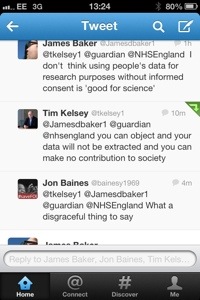
Someone who liked Toynbee’s post was Tim Kelsey, NHS National Director for Patients and Information, and former government “czar” for Transparency and Open Data. He described it as “seminal” on twitter. I’m sure Tim finds the constant questioning of the care:data plans irritating: his tweets are often replied to by people who are not as convinced as he is that it is unequivocally a Good Thing. An example of this irritation was his response to an observation by Calderdale councillor James Baker. James tweeted, in response to Tim’s “seminal” tweet

I don’t think using people’s data for research purposes without informed consent is ‘good for science’

This is unexceptional, and a fair comment. Tim’s reply* was certainly not

you can object and your data will not be extracted and you can make no contribution to society

I think that to suggest that someone who might object (in the context of a worrying lack of, er, transparency, about the details of care:data) to the extraction of their highly sensitive medical data is making “no contribution to society” is extraordinarily unfair, and, as James pointed out in reply

It’s an offensive thing to say to an elected representative who contributes a lot to society…It’s also using trying to use guilt and shame to persuade someone to partake in medical research. Unethical

I couldn’t agree more.

UPDATE:

*It appears the tweet has now been deleted. Tim did reply to James saying

offence not intended – I meant contribution to health improvement thru sharing non PID

but there’s been no explanation or apology for that original tweet

20130823-174459.jpg

3 Comments

Filed under Data Protection, NHS, Privacy, transparency