Category Archives: personal data breach

MoD: “too costly” to find out if there have been further spreadsheet data breaches

Response to FOI request says it would take 237 hours to find out. How can ICO have confidence lessons have been learnt?

Anyone who’s ever had been responsible for compiling or overseeing a data breach log will know that one of the commonest incidents is the inadvertent disclosure of personal data. And since the time spreadsheets could first be sent via, or uploaded to, the internet people have mistakenly left personal data in them which should have been removed or otherwise masked. It’s not a new phenomenon: as long ago as 2013 I wrote for the Guardian about the risks, and what I perceived then as a lack of urgency by the Information Commissioner’s Office in addressing, and educating about, those risks.

So it might be found surprising that, two years after the most catastrophic data breach in UK history, in which the information of thousands of Afghan citizens was mistakenly disclosed, putting many lives directly at risk, the Ministry of Defence appears to have no process for identifying when or whether there have been recurrences of the issue.

Section 12 of the Freedom of Information Act 2000 permits a government department not to comply with a request where locating and retrieving any information held would take more than 24 hours. It’s not uncommon for it to be invoked where requests are formulated in too general a manner.

But when I made a request to the MoD for

the number of personal data breaches recorded between April 2023 to date which involved: a) disclosure of personal data to the wrong recipient; b) inadvertent disclosure of personal data contained in a spreadsheet

I imagined that this would be relatively easily located and extracted. Most data breach logs I’ve seen would be categorised in such a way as to enable this. However, the MoD instead informed me that it would take over 237 hours to do so.

Helpfully, the MoD said that if I restricted my request just to the first part (“disclosure of personal data to the wrong recipient”) they might be able to comply. But what this appears to indicate is that no, or no clear, record is being taken of whether there have been repeats of the spreadsheet error involving Afghan citizens.

The Information Commissioner’s Office (ICO) has come under some criticism – including from the leading academics, the Science, Innovation and Technology Committee, and me – for failing even to conduct a formal investigation into the Afghan spreadsheet data breach. Justifying that decision, the Commissioner himself said that

MoD has briefed us on the measures it has adopted since the breach, which seek to mitigate risk of such an incident occurring in future

But if the MoD cannot say (without it taking more than 237 hours) whether there have been further such incidents, how can they reassure themselves that the risk has been indicated?

And perhaps more pertinently, how can the ICO be satisfied of this?

The views in this post (and indeed most posts on blog) are my personal ones, and do not represent the views of any organisation I am involved with.

4 Comments

Filed under Data Protection, data security, Freedom of Information, Information Commissioner, Ministry of Defence, personal data breach

Is the legal sector really suffering a flood of databreaches?

[reposted from my LinkedIn account]

There have been various articles in the media recently, reporting a significant rise in personal data breaches reported by the legal sector to the Information Commissioner’s Office. I have some real doubts about the figures.

An example article says

A new analysis of data from the Information Commissioner’s Office (ICO) by NetDocuments has revealed a sharp increase in data breaches across the UK legal sector. In the period between Q3 2023 and Q2 2024, the number of identified data breaches in the UK legal sector rose by 39% (2,284 cases were reported to the ICO, compared to 1,633 the previous year)

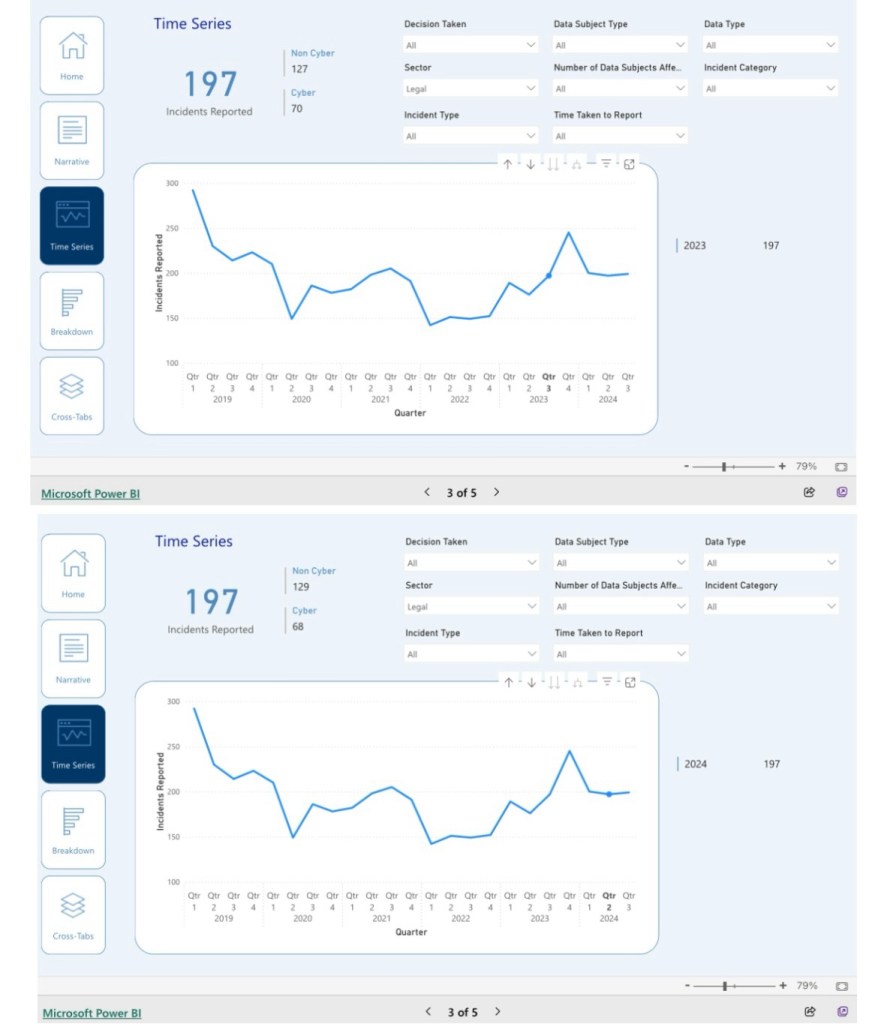
But something didn’t seem right about those numbers. The ICO say that they have received 60,607 personal data breach reports since their current reporting methods began in Q2 2019 (see their business intelligence visualised database), so it seemed remarkable to suggest that the legal sector was scoring so highly. And, indeed, when I look at the ICO BI data for self-reported personal data breaches, filtered for the legal sector, I see only 197 reported in Q3 2023, and, coincidentally, 197 in Q2 2024 (see attached visuals) – an increase from one relatively low number to another relatively low number of precisely 0%.

A serious question to those more proficient with data than I am – am I missing something?

If I’m not, I really think the ICO should issue some sort of corrective statement.

The views in this post (and indeed most posts on this blog) are my personal ones, and do not represent the views of any organisation I am involved with.

Leave a comment

Filed under Data Protection, data security, Information Commissioner, personal data breach

You must be taking the PSNI

[Reposted from LinkedIn]

The Information Commissioner’s Office has fined the Police Service of Northern Ireland £750,000 for the failings that led to the public disclosure of the surnames, initials, ranks and roles of all 9,483 PSNI officers and staff, putting countless people’s lives at risk from dissident republicans. The fine would have been £5.6m if the ICO’s “public sector approach” had not been applied.

The disclosure was made in a spreadsheet attached to a Freedom of Information Act response. The spreadsheet was intended to disclose some information, but also contained a hidden tab, where the offending information was situated.

Eleven years ago I was asked to write a piece in The Guardian about the risks of hidden data in spreadsheets. At the time, as many of you will remember, these sort of incidents were prevalent in councils and the NHS. I called for the ICO to do more to warn, and, in fairness, they did. But the fact that this sort of incident was allowed to happen is shocking: the ICO notice points out that there PSNI would regularly create pivot tables to prepare information for disclosure, where the risk of data being hidden (but easily revealed) is particularly high.

The ICO announcement is unusual in that it also allows the Chief Constable of PSNI to comment, and – extraordinarily – to express that he is “extremely disappointed at the level of the fine” (despite the massive reduction over what it would have been if he was in charge of a private sector organisation).

Chief Constable Boucher – you got off lightly.

The views in this post (and indeed most posts on this blog) are my personal ones, and do not represent the views of any organisation I am involved with.

Leave a comment

Filed under Data Protection, fines, Freedom of Information, Information Commissioner, personal data breach, police, UK GDPR

Crowdstrike and personal data breaches: loss vs unavailability

I ran a poll on LinkedIn in recent days which asked “If a controller temporarily can’t access personal data on its systems because of the Crowdstrike/MSFT incident is it a personal data breach?” 

I worded the question carefully.

50% of the 100-odd people who voted said “no” and 50% said “yes”. The latter group are wrong. I say this with some trepidation because there are people in that group whose opinion I greatly respect. 

But here’s why they, and, indeed, the Information Commissioner’s Office and the European Data Protection Board, are wrong.

Article 4(12) of the GDPR/UK GDPR defines a “personal data breach”. This means that it is a thing in itself. And that is why I try always to use the full term, or abbreviate it, as I will here, to “PDB”. 

This is about the law, and in law, words are important. To refer to a PDB as the single word “breach” is a potential cause of confusion, and both the ICO and the EDPB guidance are infected by and diminished by sloppy conflation of the terms “personal data breach” and “breach”. In English, at least, and in English law, the word “breach” will often be used to refer to a contravention of a legal obligation: a “breach of the law”. (And in information security terminology, a “breach” is generally used to refer to any sort of security breach.) But a “breach” is not coterminous with a “personal data breach”.

And a PDB is not a breach of the law: it is a neutral thing. It is also crucial to note that nowhere do the GDPR/UK GDPR say that there is an obligation on a person (whether controller or processor) not to experience a PDB, and nowhere do GDPR/UK GDPR create liability for failing to prevent one occurring. This does not mean that where a PDB has occurred because of an infringement of other provisions which do create obligations and do confer liability (primarily Article 5(1)(f) and Article 32) there is no potential liability. But not every PDB arises from an infringement of those provisions.

The Article 4(12) definition is “a breach of security leading to the accidental or unlawful destruction, loss, alteration, unauthorised disclosure of, or access to, personal data transmitted, stored or otherwise processed”. Let us break that down:

  • A breach of security…
  • leading to [one or more of]
  • accidental or unlawful…
  • 1. destruction of…
  • 2. loss of…
  • 3. alteration of…
  • 4. unauthorised disclosure of…
  • 5. unauthorised access to…
  • personal data processed.

If an incident is not a breach of security, then it’s not a PDB. And if it is a breach of security but doesn’t involve personal data, it’s not a PDB. But even if it is a breach of security, and involves personal data, it’s only a PDB if one of the eventualities I’ve numbered 1 to 5 occurs.

Note that nowhere in 1 to 5 is there “unavailability of…” or “loss of access to…”. 

Now, both the ICO, and the EDPB, read into the words “loss of…personal data…” the meaning, or potential meaning “loss of availability of personal data”. But in both cases they appear to do so in the context of saying, in terms, “loss of availability is Article 4(12) ‘loss’ because it can cause harm to data subjects”. I don’t dispute, and nor will many millions of people affected by the Crowdstrike incident, that unavailability of personal data can cause harm. But to me, “loss” means loss: I had something, and I no longer have it. I believe that that is how a judge in the England and Wales courts would read the plain words of Article 4(12), and decide that if the legislator had intended “loss” to mean something more than the plain meaning of “loss” – so that it included a meaning of “temporary lack of access to” – then the legislator would have said so. 

Quite frankly, I believe the ICO and EDPB guidance are reading into the plain wording of the law a meaning which they would like to see, and they are straining that plain wording beyond what is permissible.

The reason, of course, that this has some importance is that Article 33 of the GDPR/UK GDPR provides that “in the case of” (note the neutral, “passive” language) a PDB, a controller must in general make a notification to the supervisory authority (which, in the UK, is the ICO), and Article 34 provides that where a PDB is likely to result in a high risk to the rights and freedoms of natural persons, those persons should be notified. If a PDB has not occurred, no obligation to make such notifications arises. That does not mean of course, that notifications cannot be made, through an exercise of discretion (let’s forget for the time being – because they silently resiled from the point – that the ICO once bizarrely and cruelly suggested that unnecessary Article 33 notifications might be a contravention of the GDPR accountability principle.)

It might well be that the actions or omissions leading to a PDB would constitute an infringement of Articles 5(1)(f) and 32, but if an incident does not meet the definition in Article 4(12), then it’s not a PDB, and no notification obligation arises. (Note that this is an analysis of the position under the GDPR/UK GDPR – I am not dealing with whether notification obligations to any other regulator arise.)

I can’t pretend I’m wholly comfortable saying to 50% of the data protection community, and to the ICO and EDPB, that they’re wrong on this point, but I’m comfortable that I have a good arguable position, and that it’s one that a judge would, on balance agree with. 

If I’m right, maybe the legislator of the GDPR/UK GDPR missed something, and maybe availability issues should be contained within the Article 4(12) definition. If so, there’s nothing to stop both the UK and the EU legislators amending Article 4(12) accordingly. And if I’m wrong, there’s nothing to stop them amending it to make it more clear. In the UK, in particular, with a new, energised government, a new Minister for Data Protection, and a legislative agenda that will include bills dealing with data issues, this would be relatively straightforward. Let’s see.

And I would not criticise any controller which decided it was appropriate to make an Article 33 notification. It might, on balance, be the prudent thing for some affected controllers to do so. The 50/50 split on my poll indicates the level of uncertainty on the part of the profession. One also suspects that the ICO and the EU supervisory authorities might get a lot of precautionary notifications.

Heck, I’ll say it – if anyone wants to instruct me and my firm to advise, both on law and on legal strategy – we would of course be delighted to do so.

The views in this post (and indeed most posts on this blog) are my personal ones, and do not represent the views of any organisation I am involved with.

1 Comment

Filed under Data Protection, EDPB, GDPR, Information Commissioner, Let's Blame Data Protection, LinkedIn Post, personal data breach, UK GDPR