Category Archives: police

If not that, then this?

Does the dropping of criminal charges against police officers under data protection and computer misuse legislation open the door to investigation of their employer’s civil liabilities?

The BBC reports that criminal charges have been dropped against three Nottinghamshire police officers. The charges appear to have been originally brought under the Data Protection Act 1998 (DPA) and Computer Misuse Act 1990 (CMA), and, according to the Police Federation it seems they were dropped because

prosecutors had found issues with training and advice on data protection for officers

Under section 55 of the DPA it is an offence to knowingly or recklessly, without the consent of the data controller, obtain or disclose personal data or the information contained in personal data. But the elements of the offence are not made out if the person doing this acted, for instance, in the reasonable belief that he or she had a lawful right to obtain or disclose the data, or if the obtaining was necessary for the purpose of preventing or detecting crime. Similarly, the offence of unauthorised access to computer material under section 1 of the CMA is only committed if the person knows that the access is unauthorised. If inadequate training and advice on access to data is given to employees of a data controller, then it will be difficult – as this story seems to reveal – to bring prosecutions. Effectively, the mens rea element of the offence is lacking.

However, perceptive readers of this blog might have noticed something: if incidents of inappropriate access to personal data have occurred, as appears to have been the case here, and the individuals accessing the data have been inadequately trained, does that not raise issues about the employer’s (the data controller’s) compliance with the seventh data protection principle in Schedule One of the DPA? This provides that

Appropriate technical and organisational measures shall be taken against unauthorised or unlawful processing of personal data

The Information Commissioner’s Office (ICO) has repeatedly stressed that appropriate staff training is essential for compliance with the seventh principle. The ICO has the power, under section 55A of the DPA, to serve a civil monetary penalty notice on a data controller which has seriously contravened the DPA, where the contravention is of a kind likely to cause substantial damage or substantial distress. One wonders whether the ICO will now look into Nottinghamshire Police’s compliance with the Act, in view of the fact that incidents serious enough to bring now-dropped criminal charge took place, and the fact that they appear to have taken place against a background of inadequate staff training.

5 Comments

Filed under Breach Notification, Data Protection, Information Commissioner, monetary penalty notice, police, Privacy

Shaming the not guilty

UPDATE
9 January 2014, after a bit of prompting, the Information Commissioner’s Office have confirmed to me that they are looking into whether Staffordshire Police’s twitter campaign was compliant with the Data Protection Act
END UPDATE

Is Staffordshire Police’s social media campaign naming those charged with drink-driving offences fair and lawful?

A month ago I wrote about media coverage of Sussex Police’s crackdown on drink-driving. I was concerned that the impression was being given by the media that the police were “naming and shaming” people who had merely been charged – not convicted – with the offence. I asked Sussex Police if they were happy with the words attributed to them by the Eastbourne Herald but they chose not to reply (which I suppose is one way of dealing with enquiries from the public).

I have to concede that, in that instance, it was not clear whether the police themselves were suggesting people were guilty of an offence before any conviction. However, I heard today (thanks @primlystable) that Staffordshire Police have been running a campaign which is much more overt in its suggestion that people who have been charged with drink-driving offences can be called “drink drivers”. They have been running a social media campaign using the hashtag #drinkdriversnamedontwitter, and, they announce, there has been “overwhelming support” for it

Overwhelming support #drink drivers named on twitter

Staffordshire Police has received tremendous support for its name and shame tactic to reduce the number of drink-drivers.

Nearly 500 people completed an on-line survey asking whether they supported naming people charged with drink-drive offences and whether it would help people think about the consequences of this type of offence.

But the blurring of the line in that press release between the guilty and the not-proven-guilty is highly problematic. If someone has merely been charged with an offence, it is contrary to the ancient and fundamental presumption of innocence to shame them for that fact. Indeed, I struggle to understand how it doesn’t constitute contempt of court to do so, or to suggest that someone who has not been convicted of drink-driving is a drink driver. Being charged with an offence does not inevitably lead to conviction. I haven’t been able to find statistics relating to drink-driving acquittals, but in 2010 16% of all defendants dealt with by magistrates’ courts were either acquitted or not proceeded against 1.

I asked the Attorney General’s Office (by twitter) what it thought of the use of the hashtag against the names of those merely charged with an offence, but, in saying

Tweets are same details automatically given to Magistrates’court and made public at hearing – not contempt in this case

I think they rather missed the point – it wasn’t the naming of charged people which concerned me, it was the association of the name with the hashtag. And, in an excellent response on twitter @richgreenhill said

You’d be similarly sanguine about tweeting certain names and “#phonehacker” right now?

But I’ve also asked the Information Commissioner’s Office (ICO) whether the practice is compliant with Staffordshire Police’s obligations under the first data protection principle (Schedule 1 of the Data Protection Act 1998 (DPA)) to process personal data fairly and lawfully. The ICO has shown itself commendably willing recently to challenge unfair processing, and has, for instance, served DPA enforcement notices against Southampton City Council for making it a licensing requirement that taxi drivers have continuous CCTV-with-audio in their cabs, and against Hertfordshire Police for its automatic number-plate recognition “ring of steel” around Royston. I would urge the ICO to consider whether this current campaign warrants some regulatory action.

As I was writing this piece I saw a news item in which a traffic lawyer has called for the Staffordshire Police and Crime Commissioner (PCC) to resign as a result of the campaign, saying

By his comments he is now presuming that everyone named by his officers are guilty as charged even before they have appeared before a court. In other words he is demonstrating a cavalier disregard for the presumption of innocence.

His comments have potentially prejudiced every drink driving case before it is heard.

This pitches it stronger than I have, but I also note that Matthew Ellis, the PCC, has said in response

No-one will be named where there is any doubt

That is deeply concerning: it is no part of the police’s role to determine or pronounce on someone’s guilt or innocence.

1.Ministry of Justice, Criminal Justice Statistics, Quarterly Update to December 2010

16 Comments

Filed under Data Protection, human rights, Information Commissioner, police, social media

For Shame

A newspaper says police are “naming and shaming” drivers who have been charged with, but not convicted, of drink-driving offences. Sussex Police say they are merely “naming” the drivers, but do not appear to feel the need to correct the media reports.

The risk for social media users of being held in contempt of court was highlighted this week by the Attorney General, who has said that, in future, the advisory notes issued to “traditional” media on individual cases will now be made more widely available (published on the gov.uk website and twitter).

With this in mind I was concerned to see that Sussex Police were reported by the Eastbourne Herald to be “naming and shaming” drivers arrested and charged with drink-driving

Police have said this year they are ‘naming and shaming’ everyone they arrest in connection with drink driving

The report goes on to quote Chief Inspector Natalie Moloney as saying

It is sad that so many people ignored the warnings that we would be looking for drink-drivers and have been charged with offences within hours of the start of the campaign. The arrests and the naming of those charged with offences will continue across the county throughout the month

This seemed to me potentially to engage the provisions of the Contempt of Court Act 1981 of an offence of strict liability “whereby conduct may be treated as a contempt of court as tending to interfere with the course of justice in particular legal proceedings regardless of intent to do so”, because it is a publication addressed to the public at large, about active proceedings. For an offence to be committed the publication must give rise to a substantial risk that the course of justice in the proceedings in question will be seriously impeded or prejudiced. I am not convinced that would be the case, but, nonetheless, I was surprised to see a police force effectively being reported as saying that  naming someone only charged with an offence gives rise to “shame” (it does nothing of the sort, of course, given the legal maxim of “innocent until proven guilty”). So I asked the Sussex Police twitter account

Are you really running a policy of “shaming” people by naming them prior to a trial?

to which they replied

We are not “shaming” anyone. We are naming those charged with a drink-related driving offence as we do for a range of offences

That was fair enough, (although one might ask Chief Inspector Moloney why an innocent person would heed a warning that police were looking for drink- drivers) but, as it appeared that this “naming-not-shaming” initiative had been launched in conjunction with the media, I wondered if they would be asking the Herald to correct its misleading article. Sussex Police replied

The campaign doesn’t aim to ‘shame’, but rather to deter & the article does not attribute the phrase to us

but this is simply not true: the article may not directly attribute the phrase to the police, but it does so indirectly

Police have said this year they are ‘naming and shaming’…

I have had no response yet to my further tweet pointing this out.

So, in a week when contempt via social media is very much in the headlines, we appear to have an online newspaper report which suggests there is shame attached to being charged with an offence, and which attributes this phrase to a police force, who seem unconcerned about correcting it. Odd.

For the avoidance of doubt, I should say that I have no sympathy whatsoever with people convicted of drink driving offences, but, to suggest there is “shame” in being charged with an offence prior to trial, is to go against centuries of presumption of innocence.

4 Comments

Filed under human rights, journalism, police, social media

THIS is the purpose of subject access requests

In a recent blogpost the rather excellent Bilal Ghafoor (who goes by the handle of “FOIKid”, although I note he’s now extended this to “FOI (and DP) Kid”, evidently having rather belatedly discovered the joys of data protection) asked “What is the purpose of subject access requests?“. He drew attention to the potential discord between approaches by the Information Commissioner and by the courts (in cases such as Durant  v Financial Services Authority [2003] EWCA Civ 1746) to such requests (made under section 7 of the Data Protection Act 1998 (DPA)).

In a comment on that post I argued that the Court of Appeal in Durant was perhaps not as out-of-step with, at least, the EC data protection Directive 95/46/EC as is sometimes thought

it’s important to note that the Court of Appeal were keen to stress the fact that the Act gives effect to the Directive, and that the Directive and its recitals have a “primary objective” to “protect individuals’ fundamental rights, notably the right to privacy and accuracy of their personal data held by others…

This particular primary objective is illustrated quite starkly by the news from the Press Gazette that comedian/journalist Mark Thomas discovered, through submitting a subject access request, that his name is on a “domestic extremist database”:

police held a file of seven pages containing more than 60 individual items of intelligence…”a bizarre list of events monitored by the police, lectures given, panels attended, even petitions I have supported…the police have monitored public interest investigations in my case since 1999″

Thomas says he is taking legal action to have his name removed. This will be an interesting case if it reaches court, joining a line of cases where people try to effect removal of records from police systems.

What is also interesting though is that Thomas, and the National Union of Journalists (NUJ), are encouraging journalists to submit subject access requests to the police. As Thomas says

I know of other NUJ members on the database….Which is why I am asking NUJ members to take action. If your work brings you into contact with the police whether covering riots or climate camp, from Plebgate to the NSA, then the police could have you on their database

and the NUJ general secretary Michelle Stanistreet adds

we want as many other members as possible to find out what information the Met is holding

In answer to Bilal’s question, then, I think that this – the investigation of how an arm of the UK state monitors and records the activities of the free press – is a vitally important example of what the purpose is of subject access requests.

1 Comment

Filed under Data Protection, police, Privacy, surveillance

On the tweet where you live

Do Home Office tweets of people arrested on suspicion of committing immigration offences engage data protection law?

The recent sordid campaign by the Home Office to publicise their “crackdown on illegal immigration” involved the tweeting of pictures of people apparently arrested in connection with immigration offences. I’m loath to post links because any further publicity risks undermining my point in this piece, but suffice to say that two pictures in particular were posted, one of a man being escorted (police officers at either side of him, holding his arms) from what look like retail premises, and one of a man being led by other officers into a cage in the back of a van. In both cases, the person’s face has been blurred by pixelation. There have been suggestions that the broader aspects of the campaign (disgracefully, vans have been deployed displaying advertisements saying “In the UK illegally? Go home or face arrest“) might be unlawful for breach of the Public Sector Equality Duty, and some have argued that to use the hashtag #immigrationoffenders to accompany pictures of people only suspected of crime might be to prejudge a trial, and could even constitute contempt of court. However, I would argue that the tweets also engage, and potentially breach, data protection law.

For the sake of this argument I will work on the presumption that, because the images of their faces have been obscured no third party can recognise the individuals concerned (I think this is actually probably wrong – potential identifying features, such as location and clothing are still displayed, and it is quite likely that friends, relative, colleagues could identify them). However, this does not mean that the images are outwith the Data Protection Act 1998 (DPA) and the European Data Protection Directive 95/46/EC to which it gives effect. The former defines personal data as

data which relate to a living individual who can be identified—
(a) from those data, or
(b) from those data and other information which is in the possession of, or is likely to come into the possession of, the data controller [emphasis added]

In this instance the Home Office (or its agents) must itself know who the people in the images are (they will have had sufficient identifying information in order to effect an arrest) so, in their hands, the images constitute the personal data of the people in them. As the Information Commissioner’s Office (ICO) explains

It is important to remember that the same piece of data may be personal data in one party’s hands while it may not be personal data in another party’s hands…data may not be personal data in the hands of one data controller…but the same data may be personal data in the hands of another data controller…depending on the purpose of the processing and the potential impact of the processing on individuals

So the taking, retaining and publishing of images of people whose identities are obscured but who can be identified by the data controller will constitute the processing of personal data by that data controller. Consequently, the legal obligations for fair and lawful processing apply: section 4(4) of the DPA imposes a duty on a data controller to comply with the data protection principles in relation to all personal data with respect to which he is the data controller. Lord Hoffman explained this, in the leading FOI (and DPA) case on identification 

As the definitions in section 1(1) DPA make clear, disclosure is only one of the ways in which information or data may be processed by the data controller. The duty in section 4(4) is all embracing. He must comply with the data protection principles in relation to all “personal data” with respect to which he is the data controller and to everything that falls within the scope of the word “processing”. The primary focus of the definition of that expression is on him and on everything that he does with the information. He cannot exclude personal data from the duty to comply with the data protection principles simply by editing the data so that, if the edited part were to be disclosed to a third party, the third party would not find it possible from that part alone without the assistance of other information to identify a living individual. Paragraph (b) of the definition of “personal data” prevents this. It requires account to be taken of other information which is in, or is likely to come into, the possession of the data controller. Common Services Agency v Scottish Information Commissioner (Scotland) [2008] UKHL 47

So the Home Office cannot merely edit the data (by pixelation) and thus exclude it from the duty to process it in accordance with the data protection principles: these images are personal data. Moreover, they will come under the subset known as sensitive personal data, because they consist of information as to the commission or alleged commission by the data subject of any offence (they might also fall into this subset because they show the racial or ethnic origin of the data subject, but this is less certain).

The first data protection principle requires that

Personal data shall be processed fairly and lawfully and, in particular, shall not be processed unless
(a) at least one of the conditions in Schedule 2 is met, and
(b) in the case of sensitive personal data, at least one of the conditions in Schedule 3 is also met.
As this is sensitive personal data, a Schedule 3 condition must be met in order for the processing to be fair and lawful. Try as I might, I cannot find one that is (I adopt the list as explicated by the ICO)

  • The individual who the sensitive personal data is about has given explicit consent to the processing.
  • The processing is necessary so that you can comply with employment law.
  • The processing is necessary to protect the vital interests of: – the individual (in a case where the individual’s consent cannot be given or reasonably obtained), or- another person (in a case where the individual’s consent has been unreasonably withheld).
  • The processing is carried out by a not-for-profit organisation and does not involve disclosing personal data to a third party, unless the individual consents. Extra limitations apply to this condition.
  • The individual has deliberately made the information public.
  • The processing is necessary in relation to legal proceedings; for obtaining legal advice; or otherwise for establishing, exercising or defending legal rights.
  • The processing is necessary for administering justice, or for exercising statutory or governmental functions.
  • The processing is necessary for medical purposes, and is undertaken by a health professional or by someone who is subject to an equivalent duty of confidentiality.
  • The processing is necessary for monitoring equality of opportunity, and is carried out with appropriate safeguards for the rights of individuals.

It will be noted that the two conditions emphasised by me in italics might be thought to apply, but one notes the word “necessary”. In no way were these tweets “necessary” for the purposes to which those conditions relate. By contrast, when authorities publish photographs of wanted criminals, the necessity test will normally be made out. It is, I suppose, just possible that the data subjects gave their explicit consent to the tweets, but that’s vanishingly unlikely. (A question does arise as to what conditions permit the processing by the police of pixelated images of potential offenders in programmes such as “Police, Camera, Action” and “Motorway Cops”: it may be that this has never been challenged, but it may also be that the data controller is in fact the film company, who might be protected by the exemption from much of the DPA if the processing of data is for journalistic purposes).

(I would observe, in passing, that many customary practices to do with publication of information about crimes or suspicion of criminal behaviour are potentially in breach of these provisions of the DPA if they are construed strictly. Although there is the journalistic exemption mentioned above, those to whom that exemption arguably does not apply (bloggers, tweeters, police, other public authorities) are at risk of breach if they, for instance, publish identifying information about people who have criminal convictions or are suspected of having committed a crime. This area of the law, and its implications for open justice, have not, I think, been fully played out yet. For discussions about it see my post and others linked here.)

If no Schedule 3 condition can be met, the processing will not be in accordance with the first data protection principle, and the data controller will be in breach of section 4(4) of the DPA. What flows? Well, probably very little – the data subjects have a right to serve a notice (under section 10 of the DPA) requiring the cessation of processing which is causing or likely to cause substantial unwarranted damage or distress. Additionally, they have a right either to bring a civil claim for damages (very difficult to show) or to complain to the ICO. However, data subjects like this are not necessarily going to want to assert their rights in a strident way. The ICO himself could intervene – he has the power to take enforcement action if he is satisfied a data controller has contravened or is contravening the data protection principles (and, much to his credit, he has recently issued notices against a Council which was requiring taxi drviers to instal CCTV/audio recording facilities in all cabs, and against a Police force which was operating a “ring of steel” ANPR network). It appears though that the Home Office twitter account has gone quiet (it hasn’t tweeted in several days). Perhaps there have been second thoughts not just about the legality, but also the morality, of the campaign. I am always the optimist.

The views in this post (and indeed all posts on this blog) are my personal ones, and do not represent the views of any organisation I am involved with.

1 Comment

Filed under Data Protection, Home Office, human rights, Information Commissioner, journalism, police

It’s still not fine

Last week I blogged about enforcement notices served on three Midlands police forces by the Information Commissioner (IC). I was surprised that the circumstances hadn’t merited stronger sanctions, in the form of monetary penalty notices (MPNs), and I tweeted to ask why.

As you can perhaps see, the IC’s office has kindly replied to my tweet. I had asked

I would really like to know why the IC did not see fit to issue Monetary Penalty Notices. Can you advise?

and their reply says

enforcement notices best means of improving compliance. Considered details of the case inc limited involvement of each force

I have to say I think this is a questionable response (although I take the point that a 140-character limit is restrictive).

Firstly, enforcement activities are not mutually exclusive – it is not uncommon for an enforcement notice and an MPN to be served in tandem on a data controller. thus, as recently as June this year, Glasgow City Council was served an MPN of £150,000 by the IC following the loss of, er, unencrypted laptops, and at the same time was served an enforcement notice requiring certain corrective actions to be undertaken.

Secondly, and I may be misinterpreting, but the reply seems to say that the “limited involvement of each force” was a determining factor in a decision not to serve an MPN. However, there were three data controllers involved. If each of them had a “limited” involvement, one is led to ask “wasn’t that the main problem?”. Derbyshire and Leicestershire both “did not carry out a risk assessment before they joined [the collaboration unit]…relying on the security measures taken by Nottinghamshire“, but those security measures were inadequate (lack of encryption, laptops not physically secured). Meanwhile, none of the forces properly monitored its officers while they were seconded.

It seems to me that the limited involvement of each of the forces might, instead of excusing it, have in fact been the key factor why the security breach happened.

Principle seven of the first schedule to the Data Protection Act 1998 (DPA) requires that

Appropriate technical and organisational measures shall be taken against unauthorised or unlawful processing of personal data and against accidental loss or destruction of, or damage to, personal data

Many many public (and private) sector data controllers are undertaking collaborative and partnership working, or are taking steps to do so. All responsible organisations are very aware, where they continue, either jointly or in common with other organisations, to determine the purposes for which and the manner in which any personal data are, or are to be, processed, that they remain a data controller, with the consequent responsibilities and liabilities. They are very aware of the IC’s Data Sharing Code of Practice.

And they are very aware that, if things go wrong with data-sharing, it will not normally be sufficient to point at a partner, and say “it was their fault”, or, even less, for all partners to shrug their shoulders and say, “that wasn’t our responsibility”.

Leave a comment

Filed under Data Protection, data sharing, enforcement, Information Commissioner, monetary penalty notice, police, Uncategorized

It’s not fine.

About the rather odd Friday afternoon news that the ICO has served enforcement notices, not monetary penalties, on three police forces

In February 2011 the Information Commissioner (IC) served civil Monetary Penalty Notices (MPNs) under section 55A-E of the Data Protection Act 1998 (DPA) on Ealing and Hounslow Councils (£80,000 and £70,000 respectively), after two unencrypted laptops containing sensitive personal data of approximately 1700 individuals were stolen. The Councils had a joint working arrangement whereby Ealing would provide an out-of-hours service on behalf of both councils. The MPNs were fair enough – the IC and others had been saying for some time that encryption of hardware was a necessary data security measure, and even though Ealing Council had a policy on this, it issued the laptops to an employee in breach of it. Hounslow took the hit because they didn’t have a written contract in place to describe and prescribe the collaborative working arrangements it had entered into with Ealing.

One might have wondered, more than two years further on, what size of monetary penalty a data controller would receive if it had also entered into a joint working arrangement in the absence of a written contract, but had failed to carry out a risk assessment, simply relying on what turned out to have been inadequate security measures taken by one of parties, and several unencrypted laptops containing the sensitive personal data of approximately 4500 individuals were stolen.

The answer (unless MPNs are to follow) based on the IC’s news release and blog today about three police forces, appears to be that no MPNs of any size will be served. Rather, enforcement notices have been issued, requiring the police forces to appoint Senior Risk Information Owners (you mean they haven’t got them already?), encrypt all portable devices (you mean they don’t already?), ensure appropriate security measures are taken to protect personal data (you mean they aren’t already?), and ensure officers have received training on the security requirements of the DPA (you mean…etc, etc, etc).

Don’t get me wrong, enforcement notices are an important part of the IC’s regulatory weaponry (I just wish he’d use them on FOI miscreants) but they are a step down from MPNs, and they don’t really serve as a punishment for serious contraventions of the DPA, but merely act as a warning.

Clearly, considerable discretion is conferred on the IC as to what sort of enforcement action is appropriate, but, on the facts, and on comparison with previous MPNs, it is very hard to avoid the conclusion that: the contraventions of the DPA were serious; they were likely to cause damage or distress which was significant; and the police forces knew or ought to have known that there was a risk that a contravention of this kind would occur but failed to take reasonable steps to prevent it. In those circumstances, the relevant conditions for an MPN exist, and I struggle to understand why none transpired.

I do note that the laptop thefts were in August 2010, but this was after DPA provisions conferring the power on the IC to serve MPNs were commenced. I also note that the data subjects appear to have been criminals, but information about criminality is sensitive personal data under the DPA and accorded a higher level of protection.

I’ve asked the ICO on twitter if they can tell me why MPNs were not served. I don’t really expect an answer – it’s a thorny question, and probably doesn’t qualify as an FOI request, but I am, genuinely, interested to know. If anyone has any ideas, I’d like to hear them.

2 Comments

Filed under Data Protection, enforcement, Freedom of Information, Information Commissioner, monetary penalty notice, police

Police, poems and FOI

In which I am inspired into literary expression by a rather bizarre ICO decision notice saying that a poem sent by a senior police officer on his mobile device is exempt from disclosure under the “personal data” provisions of the Freedom of Information Act

Mr Plod once sent friends a rhyme
Which was rumoured to be out of line
When a request was lodged
To see what it was
His bosses politely declined

Chris Graham agreed with the force
Saying “It’s personal data because
He’s easy to spot
From the words that we’ve got:
It’s exempt from disclosure, of course!”

A Tribunal may have to decide later
– As the statutory arbitrator –
If it’s rather perverse
To suggest that a verse
Can possibly be personal data.

1 Comment

Filed under Data Protection, Freedom of Information, Information Commissioner, police

The Public Interest in the Hillsborough Disaster

How could the Cabinet Office have originally decided the public interest favoured non-disclosure of information held about the Hillsborough Disaster?

On 15 December 2009 Alan Johnson, the then Secretary of State for the Home Department, announced that an Independent Panel would be appointed to enable disclosure of information relating to the 1989 Hillsborough disaster, and the events which followed it. The Panel would lead to

maximum possible public disclosure of governmental and other agency documentation on the events that occurred and their aftermath

As we all know, the Panel has now published an extraordinary amount of information, with a devastating covering report. It was not the Panel’s role to apportion blame for the tragedy but the disclosure has finally led to unequivocal public and political acceptance that, in the words of the Prime Minister, and despite previous despicable insinuations or outright pronouncements to the contrary

Today’s report is black and white. The Liverpool fans “were not the cause of the disaster”.

The efforts of bereaved families and those close to them in effecting this outcome can never be overstated. But a small part was attempted to be played using the Freedom of Information Act 2000. On 23 April 2009 a BBC journalist made an FOI request to the Cabinet Office for

Copies of all briefings and other information provided to Margaret Thatcher in April 1989 relating to the Hillsborough disaster [and] Copies of minutes and any other records of meetings attended by Margaret Thatcher during April 1989 at which the Hillsborough disaster was discussed.

The request was turned down. The Cabinet Office, rather than the 20 working days permitted by law, took nine months (they’re traditionally not very good at this FOI compliance thing, you must understand) to state that the information was exempt from disclosure under sections 31(1)(a), 31(1)(b), 31(1)(g) – which deal with prejudice to law enforcement – and sections 35(1)(a), 35(1)(b) and 35(1)(d) – which deal with information relating to the formulation or development of government policy, Ministerial communications and the operation of any Ministerial private office. All of these exemptions, if engaged, required consideration whether the public interest in disclosure outweighed the public interest in maintaining the exemption. In all instances, the decision was against disclosure: the public interest did not – according to those at the Cabinet Office determining this request – favour disclosure.

On appeal the Information Commissioner disagreed. He said

 the Commissioner considers it clear that the public interest in disclosure of information relating to the Hillsborough disaster – constituting improved public knowledge and understanding of the causes of and reaction to this event (and in relation to this specific information how the Government of the day reacted) – means that the balance of the public interest favours disclosure

He did not accept the Cabinet Office’s argument that the fact that the Independent Panel had now been set up was relevant to a decision as to whether the application of the exemptions was correct

 [the Panel] did not exist at the time of the request, or within 20 working days following the receipt of the request by the public authority. This Notice concerns whether the information should have been disclosed within 20 working days from the receipt of the request, and any factor that did not apply at the time of the request is not relevant

Notwithstanding this, the BBC ultimately agreed to withdraw its request, given the imminence of the outcome of the Panel’s work. And now we know the truth.

The Prime Minister went on to say in his statement

 At the time of the Taylor Report [Margaret Thatcher] was briefed by her private secretary that the defensive and – I quote – ‘close to deceitful’ behaviour of senior South Yorkshire officers was ‘depressingly familiar’. And it is clear that the then government thought it right that the Chief Constable of South Yorkshire should resign. But… governments then and since have simply not done enough to challenge publicly the unjust and untrue narrative that sought to blame the fans.

Information Commissioner decisions requiring disclosure of Cabinet minutes, and similar information, have four times been subject to a ministerial veto to maintain secrecy. Was the initial refusal of the BBC’s FOI request for this Hillborough disaster information simply reflective of a government approach which automatically seeks to exempt any Cabinet minutes from disclosure? I rather hope so, because the alternative is that officials, and ministers, thought that the public interest did not favour disclosure of information relating to what some are calling the biggest cover-up in British history.

UPDATE

I’ve been reflecting on this. I think it’s only fair to point out that, arguably, because the Cabinet Office took so long (nine months, remember) to get round to responding to the request, by the time they did so, the Independent Panel was set up. So, by that argument, the person looking at the request never actually determined that the public interest did or did not favour disclosure, until it was clear that it was going to be published in the future. The Information Commissioner did not accept that point

This Notice concerns whether the information should have been disclosed within 20 working days from the receipt of the request, and any factor that did not apply at the time of the request is not relevant. This situation applies regardless of the lengthy delay

and was correct in law not to, but in fairness to the Cabinet Office officials, they might have handled the request differently (by the time they got round to it) if the Independent Panel, with its remit to disclose, had not been set up.

10 Comments

Filed under BBC, Cabinet Office, Freedom of Information, Information Commissioner, police, Uncategorized

What the Papers Say

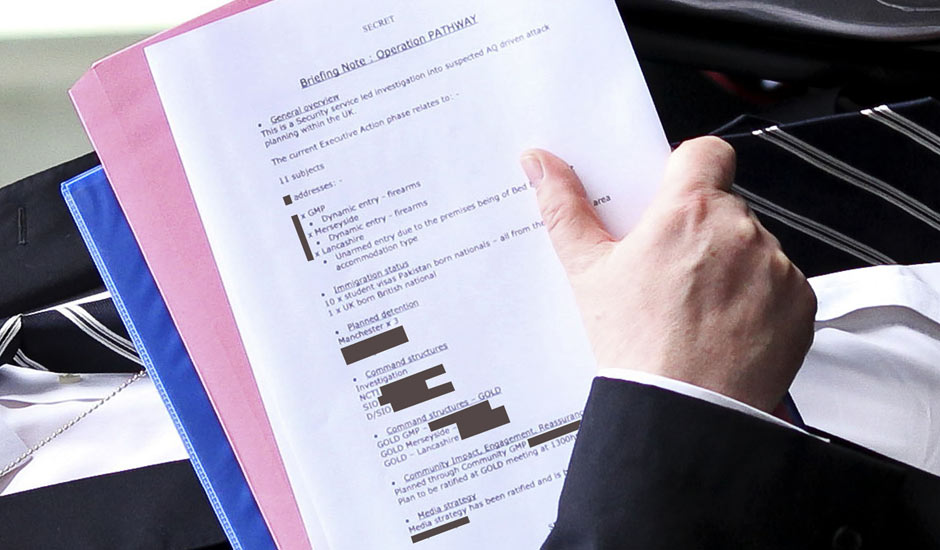
It appears that a police officer has inadvertently disclosed operational notes regarding arrangements for the arrest of Julian Assange. This is not the first time a blunder like this has happened, and it should serve as a reminder that physical data needs to handled just as securely as electronic data.

In 2009 Britain’s then most senior counter-terrorism officer, Bob Quick, arrived at Downing Street for an important meeting. He’d probably been reading up on the issues during the journey there, and was clutching a file as he emerged from his car. Unfortunately for him, photographers were able to capture the contents of the document he was holding face up. Marked “Secret” (the second highest category in the government protective marking Security Policy Framework) it contained information some of which still cannot be disclosed because a DA-Notice applies. It led to anti-terror raids being brought forward, and it also led to his resignation.

Now we learn that a rather less senior police officer has been photographed in similar circumstances, outside the Ecuadorian Embassy wherein lies the persecuted activist/suspected rapist (delete according to your leanings) Julian Assange. Apparently the information relates to possible arrest plans.

Now, when I have to carry papers from one building to another at work, I make damn sure that they’re secured in an opaque binder, and as far as I know the eyes of the world’s press are not on me when I’m doing so. Information security and data protection are not just about taking care with electronic data: I recently did a quick analysis of the monetary penalty notices handed down by the Information Commissioner, and found that around two-thirds arose from a breach of security involving physical data*.

Modern photographic developments mean that millions of people have the ability quickly to capture compromising or damaging information, and internet publishing means that the same information can be uploaded and circulated within seconds. The European Association for Visual Data Security (yep, there is one) recently produced a white paper on the subject. In its article about the white paper The Register gave some examples of shoulder-surfing, in addition to Bob Quick’s infamous incident

a senior UK civil servant at the department of Business, Innovation and Skills fell asleep on a commuter train, leaving highly sensitive information displayed on his screen. A fellow passenger took two photographs of the information while it was displayed on the screen, which made their way into a Daily Mail story about the breach…[and] in August 2011 the UK’s International Development Secretary was photographed leaving Number 10 Downing Street with sensitive government papers relating to Afghanistan on display. These papers were caught on camera by news photographers and film crews.

Any organisation which needs to handle data outside its own office walls should make very sure it can’t be seen by prying eyes.


*It’s difficult accurately to categorise them. For instance, a fax is both electronic and physical, and a lost hard-drive is loss of physical data, but seriousness is tied to the electronic contents of said drive.

Leave a comment

Filed under Confidentiality, Data Protection, Information Commissioner, monetary penalty notice, police, Uncategorized