Category Archives: transparency

Reducing regulation…by clogging up the courts

The only thing that made me stop laughing about the Cabinet Office’s arguments in a doomed Tribunal appeal was thinking about the cost to the public purse.

Soon after it was formed the coalition government made an admirable commitment to cut government red tape, by reducing the amount of domestic regulation

Through eliminating the avoidable burdens of regulation and bureaucracy, the Government aims to promote growth, innovation and social action

A Cabinet sub-committee – the Reducing Regulation Committee (RRC) – was set up, to “take strategic oversight of the delivery of the Government’s regulatory framework”.

Around the same time the government was also trumpeting its transparency agenda, with the Prime Minister saying, in an Observer article in September 2010

For too long those in power made decisions behind closed doors, released information behind a veil of jargon and denied people the power to hold them to account. This coalition is driving a wrecking ball through that culture – and it’s called transparency

One might not have supposed, therefore, that it would have been necessary in August 2012 for a request under the Freedom of Information Act 2000 (FOIA) to be made, for (merely) the number of times the RRC had met. Surely this is the sort of information which should be made public as a matter of course? But it was necessary. Moreover, this particular door stayed shut, despite the gentle tapping of transparency’s wrecking ball, when the Cabinet Office refused the request, citing the FOIA exemption which applies to information held by a government department which relates to a) the formulation or development of government policy, or (b) Ministerial communications (section 35(1)(a) and (b)).

The Cabinet Office continued to argue that this exemption was engaged, and that the public interest favoured non-disclosure, when the requester complained to the Information Commissioner’s Office (ICO). And when the ICO held that, yes, the exemption was engaged, but, no, the public interest favoured disclosure , the Cabinet Office appealed the decision.

The First-tier Tribunal (Information Rights) (FTT) has now handed down its judgment, and it makes amusing if dispiriting reading. Wholly unsurprisingly, the ICO’s decision is upheld, and it seems that the Cabinet Office’s argument boils down to two main points: “if we tell you how often the RRC has met then it might mislead you into missing all the great work being done elsewhere, and as a result that great work elsewhere might be adversely affected” (my apologies to the Cabinet Office if this misrepresents their position, but I’ve really tried my best).

The FTT had very little time for these arguments. The only thing vaguely in the Cabinet Office’s favour was that, as a lot of information about “reducing regulation” processes was already publicly available, the public interest in disclosure was small. But, rather devastatingly, the FTT says

the public interest in maintaining the exemption is so weak that it does not equal, let alone outweigh, the, admittedly light, public interest in disclosure (para 27) [emphasis added]

It is worth reading the judgment (which I won’t dissect in detail), as an example of a particularly weak argument against FOIA disclosure, but I would add three closing observations from which you might deduce my level of approval of the Cabinet Office’s conduct:

1. this was a request simply and merely for the number of times a government committee has met (how “transparent” is a refusal to disclose that?)
2. taking a case to FTT is not without significant costs implications (bear in mind this was an oral hearing, with a witness, and with counsel instructed on both sides)
3. the whole litigation in any case carries a huge hint as to the nature/substance of the information held (if the RRC had met often, would the Cabinet Office really want to withhold that fact?)

Leave a comment

Filed under Cabinet Office, Freedom of Information, Information Commissioner, Information Tribunal, transparency

Let’s Blame Data Protection – the Gove files

Thanks to Tim Turner, for letting me blog about the FOI request he made which gives rise to this piece

On the 12th September the Education Secretary, Michael Gove, in an op-ed piece in the Telegraph, sub-headed “No longer will the quality, policies and location of care homes be kept a secret” said

A year ago, when the first shocking cases of sexual exploitation in Rochdale were prosecuted, we set up expert groups to help us understand what we might do better…Was cost a factor? Did we need to spend more? There was a lack of clarity about costs. And – most worrying of all – there was a lack of the most basic information about where these homes existed, who was responsible for them, and how good they were….To my astonishment, when I tried to find out more, I was met with a wall of silence

And he was in doubt about where the blame lay (no guesses…)

The only responsible body with the information we needed was Ofsted, which registers children’s homes – yet Ofsted was prevented by “data protection” rules, “child protection” concerns and other bewildering regulations from sharing that data with us, or even with the police. Local authorities could only access information via a complex and time-consuming application process – and some simply did not bother…[so] we changed the absurd rules that prevented information being shared

This seemed a bit odd. Why on earth would “data protection” rules prevent disclosure of location, ownership and standards of children’s homes? I could understand that there were potentially child protection concerns in the too-broad-sharing of information about locations (and I don’t find that “bewildering”) but data protection rules, as laid out in the Data Protection Act 1998 (DPA), only apply to information relating to identifiable individuals. This seemd odd, and Tim Turner took it upon himself to delve deeper. He made a freedom of information request to the Department for Education, asking

1) Which ‘absurd’ rules was Mr. Gove referring to in the first
statement?

2) What changes were made that Mr. Gove referred to in the second
statement?

3) Mr Gove referred to ‘Data Protection’ rules. As part of the
process that he is describing, has any problem been identified with
the Data Protection Act?

Fair play to the DfE – they responded within the statutory timescales, explaining

Regulation 7(5) of the Care Standards Act 2000 (Registration) (England) Regulations 2010 …prohibited Ofsted from disclosing parts of its register of children’s homes to any body other than to a local authority where a home is located. Whatever the original intention behind this limitation, it represented a barrier preventing Ofsted from providing information about homes’ locations to local police forces, which have explicit responsibilities for safeguarding all children in their area…we introduced an amendment to Regulation 7 with effect from April 2013

But their response also revealed what had been very obvious all along: this had nothing to do with data protection rules:

the reference to “data protection” rules in Mr Gove’s article involved the Regulations discussed above, made under section 36 of the Care Standards Act 2000. His comments were not intended as a reference to the Data Protection Act 1998

This is disingenuous: “data protection” has a very clear and statutory context, and to extend it to more broadly mean “information sharing” is misleading and pointless. One could perhaps understand it if Gove had said this in an oral interview, but his piece will have been checked carefully before publication, and personally I am in no doubt that blaming data protection has a political dimension. The government is determined, for some right reasons, and some wrong ones, to make the sharing of public sector data more easy, and data protection does, sometimes – and rightly – present an obstacle to this, when the data in question is personal data and the sharing is potentially unfair or unlawful. Anything which associates “data protection” with a risk to child safety, serves to represent it as bureaucratic and dangerous, and serves the government agenda.

And the rather delicious irony of all this – as pointed out on twitter by Rich Greenhill – is that the “absurd rules” (the Care Standards Act 2000 (Registration) (England) Regulations 2010) criticised by Gove were made on 24 August 2010. And the Secretary of State who made these absurd rules was, of course, the Right Honourable Michael Gove MP.

How absurd.

Leave a comment

Filed under Data Protection, data sharing, Freedom of Information, Let's Blame Data Protection, transparency

It’s our Right to Know, Mr ICO

On 29 August the Information Commisioner’s Office (ICO) served a monetary penalty notice (MPN) of £100,000 on Aberdeen City Council. MPNs can be served on a data controller under section 55A of the Data Protection Act 1998 (DPA) for a serious contravention of the Act of a sort likely to cause serious damage or serious distress. In this instance, the ICO explained

sensitive information relating to social services involvement with several individuals [was] published online. The information included details relating to the care of vulnerable children.

The circumstances under which this happened were

a council employee accessed documents, including meeting minutes and detailed reports, from her home computer. A file transfer program installed on the machine automatically uploaded the documents to a website

Many people in the field of information rights have concerns that there is a significant lack of understanding on the part of many about the risk of inadvertently disclosing personal data on the web. In view of this, I though I would simply ask the ICO, and the Council, what website was involved, in order to inform my understanding. So I tweeted

What “website” were the files uploaded to?

I reminded the ICO and the Council on several occasions about this, and pointed out it was a valid request under the Freedom of Information Act 2000 (FOIA) and Freedom of Information (Scotland) Act 2002 (FOI(S)A), even though I had really only wanted a quick factual reply. The Council have asked me to contact them separately to make the FOI(S)A request, and I’m aware the Scottish Information Commissioner takes a different view on tweeted requests to her counterpart for the rest of the UK, so I’ve banged in a request at WhatDoTheyKnow. The ICO, by contrats, did treat my tweet as a valid request (although I got no acknowledgment of this, contrary to their good practice guidance) and responded yesterday on the twentieth working day, with a link to their disclosure log

Those who know me will be unsurprised to know that I don’t accept the refusal, and also unsurprised to know that, on International Right to Know Day 2013 I’ve submitted a crashingly pompous request for ICO to conduct an internal review. Here it follows, in all said crashing pomposity:

Please review your refusal to disclose information.

On 29 August you served a Monetary Penalty Notice on Aberdeen City Council

“after a council employee accessed documents, including meeting minutes and detailed reports, from her home computer. A file transfer program installed on the machine automatically uploaded the documents to a website, publishing sensitive information about several vulnerable children and their families, including details of alleged criminal offences”

I asked, on 30 August, “What ‘website’ were the files uploaded to?”

You have refused to disclose, claiming the exemption at section 44 of the Freedom of Information Act 2000, which provides an exemption “if disclosure [of the information] (otherwise than under this Act) by the public authority holding it…is prohibited by or under any enactment”. You say disclosure is prohibited, because “the information was provided to the ICO in confidence as part of our regulatory activities” and that the provisions of section 59(1) of the Data Protection Act 1998 forbid disclosure. Section 59(1) says

“No person who is or has been the Commissioner, a member of the Commissioner’s staff or an agent of the Commissioner shall disclose any information which—

(a)has been obtained by, or furnished to, the Commissioner under or for the purposes of the information Acts [of which FOIA is one],

(b)relates to an identified or identifiable individual or business, and

(c)is not at the time of the disclosure, and has not previously been, available to the public from other sources

unless the disclosure is made with lawful authority”

I am happy to concede that a) and b) are met here, but not c). This is because section 59(2) explains what “with lawful authority” means. Firstly, and largely as an aside, section 59(2)(a) says that a disclosure is made with lawful authority if

“the disclosure is made with the consent of the individual or of the person for the time being carrying on the business”

I am surprised you do not feel that, in your role as a public authority but also as the regulator for Freedom of Information, it would be prudent and transparent simply to ask the Council whether it consents. Nonetheless, on a strict reading of the law, I concede that you do not have an obligation to do so.

Secondly (and I note you do not even address this important provision), section 59(2)(e) says that disclosure is made with lawful authority if

“having regard to the rights and freedoms or legitimate interests of any person, the disclosure is necessary in the public interest”

I would argue that analysis of whether this provision permits disclosure requires a two-fold test. Firstly, is disclosure necessary in the public interest? Secondly, if it is, do the rights and freedoms or legitimate interests of any person militate against this public-interest disclosure?

On the first point, I am not aware of any direct authority on what “necessary” means in section 59(2)(e) of DPA, but I would argue that it imports the meaning adopted by leading European authorities. Thus, as per the high Court in Corporate Officer of the House of Commons v The Information Commissioner & Ors [2008] EWHC 1084 “‘necessary”…should reflect the meaning attributed to it by the European Court of Human Rights when justifying an interference with a recognised right, namely that there should be a pressing social need and that the interference was both proportionate as to means and fairly balanced as to ends”. It is my view that there is a pressing social need to recognise the risks of indavertent uploading to the internet, by public authorities and others, of sensitive personal data, especially when this is by automatic means. Other examples of recent incidents and enforcement action illustrate this. For instance, as your office is aware, there have been reports that a regional Citizens’ Advice Bureau has indavertently made available on the internet very large amounts of such data, probably because of a lack of technical knowledge or security which resulted in automatic caching by Google of numerous files https://informationrightsandwrongs.com/2013/09/24/citizens-advice-bureaucracy/. Also for instance, as you are aware, there have been many many examples of indavertent internet publishing of personal data in hidden cells in spreadsheets http://www.ico.org.uk/news/blog/2013/the-risk-of-revealing-too-much. There is a clear lack of public understanding of the risks of such indavertent disclosures, with a consequent risk to the privacy of individuals’ often highly sensitive personal data. Any information which the regulator of the DPA can disclose which informs and improves public understanding of these risks serves a pressing social need and makes the disclosure “necessary”.

On the second point, I simply fail to see what rights and freedoms or legitimate interests of any person can be engaged, let alone suffer a detriment by disclosing what public website the Council employee uploaded this to. If there are any, it would be helpful if your response to this Internal Review could address this. It may be that you would point to the information having been provided to you in confidence, but I similarly fail to see how that can be: was this an express obligation of confidence, or have you inferred it? In either case, I would question (per one the elements of the classic formulation for a cause of action in breach of confidence given by Megarry J in Coco v A.N.Clark (Engineers) Ltd [1969] R.P.C. 41) whether the information even has the necessary quality of confidence (this was a public website after all).

I hope you can reconsider your decision.

best wishes

1 Comment

Filed under Confidentiality, Data Protection, FOISA, Freedom of Information, human rights, Information Commissioner, monetary penalty notice, transparency

Must Try Harder

So, I managed to get a piece run on the Guardian Public Leaders network on the continuing incidents of or risks of exposure of sensitive personal data in pivot tables. I tried to argue that those in the know probably know about these risks, and that those not in the know don’t. I suggested the Information Commissioner’s Office (ICO) and the government could do more to alert the latter.

Although I got nice and positive feedback from friends/colleagues/fellow professionals, there appears to have been very little interest. Clearly it’s not a subject that interests lay people (or rather, it’s probably a subject which actually repels lay people). But that was rather my point: as long as the relevant regulators and policy-makers don’t take sufficient steps to issue warnings and guidance these and similar breaches of data security will continue to happen.

What I’m slightly surprised at is the lack of any response from the ICO. I noticed that Tim Turner asked the ICO twitter account if they had a response to the piece, but, unless it was off-line, he appeared to get no response. And I asked their press office, again, with no reply (maybe the press office was the wrong place to ask?).

In the article I also called on government departments to do more. That’ll be my next move. The problem of inadvertent internet disclosure of sensitive data, normally through ignorance of technology, continues, and it goes broader than pivot tables. As public authorities, in particular, are being required to open up more and more data to promote transparency and economic growth, this is going to become more and more serious. We can’t pretend the gulf between those ambitions and the technological knowledge of some of those doing the “opening up” is a minor problem. Authorities need guidance, and, where appropriate, warnings, and these need to be targetted at the right people within organisations. The ICO and government cannot always rely on, say, data protection officers to do this.

Leave a comment

Filed under Breach Notification, Data Protection, Information Commissioner, transparency

Contributing to society?

Why are proponents of care:data resorting to rudeness about those who are not as convinced as they are?

When I attended the launch of MedConfidential in April of this year I was largely ignorant of the proposals to amass patient data by the Health and Social Care Information Centre (HSCIC) under the banner of care:data. I was concerned by what I heard, and I remain so: details were unclear and in many cases remain so, regarding what data will be gathered, and how, and for what purposes, and what arrangements will be to allow third party access to it, and whether or to what extent it will be anonymised, and whether patients’ consent will be sought, or assumed, or ignored.

What I did see, and was greatly impressed by, was a large group of people, from various backgrounds and roles, coming together, mostly on a purely voluntary basis (for instance, I took a day’s leave to attend), to discuss the implications of this.

The centralising and use of patient confidential data raises questions of profound importance, which don’t have easy answers: such as to what extent should people waive an expectation of privacy in order – for instance – to further medical research? These are issues which led two of my favourite bloggers to come to (digital) blows recently.

Yet earlier today I read an otherwise sensible piece on the subject (I am not saying I agree with it) by the high-profile columnist Polly Toynbee, which talked about her receiving letters from people who ask her to

investigate the dark forces planting cameras and microphones in their walls: they think I’m part of the conspiracy when I suggest this is a usually curable delusion, and their doctor is probably not part of the plot

I fail to see the relevance of this reference to people with a diagnosis of apparent paranoid schizophrenia, unless it is to draw an analogy by insinuation with

those not clinically ill [among whom] there is a growing trend to fear Big Brother and the state

This is nasty stuff, and leads one to wonder why she feels the need to resort to such a rhetorical device.

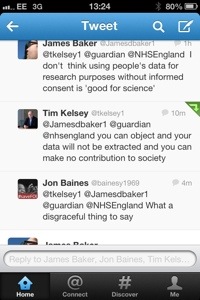
Someone who liked Toynbee’s post was Tim Kelsey, NHS National Director for Patients and Information, and former government “czar” for Transparency and Open Data. He described it as “seminal” on twitter. I’m sure Tim finds the constant questioning of the care:data plans irritating: his tweets are often replied to by people who are not as convinced as he is that it is unequivocally a Good Thing. An example of this irritation was his response to an observation by Calderdale councillor James Baker. James tweeted, in response to Tim’s “seminal” tweet

I don’t think using people’s data for research purposes without informed consent is ‘good for science’

This is unexceptional, and a fair comment. Tim’s reply* was certainly not

you can object and your data will not be extracted and you can make no contribution to society

I think that to suggest that someone who might object (in the context of a worrying lack of, er, transparency, about the details of care:data) to the extraction of their highly sensitive medical data is making “no contribution to society” is extraordinarily unfair, and, as James pointed out in reply

It’s an offensive thing to say to an elected representative who contributes a lot to society…It’s also using trying to use guilt and shame to persuade someone to partake in medical research. Unethical

I couldn’t agree more.

UPDATE:

*It appears the tweet has now been deleted. Tim did reply to James saying

offence not intended – I meant contribution to health improvement thru sharing non PID

but there’s been no explanation or apology for that original tweet

20130823-174459.jpg

3 Comments

Filed under Data Protection, NHS, Privacy, transparency

Pivot tables and databreaches

About a year ago I first became aware of reports of disturbing inadvertent disclosures of personal data (often highly sensitive) by public authorities who had intended only to disclose anonymous and/or aggregate data. These incidents were occurring both in the context of disclosures under the Freedom of Information Act 2000 (FOIA) and in the context of proactive disclosure of datasets. Mostly they were when what had been disclosed was not just raw data, but the spreadsheet in which the data was presented. Spreadsheet software is often very powerful, and not all users necessarily understand its capabilities (I don’t think I do). By use of pivot tables data can be sorted, summarised etc, but also, from the uninitiated or unwary, hidden. If the person who created or maintained a spreadsheet containing a pivot table is not involved in the act of publicly disclosing it it is possible that an apparently innocuous disclosure will contain hidden personal data.

Clearly such errors are likely to constitute breaches – sometimes very serious breaches – of the Data Protection Act 1998 (DPA) Those of us who were aware of a number of these inadvertent breaches were also aware that, if public authorities were not alerted to the risk a) the practice would continue and b) potentially large numbers of “disclosive” datasets would remain out in the open (in disclosure logs, on WhatDoTheyKnow, in open data sets etc). But we were also aware that, if the situation was not managed well and quietly, with authorities given the opportunity to correct/withdraw errors, inquisitive or even malicious sorts might go trawling open datasets for disclosures which could potentially be very damaging and distressing to data subjects.

It was with some relief, therefore that, following an earlier announcement by WhatDoTheyKnow, the Information Commissioner’s Office (ICO) finally gave a warning, and good guidance, on 28 June (although this relief was tempered by finding out, via Tim Turner, that the ICO had known about, and apparently done nothing about, the problem for three years). At the same time the ICO announced that it was “actively considering a number of enforcement cases on this issue”.

It appears that, according to an announcement on its own website, Islington Council is the first recipient of this enforcement. The Council says it has

accepted a £70,000 fine from the Information Commissioner’s Office (ICO) after a mistake led to personal data being released

after it

responded to a Freedom of Information (FOI) request asking for information including the ethnicity and gender of people the council had rehoused. The response, in the form of Excel spreadsheet tables, included personal information concealed behind the summary tables

Fair play to Islington for acknowledging this and agreeing immediately to pay the monetary penalty notice. And if some of the other reported breaches I heard about were as bad as they sounded £70,000 will be at the lower end of the scale.

(thanks to @owenboswarva on twitter for flagging this up)

UPDATE:

The ICO has now posted details of the MPN, and this clarifies that the disclosure was made on WhatDoTheyKnow and was only identifed when one of their site administrators noticed it.

Leave a comment

Filed under Breach Notification, Data Protection, Freedom of Information, Information Commissioner, monetary penalty notice, transparency

The loophole to avoid enforcement?

Cabinet Office, FOI, Financial Times, Christopher Graham, blah blah blah

To recap. The Financial Times recently ran a resounding editorial on FOI, the ICO and the Cabinet Office, lauding the first, criticising the second’s lack of enforcement against the first, and lambasting the third. The Information Commissioner himself, Christopher Graham, replied in rather hurt tones, defending his office. Both Paul Gibbons (FOIMan) and Tim Turner have blogged on this. Here are my oar-sticking-in-coattail-hanging observations.

A key measure used by the Information Commissioner’s Office (ICO) to assess public authorities’ compliance with the Freedom of Information Act 2000 (FOIA) is the percentage of requests which are responded to within the statutory twenty day timescales. The guidance on this says

The ICO is may contact authorities [sic] if…(for those authorities which publish data on timeliness) – it appears that less than 85% of requests are receiving a response within the appropriate timescales.

Let’s ignore the obvious and worrying point that this is an encouragement not to publish such data. Fortunately for our purposes, government departments do commit to doing so, and quarterly reports covering the whole of central government are published. I can’t actually find them all on one page, so here are the reports for the last four quarters

April-June 2012
July-September 2012
October-December 2012
January-March 2013 

If you scroll through those datasets you’ll see that, over the last four quarters, the Cabinet Office has managed to respond to FOI requests within the statutory time limit or with a permitted extension in 92, 93, 95 and 86% of cases. Pretty good eh? This keeps them out of reach of the ICO radar. And, in fact, just prior to this, the Cabinet Office had been monitored by the ICO, and been required to sign an undertaking to improve, after appalling previous statistics had showed compliance in only 42 and 55% of cases in two quarters. After this monitoring period (the MoD were also monitored) the ICO announced

Both authorities have now improved their response times with over 85% of information requests being answered within the time limit of 20 working days and are working hard to deal with outstanding requests where responses have been unduly delayed. The ICO will continue to offer support and advice to help both Departments to ensure that outstanding requests are cleared as soon as possible.

However, what does “with a permitted extension” mean? It means, that in complex cases where a public authority needs more time to consider whether the public interest favours disclosure, it can disapply the twenty-working-day deadline and extend its time for compliance indefinitely, subject to reasonableness (although the ICO says it should be no more than an extra 20 days, he cannot enforce that). So let’s go back to those figures and see how the Cabinet Office would do if there wasn’t this potential loophole. If one simply asks “what percentage of requests were responded to within 20 working days?”, the figures are in fact 77, 77, 79 and 74%. Of course, without access to individual cases it is impossible to say whether these multiple extensions to consider public interest were made legitimately or not. However, the Cabinet Office appears to claim the extension much more than most other departments (the Foreign and Commonwealth Office has similar figures, however).

I am sure the Cabinet Office will claim that the reason it does this is because it has to deal with more complex cases. Maybe that’s the case, but it would be nice if someone could look into it. And, of course, the ICO could. The guidance on how authorities are selected for monitoring doesn’t stop at the 85%-compliance measure. It also says they may contact authorities if 

our analysis of complaints received by the ICO suggests that we have received three or more complaints citing delays within a specific authority within a six month period [or if there is] Evidence of a possible problem in the media or other external sources.

To which I say, ICO, the evidence is clear (look at Tim’s analysis, look at Paul’s, even look again at Chris Cook’s). Compliance stats are not the only measure (and even then they may hide the true picture). The triggers for enforcement are there, but is there a will?

And finally.

3 Comments

Filed under Cabinet Office, Freedom of Information, Information Commissioner, transparency

The future of the ICO’s funding and functions

In February of this year the House of Commons Justice Committee took evidence from the Information Commissioner and his two deputies, and in March published a lengthy, sympathetic and wide-ranging report on The functions, powers and resources of the Information Commissioner. The Committee has now published the government response, which was in the form of a letter from Lord McNally, Minister of State for Justice. With the greatest of respect for the Ministry of Justice, the response seems to be little more than a deft kick into touch. Here are some examples.

Funding

The report raised various concerns about future funding for the Information Commissioner’s Office (ICO). Firstly, it noted that the ICO cannot use the money it receives for FOI work in the form of grant-in-aid for Data Protection work, and not can it use the funding it receives for Data Protection work from notification fees for FOI work. The report recommended that

The Government should consider relaxing the governing rules around virement and overheads

Lord McNally’s response says

…my officials have been working with the ICO to explore the potential for greater flexibility in the way the ICO apportions shared costs between the Freedom of Information (FOI) and Data Protection (DP) funding streams, in line with the Committee’s recommendation

Which adds little, if any, new information.

The report also noted that, if the European draft General Data Protection Regulation (GDPR) is passed in its current form, the ICO’s main funding for Data Protection work – notification fees – will be removed. It recommended

The Government needs to find a way of retaining a feebased self-financing system for the data protection work of the Information Commissioner, if necessary by negotiating an option for the UK to retain the notification fee or introduce an alternative fee. If the Government fails to achieve this, the unappealing consequence will be that funding of the ICO’s data protection work will have to come from the taxpayer.

To which Lord McNally replied

The work we intend to undertake in partnership with the ICO will include drawing upon research commissioned by the ICO into future funding options, and analysis they have done into the effectiveness of the tiered notification fee system which has been in place since 2009. I would like to reassure the Committee that the Government is committed to ensuring that the Information Commissioner is appropriately resourced.

Er, OK, but does that really say anything at all?

Independence of ICO

The Committee had linked the issue of adequacy of resources to the ICO’s relationship with the executive. If the regulator is reliant on government grant, can it be truly sufficiently independent? Their recommendation was

With the potential removal of the notification fee through the EU Regulation, we reiterate our recommendation that the Information Commissioner should become directly responsible to, and funded by, Parliament
Previously, during a Westminster Hall debate in January, justice minister Helen Grant had been clear that the government did not think this was appropriate. Lord McNally though was – again – equivocal
Whilst there are currently no plans for the Information Commissioner to be a Parliamentary body or to be funded by Parliament, the work we are taking forward on the ICO’s long-term funding and operating model will consider the range of recommendations that have been made by your Committee and others, including Lord Justice Leveson in relation to the future powers, governance and accountability arrangements of the ICO. I look forward to updating the Committee in due course.
Custodial data protection offences
On the subject of whether, finally, custodial sanctions for section 55 data protection offences should be commenced (see Pounder et al, passim), the Committee was clear
We call on the Government to adopt our previous recommendation, as well as that of the Home Affairs Committee, the Joint Committee on the Draft Communications Data Bill and the Leveson Inquiry, and commence sections 77 and 78 of the Criminal Justice and Immigration Act 2008 to allow for custodial sentences for breach of section 55 of the Data Protection Act 1998.
On this at least Lord McNally had a small piece of actual news. The government is to consult on Lord Justice Leveson’s proposals on data protection arising from his inquiry into the culture, practices and ethics of the press
It is…the Government’s view that the recommendations require careful consideration by a wide audience. We therefore intend to conduct a public consultation on the full range of data protection proposals, including on whether to make an Order introducing custodial sentences under section 77 CJIA (a statutory requirement), which will seek views on their impact and how they might be approached.
Compulsory data protection audits
Finally, the Committee had noted the reluctance of some public sector organisations to submit to the offer of a data protection audit by the ICO. They found it “shocking” that this should be the case (sensitive souls eh?) and recommended that the power of compulsory audit should be extended (it currently applies to government departments)
We recommend the Secretary of State bring forward an order under section 41 A of the Data Protection Act to meet the recommendation of the Information Commissioner that his power to serve Assessment Notices be extended to NHS Trusts and local councils.
Lord McNally confirmed that consultation was already under way regarding the extension of this ICO audit power to compel NHS bodies to submit, but he was – you’ve guessed it – equivocal on whether local government would be similarly compelled
There are currently no plans to extend the Information Commissioner’s powers of compulsory audit to local government but the Department for Communities and Local Government are taking a partnership approach to improving local government’s compliance with data protection principles.
I can’t help seeing Lord McNally’s response as little more than a polite nod to the Justice Committee. It promises very little (other than a consultation on Leveson’s data protection proposals, which, given the continuing wrangles over the GDPR, I can’t see achieving much quickly) and delivers nothing immediate. However, the ICO tweeted this morning that it welcomed the response regarding funding and powers, so maybe the future of the independent regulator of transparency and privacy is being decided behind closed doors.

1 Comment

Filed under Data Protection, Europe, Freedom of Information, Information Commissioner, transparency, Uncategorized

Who’s to blame for the Ministerial Veto?

The people to blame for our not being able to see Prince Charles’ lobbying correspondence with the government are not the judges – it’s the people who passed the FOI Act.

So, perhaps to no one’s great surprise, the judicial review application by the Guardian’s Rob Evans of the Attorney General’s ministerial veto has failed. As three of 11KBW’s array of brilliant information law advocates were instructed in the proceedings, I am sure we will see a Panopticon blog post shortly, and I wouldn’t try to compete with what will be the usual clear and percipient legal analysis (for which, also, see this excellent post from Mark Elliott). However, I wanted to address what I see as a potential misapprehension that this was an expression by the High Court that it agreed that the Attorney General was correct to issue a certificate vetoing disclosure of correspondence between Prince Charles and government departments. While the natural outcome of the court’s judgment is that the correspondence will not be disclosed, what was actually to be decided, and ultimately was decided in the Attorney General’s favour, was whether the exercise of his powers was lawful.

Under section 53(2) of the Freedom of Information Act 2000 (FOIA) a decision notice issued by the Information Commissioner (IC) (or later remade by a tribunal) ceases to have effect if an “accountable person” (effectively, either a Cabinet Minister or the government’s senior law officer) issues a certificate stating that he has “on reasonable grounds” decided that there was in fact no prior failure by the government department in question to comply with a request for information under FOIA. It is a power of executive override of a decision made by the statutory regulator (the IC). Its place in the statutory, and constitutional, scheme is what people should be objecting to, particularly in light of what the court in this case found.

The case dates back to the earliest days of the commencement of FOIA. Evans had requested correspondence between Prince Charles and various government departments, but those departments had refused to disclose. In a detailed and complex analysis the Upper Tribunal (the case having been transferred from the First-tier Tribunal) last September decided that, although the FOIA exemption (at section 37) relating to communications with the Royal Household was engaged, the public interest fell in favour of disclosure of the information (two points of note: first, the section 37 exemption, which was at the time of the request a qualified one, subject to the application of the public interest, has since been amended to make it absolute; second, there were other exemptions engaged, but the section 37 was the focal one). 

There was potentially further right of appeal, to the Court of Appeal and, ultimately, the Supreme Court. So why did the government not follow this route? The Campaign for Freedom of Information have issued a press release in which their Director Maurice Frankel says “Ministers should have to appeal against decisions they dislike and not be able simply to overturn them”. I agree (of course) but the reason the government departments did not appeal in this case is because any appeal would have had to have been on a point of law – the more senior courts could not have substituted different findings of fact, or decided whether an exercise of discretion should have been exercised differently. In short, I suspect the government did not appeal because they knew they would have been unsuccessful (or rather, their lawyers would presumably have advised, as lawyers do, that the chances of success were low).

Davis LJ, giving the leading judgment in the High Court, identified that

The underlying submission on behalf of the claimant is, in effect, that the accountable person is not entitled simply to prefer his own view to that of the tribunal

to which he countered

why not? It is inherent in the whole operation of s.53 that the accountable person will have formed his own opinion which departs from the previous decision (be it of Information Commissioner, tribunal or court) and may certify without recourse to an appeal. As it seems to me, therefore, disagreement with the prior decision…is precisely what s.53 contemplates, without any explicit or implicit requirement for the existence of fresh evidence or of irrationality etc. in the original decision which the certificate is designed to override. Of course the accountable person both must have and must articulate reasons for that view…[It] is for the accountable person in practice to justify the certification. But if he does so, and that justification comprises “reasonable grounds”, then the power under s.53(2) is validly exercised. Accordingly, the fact the certificate involves, in this case, in effect reasserting the arguments that had not prevailed before the Upper Tribunal does not of itself mean that it is thereby vitiated

 The power to issue a certificate exists under section 53(2), even if, as Lord Judge said, such a power “appears to be a constitutional aberration”. If it exists, it can be exercised, subject to it being done so lawfully. To admit of another interpretation, says David LJ, would be (taken with the claimant’s other arguments) to 

greatly [narrow] the ostensible ambit of s.53. As a matter of statutory interpretation I can see no justification for such a limitation, either on linguistic grounds or on purposive grounds

Parliament chose to enact s53, and any potential inherent constitutional imbalance or threat to the rule of law in its having done so is overcome by the availability of judicial review:

for the purposes of s.53 of FOIA, Parliament has provided the procedure by which this statutory provision is to be mediated. It is to be mediated, on challenge by way of judicial review, by the courts assessing whether the Secretary of State has certified “on reasonable grounds”. That involves no derogation from the fundamental principle of the rule of law: on the contrary, it is an affirmation of it.

For the same reasons, any challenge as to whether the exercise of the veto (as applied to environmental information under the Environmental Information Regulations 2004) offends the relevant sections of the originating EC Directive and the Aarhus Convention (specifically, those that deal with the need to have a “review procedure”) could also be met by reference to the availability of judicial review (although one wonders, along with the Aarhus Convention Compliance Committee, whether judicial review meets the requirement to be not “prohibitively expensive”).

And ultimately, and  relatively straighforwardly, it fell to the court to

consider whether the Attorney General has shown in the present case reasonable grounds for certifying as he did…[and] the Statement of Reasons appended to the certificate, once carefully read and analysed, does indeed demonstrate such “reasonable grounds”. The views and reasons expressed as to where the balance of public interest lies are proper and rational. They make sense. In fact, I have no difficulty in holding them to be “cogent”. Indeed – especially given that the Attorney General’s reasons and conclusions are in many respects to the like effect as those previously provided by the Information Commissioner – it will be recalled that the Upper Tribunal had itself, in paragraph 4 of its decision, acknowledged that there are “cogent arguments for nondisclosure”

So, if you want to criticise the fact that the Attorney General was allowed to veto disclosure of Prince Charles’ correspondence with the government, don’t criticise the judges, don’t even criticise (too much, at least) the Attorney General himself – rather, criticise Parliament which passed the law.

UPDATE: 25 July 2013

The Guardian reports that permission has been granted to appeal to the Court of Appeal.


Leave a comment

Filed under Environmental Information Regulations, Europe, Freedom of Information, Information Commissioner, transparency, Uncategorized

Transparency and the ICO

It is axiomatic that, under the Freedom of Information Act 2000 (FOIA), a requester is unlikely to know precisely what the information requested consists of. This means that a requester is at a (natural and fair) disadvantage if he or she wishes to challenge a refusal. How to argue, for instance, that the public interest favours disclosure of information, if you don’t know what the information is?

A requester will often be reliant, therefore, on the Information Commissioner (ICO), as independent regulator, or the judicial system, thoroughly to interrogate a public authority’s basis for non-disclosure.

Last year I made a FOIA request to the ICO’s office itself for copies of all Undertakings (not currently on their website) agreed by the ICO and data controllers following investigation of serious breaches of the Data Protection Act 1998.

The ICO kindly disclosed to me a large number of Undertakings, but withheld three, citing the exemption at section 22 of FOIA. This section provides an exemption to the general FOIA obligation to disclose information, if the information is held, at the time of the request, with a view to its publication at some future date (whether determined or not). Furthermore it must be reasonable in all the circumstances that the information should be withheld from disclosure until that future date. Section 22 is a qualified exemption, and, therefore, subject to the application of a public interest test. I was told by the ICO that the Undertakings

were not published at the time due to a risk of prejudice, in one case to a criminal trial and in the others to commercial interests. In light of your request we have revisited these considerations and find that they are still relevant

I’m a reasonable chap, and accepted that the ICO was well-placed to determine that the public interest did not favour disclosure. However, I thought they might be able to disclose the identities of the data controllers involved. So I made a FOIA request for that information.

This was also refused. I was told that one of the data controllers was News Group Newspapers and the Undertaking was

in connection with a cyber-security attack perpetrated against NGN for which criminal proceedings are ongoing. As we have previously indicated, the Undertaking will be published once the proceedings have been concluded

This was the case relating to a criminal trial, and it has now been published.

I was told though that the names of the other two data controllers were still exempt under section 22, as, even though the ICO accepted my argument

that prejudice is “unlikely to occur simply by disclosing the identity of the data controllers”, having consulted with the organisations involved, I am satisfied that there is a possibility that the release of even the identities could potentially damage the commercial interests of the Data Controllers

Well, after I waited a while, and then made a further FOI request, the names and Undertakings have now been disclosed. And I fail to see what the fuss was about: they related to some issues with residual data on legacy systems. I also fail completely to understand how, in any conceivable way, disclosure of the names of the Councils involved could have caused prejudice to their commercial interests, and I’d invite anyone else to explain to me how it could. If I am right, the argument that it was reasonable in all the circumstances that the information should be withheld from disclosure until a later date, and, indeed, the argument that the public interest favoured maintaining the section 22 exemption falls away.

I could, of course, have appealed at the time, but the point is that I did not know what information was being suppressed, or why. I trusted the ICO to apply the law properly.

It is interesting to consider this matter of “trust” in light of an important recent Upper Tribunal (UT) case. Although that case was concerned with the use of “closed material” and “closed proceedings” in FOIA cases in the First-tier Tribunal (FTT) some points are arguably of general application to public authorities. One strikes me in particular

The other side of the coin concerning the application of the FOIA exemptions is of course that the requester may want to challenge the reasons and evidence which are advanced to establish them and thereby show that the requested information should be provided to him or her pursuant to FOIA…This competing right and interest within the FOIA scheme is founded on the right of access to information held by public authorities that is given by FOIA.  So it is one of the starting points for the need for a decision-making process to weigh competing rights and interests [emphasis added]

I would argue (knowing now what I didn’t know then) that as one of the prime reasons for DPA Undertakings is to draw attention to serious breaches of the DPA (see ICO Guidance: Communicating Enforcement Activities) withholding this information under section 22 potentially is seen to undermine the regulatory functions of the ICO. I struggle to understand how the refusal to disclose the Undertakings, let alone the mere identities of the recipients, shows proper weighing of competing rights and interests.

One a final note, the guidance above also says

We will not risk damage to the reputation of the ICO by agreeing with an organisation that we won’t publicise our action or that we will give advance warning

I’m not sure how to square that with what I was told last year that

the Undertakings were signed on the understanding that they would not be publicised in the usual manner

2 Comments

Filed under Breach Notification, Confidentiality, Data Protection, enforcement, Freedom of Information, Information Commissioner, monetary penalty notice, transparency