Tag Archives: consent

The Crown Estate and behavioural advertising

A new app for Regent Street shoppers will deliver targeted behavioural advertising – is it processing personal data?

My interest was piqued by a story in the Telegraph that

Regent Street is set to become the first shopping street in Europe to pioneer a mobile phone app which delivers personalised content to shoppers during their visit

Although this sounds like my idea of hell, it will no doubt appeal to some people. It appears that a series of Bluetooth beacons will deliver mobile content (for which, read “targeted behavioural advertising”) to the devices of users who have installed the Regent Street app. Users will indicate their shopping preferences, and a profile of them will be built by the app.

Electronic direct marketing in the UK is ordinarily subject to compliance with The Privacy and Electronic Communications (EC Directive) Regulations 2003 (“PECR”). However, the definition of “electronic mail” in PECR is “any text, voice, sound or image message sent over a public electronic communications network or in the recipient’s terminal equipment until it is collected by the recipient and includes messages sent using a short message service”. In 2007 the Information Commissioner, upon receipt of advice, changed his previous stance that Bluetooth marketing would be caught by PECR, to one under which it would not be caught, because Bluetooth does not involve a “public electronic communications network”. Nonetheless, general data protection law relating to consent to direct marketing will still apply, and the Direct Marketing Association says

Although Bluetooth is not considered to fall within the definition of electronic mail under the current PECR, in practice you should consider it to fall within the definition and obtain positive consent before using it

This reference to “positive consent” reflects the definition in the Data Protection directive, which says that it is

any freely given specific and informed indication of his wishes by which the data subject signifies his agreement to personal data relating to him being processed

And that word “informed” is where I start to have a possible problem with this app. Ever one for thoroughness, I decided to download it, to see what sort of privacy information it provided. There wasn’t much, but in the Terms and Conditions (which don’t appear to be viewable until you download the app) it did say

The App will create a profile for you, known as an autoGraph™, based on information provided by you using the App. You will not be asked for any personal information (such as an email address or phone number) and your profile will not be shared with third parties

autograph (don’t forget the™) is software which, in its words “lets people realise their interests, helping marketers drive response rates”, and it does so by profiling its users

In under one minute without knowing your name, email address or any personally identifiable information, autograph can figure out 5500 dimensions about you – age, income, likes and dislikes – at over 90% accuracy, allowing businesses to serve what matters to you – offers, programs, music… almost anything

Privacy types might notice the jarring words in that blurb. Apparently the software can quickly “figure out” thousands of potential identifiers about a user, without knowing “any personally identifiable information”. To me, that’s effectively saying “we will create a personally identifiable profile of you, without using any personally identifiable information”. The fact of the matter is that people’s likes, dislikes, preferences, choices etc (and does this app capture device information, such as IMEI?) can all be used to build up a picture which renders them identifiable. It is trite law that “personal data” is data which relate to a living individual who can be identified from those data or from those data and other information which is in the possession of, or is likely to come into the possession of, the data controller. The Article 29 Working Party (made up of representatives from the data protection authorities of each EU member state) delivered an Opinion in 2010 on online behavioural advertising which stated that

behavioural advertising is based on the use of identifiers that enable the creation of very detailed user profiles which, in most cases, will be deemed personal data

If this app is, indeed, processing personal data, then I would suggest that the limited Terms and Conditions (which users are not even pointed to when they download the app, let alone be invited to agree them) are inadequate to mean that a user is freely giving specific and informed consent to the processing. And if the app is processing personal data to deliver electronic marketing failure to comply with PECR might not matter, but failure to comply with the Data Protection Act 1998 brings potential liability to legal claims and enforcement action.

The Information Commissioner last year produced good guidance on Privacy in Mobile Apps which states that

Users of your app must be properly informed about what will happen to their personal data if they install and use the app. This is part of Principle 1 in the DPA which states that “Personal data shall be processed fairly and lawfully”. For processing to be fair, the user must have suitable information about the processing and they must to be told about the purposes

The relevant data controller for Regent Street Online happens to be The Crown Estate. On the day that the Queen sent her first tweet, it is interesting to consider the extent to which her own property company are in compliance with their obligations under privacy laws.

This post has been edited as a result of comments on the original, which highlighted that PECR does not, in strict terms, apply to Bluetooth marketing

4 Comments

Filed under consent, Data Protection, Directive 95/46/EC, Information Commissioner, marketing, PECR, Privacy, tracking

Lib Dems in breach of ePrivacy laws?

As I’ve written on several occasions recently, the sending of direct marketing emails without the consent of the recipient is, as a general principle, unlawful under European and domestic law.

The Information Commissioner’s Office (ICO) guidance makes clear that promotion of a political party, campaign or candidate is “direct marketing” for the purposes of the Privacy and Electronic Communication (EC Directive) Regulations 2003 (PECR):

We take a broad view of what constitutes marketing and are satisfied that it is not only the offer for sale of goods or services but also includes the promotion of the aims and ideals of any organisation including political campaigns.
On 20 July I noted this on the Liberal Democrats’ home page
 
libdem
A campaign to end Female Genital Mutilation is a worthy one (and not a party political issue) and one I’m happy to put my name to. However, I did have my suspicions, so set up a new email address, entered that into the box, and clicked “I agree”. There was no indication of what would happen with my email address once I had done this, although there was, at the very foot of the page, a small unobtrusive link to a “privacy policy” (of which more later).
 
What did happen was, firstly, and straight away, I received the following email
receipt1
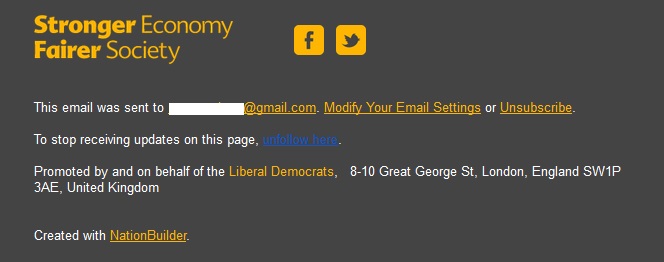
 which was fair enough. At the foot of that email was this message
receipt
again, fair enough, and that should be the end of my engagement with the Lib Dems.
  
But, you will perhaps be unsurprised to hear, it wasn’t. Two days later I received this, from Lynn Featherstone MP
featherstone
which at least was on the subject of FGM, but I was surprised she considered herself my “friend”. And two days after that I found I’d made another friend:
nick
So, a few days after I’d expressed my support for a non-party-political campaign, I was on first name terms with a political party leader, who was sending me an unsolicited marketing email. Which takes us back to PECR, and consent, and my myriad previous blog posts.
 
I thought I’d check exactly what the Lib Dems website privacy policy says. Of course there’s the usual guff about taking privacy seriously, but it goes on to say
If you provide your email address…we may use the email address to send you further information in the future. You may at any point request not to receive such information any more.
And there it is, in clear terms – a statement of non-compliance with the law. They cannot, under regulation 22(2) of PECR, infer consent to receive marketing emails merely because someone has provided an email address. I will be complaining to the Lib Dems, and, if necessary, the Information Commissioner’s Office.

2 Comments

Filed under consent, Data Protection, Information Commissioner, marketing, PECR, privacy notice

Privacy issues with Labour Party website

Two days ago I wrote about a page on the Labour Party website which was getting considerable social media coverage. It encourages people to submit their date of birth to find out, approximately, of all the births under the NHS, what number they were.

I was concerned that it was grabbing email address without an opt-out option. Since then, I’ve been making a nuisance of myself asking, via twitter, various Labour politicians and activists for their comments. I know I’m an unimportant blogger, and it was the weekend, but only one chose to reply: councillor for Lewisham Mike Harris, who, as campaign director for DontSpyOnUs, I would expect to be concerned, and, indeed, to his credit, he said “You make a fair point, there should be the ability to opt out”. Mike suggested I email Labour’s compliance team.

In the interim I’d noticed that elsewhere on the Labour website there were other examples of emails being grabbed in circumstances where people would not be sure about the collection. For instance: this “calculator” which purports to calculate how much less people would pay under Labour for energy bills, which gives no privacy notice whatsoever. Or even this, on the home page, which similarly gives no information about what will happen with your data

homepage

Now, some might say that, if you’re giving your details to “get involved”, then you are consenting to further contact. This is probably true, but it doesn’t mean the practice is properly compliant with data collection laws. And this is not unimportant; as well as potentially contributing to the global spam problem, poor privacy notices/lack of opt-out facilities at the point of collection of email address contribute to the unnecessary amassing of private information, and when it is done by a political party, this can even be dangerous. It should not need pointing out that, historically, and elsewhere in the world, political party lists have often been used by opposition parties and repressive governments to target and oppress activists. Indeed, the presence of one’s email on a party marketing database might well constitute sensitive personal data – as it can be construed as information on one’s political opinions (per section 2 of the Data Protection Act 1998).

So, these are not unimportant issues, and I decided to follow Mike Harris’s suggestion to email Labour’s compliance unit. However, the contact details I found on the overarching privacy policy merely gave a postal address. I did notice though that that page said

If you have any questions about our privacy policy, the information we have collected from you online, the practices of this site or your interaction with this website, please contact us by clicking here

But if I follow the “clicking here” link, it takes me to – wait for it – a contact form which gives no information whatsoever about what will happen if I submit it, other than the rather stalinesque

The Labour Party may contact you using the information you supply

And returning to the overarching privacy policy didn’t assist here – none of the categories on that page fitted the circumstances of someone contacting the party to make a general enquiry.

I see that the mainstream media have been covering the NHS birth page which originally prompted me to look at this issue. Some, like the Metro, and unsurprisingly, the Mirror, are wholly uncritical. The Independent does note that it is a clever way of harvesting emails, but fails to note the questionable legality of the practice. Given that this means that more and more email addresses will be hoovered up, without people fully understanding why, and what will happen with them, I really think that senior party figures, and the Information Commissioner, should start looking at Labour’s online privacy activities.

(By the way, if anyone thinks this is a politically-motivated post by me, I would point out that, until 2010, when I voted tactically (never again), I had only ever voted for one party in my whole life, and that wasn’t the Conservatives or the Lib Dems.)

6 Comments

Filed under Data Protection, Information Commissioner, marketing, PECR, Privacy, privacy notice, social media, tracking

Labour Party website – unfair processing?

Earlier this year I wrote about a questionable survey on the Conservative Party website, which failed to comply with the legal requirements regarding capture of email addresses. It is perhaps unsurprising to see something similar now being done in the name of the Labour Party.

An innocuous looking form on Labour’s donation pages lies underneath a statement that almost 44 million babies have been delivered under NHS care since 1948. The form invites people to find out what number their birth was. There are of course lots of this type of thing on the internet: “What was number one when you were born?” “Find out which Banana Split you are” etc. But this one, as well as asking for people’s date of birth, asks for their (first) name, email address and postcode. And, sure enough, underneath, in small print that I suspect they hope people won’t read, it says

The Labour Party and its elected representatives may contact you about issues we think you may be interested in or with campaign updates. You may unsubscribe at any point

So, they’ll have your email address, your first name and a good idea of where you live (cue lots of “Hi Jon” emails, telling me about great initiatives in my area). All very predictable and dispiriting. And also almost certainly unlawful: regulation 22(2) of The Privacy and Electronic Communications (EC Directive) Regulations 2003 (PECR) says that

a person shall neither transmit, nor instigate the transmission of, unsolicited communications for the purposes of direct marketing by means of electronic mail unless the recipient of the electronic mail has previously notified the sender that he consents for the time being to such communications being sent by, or at the instigation of, the sender

This Labour web page impermissibly infers consent. The European Directive  to which PECR give domestic effect makes clear in recital 40 that electronic marketing requires that prior, explicit consent  be obtained. Furthermore the Information Commissioner’s Office (ICO), issues clear guidance on PECR and marketing, and this says

Organisations must give the customer the chance to opt out – both when they first collect the details, and in every email or text. Organisations should not assume that all customers will be happy to get marketing texts or emails in future…It must be simple to opt out. When first collecting a customer’s details, this should be part of the same process (eg online forms should include a prominent opt-out box…

The ICO’s guidance on political campaigning is (given the likelihood of abuse) disappointingly less clear, but it does say that “An organisation must have the individual’s consent to communicate with them [by email]”. I rather suspect the Labour Party would try to claim that the small print would suffice to meet this consent point, but a) it wouldn’t get them past the hurdle of giving the option to opt out at the point of collection of data, and b) in the circumstances it would crash them into the hurdle of “fairness”. The political campaigning guidance gives prominence to this concept

It is not just in an organisation’s interests to act lawfully, but it should also have respect for the privacy of the individuals it seeks to represent by treating them fairly. Treating individuals fairly includes using their information only in a way they would expect

I do not think the majority of people completing the Labour Party’s form, which on the face of it simply returns a number relating to when they were born, would expect their information to be used for future political campaigning. So it appears to be in breach of PECR, not fair, and also, of course (by reference to the first principle in Schedule One) in breach of the Data Protection Act 1998. Maybe the ICO will want to take a look.

UPDATE:

I see that this page is being pushed quite hard by the party. Iain McNicol, General Secretary, and described as “promoter” of the page has tweeted about it, as have shadow Health Secretary Andy Burnham and Ed Miliband himself. One wonders how many email addresses have been gathered in this unfair and potentially unlawful way.


3 Comments

Filed under consent, Data Protection, Information Commissioner, marketing, PECR

Ticking off Neelie Kroes (sort of)

In which I take issue with the European Commission V-P about what the Consumer Rights Directive says about pre-ticked boxes

I found myself retweeting what I think was a rather misleading message from the Vice-President of the European Commission, Neelie Kroes. Her tweet said

You know those annoying “pre-ticked boxes” on shopping/travel websites? They’re banned in #EU from today http://europa.eu/rapid/press-release_IP-14-655_en.htm#eCommerce

I thought this was very interesting, particularly in light of my recent post about the implying of consent to electronic marketing if people forget to untick such boxes. The EU press release itself does say at one point

Under the new EU rules…consumers can now rely on…A ban on pre-ticked boxes on the internet, as for example when they buy plane tickets

But, it earlier says

The new rules also ban…pre-ticked boxes on websites for charging additional payments (for example when buying plane tickets online)

The emphasis I’ve added in that last quote is crucial. What DIRECTIVE 2011/83/EU OF THE EUROPEAN PARLIAMENT AND OF THE COUNCIL of 25 October 2011 on consumer rights actually proscribes is the contractual binding of a consumer to any payment in addition to the original remuneration agreed on if

the trader has not obtained the consumer’s express consent but has inferred it by using default options which the consumer is required to reject in order to avoid the additional payment

 So, as the press release explains,

When shopping online –for example when buying a plane ticket – you may be offered additional options during the purchase process, such as travel insurance or car rental. These additional services may be offered through so-called pre-ticked boxes. Consumers are currently often forced to untick those boxes if they do not want these extra services. With the new Directive, pre-ticked boxes will be banned across the European Union.

I happen to think that that text should more properly say “With the new Directive, pre-ticked boxes of this sort will be banned across the European Union”.

So, no ban on pre-ticked boxes themselves, just on those which purport to bind a consumer to an additional payment under a contract.

The Directive has been implemented in the UK by  The Consumer Contracts (Information, Cancellation and Additional Charges) Regulations 2013 and associated The Enterprise Act 2002 (Part 8 EU Infringements) Order 2013 the former of which says (at regulation 40)

Under a contract between a trader and a consumer, no payment is payable in addition to the remuneration agreed for the trader’s main obligation unless, before the consumer became bound by the contract, the trader obtained the consumer’s express consent.. There is no express consent (if there would otherwise be) for the purposes of this paragraph if consent is inferred from the consumer not changing a default option (such as a pre-ticked box on a website)

Having said all this, I do think it is interesting that clearly-defined concepts of “express consent” are making their way into European and domestic legislation. And in due course, we may even find that, for instance, electronic marketing will be restrained unless similarly clearly-defined express consent is given. But not just yet.

Update: Ms Kroes kindly replied to me, saying it’s difficult to get a message across in 140 characters. So true.


Leave a comment

Filed under Data Protection, Europe, marketing, PECR