Category Archives: access to information

Chief Constable in contempt over body-worn-video footage disclosure failures

The Court of Appeal has handed down an extraordinary judgment (Buzzard-Quashie v Chief Constable of Northamptonshire Police [2025] EWCA Civ 1397) in which the Chief Constable of Northamptonshire was forced to admit civil contempt of court, after camera footage, which the police force had repeatedly insisted, including before the lower courts, and also in response to an express order of the county court, did not exist, was found to exist just before the appeal hearing.

The appellant/applicant, Ms Buzzard-Quashie, had been arrested and initially charged with an offence in 2021. The arrest had involved three officers, all of whom had deployed body-worn-video cameras. Ms Buzzard-Quashie had complained about the arrest very shortly afterwards, and had sought copies of the footage. Although the charge was dropped, the force made only “piecemeal” disclosure, before determining that there was no further footage, or what there had been, had been destroyed.

At that point, she complained to the Information Commissioner’s Office, who told her that it had told the force “to revisit the way it handled your request and provide you with a comprehensive disclosure of the personal data to which you would be entitled as soon as possible”. (Here, the court – I believe – slightly misrepresents this as an “order” by the ICO. The ICO has the power to make an order, by way of an enforcement notice, but it does not appear to have issued a notice (and it would be highly unusual for it to do so in a case like this).)

The force did not do what the ICO had told it to do, so Ms Buzzard-Quashie issued proceedings in the Brentford County Court and obtained an order requiring the force to deliver up to her any footage in its possession or, if none was available or disclosable, to provide a statement from an officer “of a rank no lower than Inspector” explaining why it could not. It also required the force to pay her costs.

Remarkably, the force did not comply with any element of this order. This failure led to Ms Buzzard-Quashie initiating contempt proceedings in the High Court. At that hearing the Chief Constable, in evidence, maintained that that a full search had already been performed; all the footage had been produced; no other footage existed; and he was not in contempt. The judge found that Ms Buzzard-Quashie had not succeeded in establishing to the criminal standard that the Chief Constable was in contempt.

Upon appeal, and just before the hearing, primarily through the efforts of Ms Buzzard-Quashie and her lawyers (acting pro bono), the force was compelled to admit that footage did still exist: its searches had been manifestly inadequate.

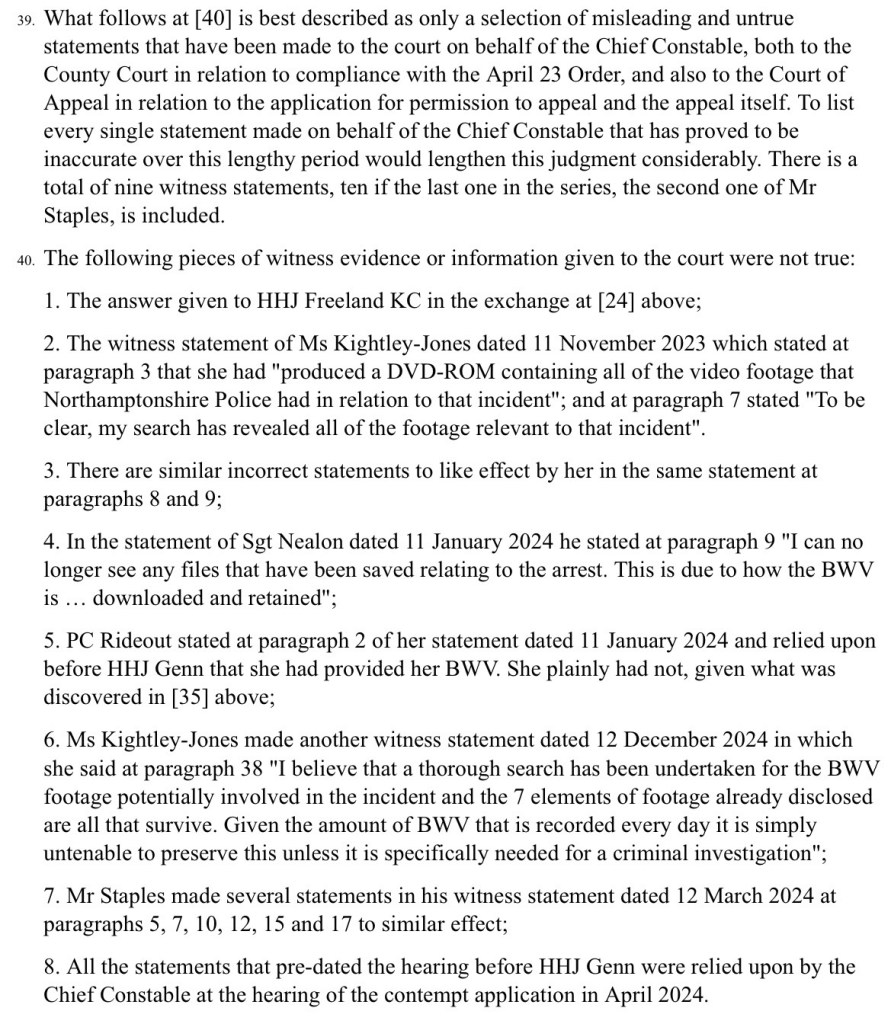
The CoA found that eight pieces of information and evidence (and this was “only a selection”) had not been true, and that “the Chief Constable had not only failed to comply with the [County Court] Order in both substance and form, but had advanced a wholly erroneous factual case before that court, and before this court as well”. Ms Buzzard-Quashie clearly succeeded in her appeal.

The judgment records that the issue of sanction for the contempt found “must wait until the next round of the process”, which presumably will be a further (or perhaps remitted) hearing.

There are any number of issues arising from this. It is, for example, notable that the data protection officer for the force was involved in the searches (and, indeed, she gave the initial statement that the County Court had ordered be given by an Inspector or above).

But a standout point for me is how incredibly difficult it was for Ms Buzzard-Quashie to vindicate her rights: the police force, for whatever reason, felt able to disregard both the statutory regulator and an order of a court. She and her pro bono lawyers showed admirable tenacity and skill, but those features (and that pro bono support) are not available to everyone. One welcomes the fact that all three judges noted her efforts and those of the lawyers.

The force has referred itself to the Independent Office of Police Conduct, and the Court of Appeal has reinforced that by making the referral part of its own order.

In this post I’ve tried to summarise the judgment, but I would strongly encourage its reading. The screenshot here is merely part of the damning findings.

The views in this post (and indeed most posts on blog) are my personal ones, and do not represent the views of any organisation I am involved with.
Leave a comment

Filed under access to information, Body worn video, Data Protection, Information Commissioner, judgments, police, subject access

Tribunal: unincorporated associations are not companies for the purposes of FOIA

The question of whether a body is a public authority for the purposes of the Freedom of Information Act 2000 (FOIA) is determined by asking (up to) three questions:

1: is it listed in Schedule 1 to FOIA?
2: has it been designated as a public authority by order by the Secretary of State or Minister for the Cabinet Office?
3: is it a company wholly owned by the wider public sector, or by the Crown (or by both of those)?

If the answer to all of those is “no”, then the body is not a public authority, and it is not obliged to comply with FOIA, no matter how much it might seem or look like a public authority.

These issues arose in a recent case in the First-tier Tribunal, following a decision by the Information Commissioner’s Office that the Conference of Colleges of the University of Oxford (the “Conference”) – an unincorporated association – was not a FOIA public authority.

It is accepted that the University of Oxford is a public authority, as is each of the colleges of the University (see paragraph 53 of Schedule 1 FOIA). The appeal to the Tribunal was based on argument by the appellant (“The Association Of Precarious Postdoctoral Researchers Ltd”) that the Conference, being a body created by the constituent colleges, met the definition of a “company” wholly owned by those colleges. Although FOIA does not define “company”, certain other legislative provisions do, including section 1121 of the Corporation Tax Act 2010, pursuant to which it is defined as meaning “any body corporate or unincorporated association…”.

That argument, however – held the Tribunal – actually counted against the appellant, because in the absence of clear legislative intent to broaden the term for the purposes of FOIA, it should take its ordinary English use: “unincorporated associations are not considered to be caught by the normal definition of a ‘company’ and…Parliament will make express provision to include them where it intends to do”.

The views in this post (and indeed most posts on blog) are my personal ones, and do not represent the views of any organisation I am involved with.

Leave a comment

Filed under access to information, FOIA, Freedom of Information, Information Commissioner, Information Tribunal

Hinkley Point C construction company is a public authority under the EIR

The Information Tribunal has ruled that the Nuclear New Build Generation Company, a subsidiary of EDF Energy, created to construct s new nuclear power plant at Hinkley Point C (HPC), is a public authority for the purposes of the Environmental Information Regulations 2004 (EIR)

In the last fifteen years or so, a very interesting body of case law has been built up regarding the extent to which certain private persons have accrued, or have been conferred upon them, the status of a public authority for the purposes of the EIR. Some of the bodies who have been held to be public authorities (at least in a limited EIR sense) are water companies, BT, public gas transporters, and port authorities. Some which have not been held to be include Heathrow Airport and housing associations.

The EIR create a scheme for public access to environmental information held by public authorities, which runs in parallel to the scheme under the Freedom of Information Act 2000 (FOIA). Where FOIA, though, specifically designates public authorities, the EIR (which implemented an EU Directive, emanating in turn from the 1998 UNECE Aarhus Convention) define a public authority by virtue of its actions and powers.

Whether a person is a public authority will often turn on whether it “carries out functions of public administration”. The tests for this derive from the “Fish Legal ” in the CJEU: whether they are “entrusted, under the legal regime which is applicable to them, with the performance of services of public interest, inter alia in the environmental field, and…are, for this purpose, vested with special powers beyond those which result from the normal rules applicable in relations between persons governed by private law”

In NNB Generation Company (HPC) Ltd v Information Commissioner & Anor [2025] UKFTT 634 (GRC), the Tribunal, considering an appeal by HPC from a decision by the Information Commissioner’s Office that it was an EIR public authority (and in which Fish Legal were again the applicant), held that the relevant Development Consent Order, and the electricity and nuclear licences granted to HPC constituted entrustment with the performance of public services in relation to the environment, and the powers accruing from that entrustment “go far beyond what a private person without the benefit of such powers would be able to do in those circumstances, for example in empowering HPC to make byelaws, even if it opts not to do so”.

Decisions of this sort are nuanced and complex, and for that reason, often amenable to appeal. I would not be surprised if this one goes to the Upper Tribunal.

The views in this post (and indeed most posts on blog) are my personal ones, and do not represent the views of any organisation I am involved with.

Leave a comment

Filed under access to information, Environmental Information Regulations, FOIA, Information Commissioner, Information Tribunal, judgments

Liz Truss leadership election not amenable to JR

Was the leadership election in which Liz Truss was elected as leader of the Conservative Party (and as a result of which she was recommended to the Queen by the outgoing Boris Johnson, and appointed by the Queen as her Prime Minister) a decision amenable to judicial review?

Whether a person is a public authority for the purposes of the Freedom of Information Act 2000 is, in principle, a relatively straightforward issue: is it listed in Schedule 1 to FOIA?; or has it been designated as such by order under section 5?; or is it wholly owned by the public sector?

Whether a person is a public authority under section 6 of the Human Rights Act 1998, or whether a person is a public authority amenable to judicial review, are more complex questions.

It was the last of these that the Court of Appeal had primarily to consider in Tortoise Media Ltd, R (On the Application Of) v Conservative and Unionist Party [2025] EWCA Civ 673. Tortoise Media had written to the Party seeking certain information in relation to the leadership election process, and argued that the public effects of the leadership election meant that, in those circumstances, the Party was exercising a public function for the purposes of CPR 54.1(2). The follow-on argument was that the judgment of the ECtHR in Magyar Helsinki Bizottság v Hungary meant that the domestic courts should read down Article 10 of the ECHR (as incorporated in domestic law in the HRA) as imposing, in some cases, a positive obligation on a body to provide information to the media, who act as “watchdogs” in the public interest.

Perhaps unsurprisingly, though, the Court of Appeal did not accept that the effects and circumstances of the Party leadership election made the decision of the Party amenable to JR:

the nature of the act of electing a party leader…is at all times a private act. The fact that it has important, indirect consequences for the public does not transform a private act into a public one.

For that reason, the Court did not need to consider the Article 10/Magyar arguments (but on which, one feels – having regard to the submissions on behalf of the Duchy of Lancaster, as intervener, which argued that the Supreme Court’s decisions in Sugar and in Kennedy (which did not follow the reasoning in Magyar) bound all inferior courts – the claimants would have in any case lost).

It’s an interesting read, even if it was – to put it mildly – an ambitious case to bring.

The views in this post (and indeed most posts on blog) are my personal ones, and do not represent the views of any organisation I am involved with.

Leave a comment

Filed under access to information, Article 10, Freedom of Information, human rights, judgments, judicial review

Cabinet Office unsuccessfully appeals FOIA information notices

When a public authority relies on an exemption to refuse to disclose information in response to a Freedom of Information Act request, the requester can ask the Information Commissioner’s Office for a decision as to whether the refusal was in accordance with the law. In order to make such a decision, the ICO may often need to see the information withheld by the public authority. Where the public authority is unwilling to provide this, or perhaps drags its heels over it, the ICO may serve, under section 51 of FOIA, an “information notice”, requiring the information to be provided. Failure to comply with an Information Notice can be certified as contempt of court, but there is a right of appeal to the First-tier Tribunal.

And so it was that the Tribunal recently found itself hearing appeals by the Cabinet Office in relation to two Information Notices served on it by the ICO, who is investigating whether FOIA requests for information relating to Rishi Sunak’s declarations of interest when he was Prime Minister.

The Cabinet Office sought to argue, among other things, that access by the ICO was not necessary, was unfair and damaging to the process of handling ministerial declarations of interest, and would constitute unlawful processing of personal data. All of these arguments got short shrift from the Tribunal – ultimately, it held that it would not be possible to determine whether any of the exemptions prayed in aid by the Cabinet Office were made out without an examination of the material, and the appeals were dismissed.

The views in this post (and indeed most posts on this blog) are my personal ones, and do not represent the views of any organisation I am involved with.

Leave a comment

Filed under access to information, Cabinet Office, Freedom of Information, Information Commissioner, information notice, Information Tribunal, judgments

An offence of unlawful access to records of the dead?

I’m starting to wonder whether Parliament should consider a new offence of accessing and/or retaining records of the deceased without lawful excuse.

The BBC, and others, are reporting concerns that there may have been unauthorised access to medical records of the victim of killer Valdo Calocane. In the last few years we have also seen similar stories emerging in relation to police files on the murders of Sarah Everard, Bibaa Henry and Nicole Smallman (and I am sure there are many others).

The offence at section 170 of the Data Protection Act 2018 cannot be engaged when the records in question relate to someone who is dead, and although there is the potential for prosecutions for misconduct in a public office, or under the Computer Misuse Act 1990, there will be times when these do not apply.

Such unwarranted access seems to be a serious risk which arises wherever there is a high profile killing, and it must cause immense extra distress for the families and friends of the victims.

I wonder if now is the time for a debate on the topic, with an agenda item of whether there is need for a new criminal offence.

The views in this post (and indeed most posts on this blog) are my personal ones, and do not represent the views of any organisation I am involved with.

1 Comment

Filed under access to information, Confidentiality, crime, parliament

Can a data subject inspect withheld information in court proceedings?

When a controller, in response to a subject access request, has withheld personal data on the grounds of an exemption or exemptions, the data subject can apply to the court for a compliance order, under section 167 of the Data Protection Act 2018. That application will be determined by a judge who must determine whether the personal data was properly withheld or not. But general rules in adversarial proceedings do not permit one side and the judge to have access to material when the other side does not. So can the claimant and his/her lawyers therefore have access to the withheld information? Of course not – you all say – that would be absurd. However, the picture is not quite as clear as one might think.

Section 15(2) of the Data Protection Act 1998 specifically dealt with this issue: it said that the information should “be made available for [the judge’s] own inspection but shall not, pending the determination of that question in the applicant’s favour, require the information sought by the applicant to be disclosed to him or his representatives”.

But no such provision is contained in the equivalent sections of the 2018 Act. That appears to have been a drafting error.

The issue came up in X -v- The Transcription Agency LLP [2024] 1 WLR 33, and the court there held that

it would defeat the purpose of the legislation if a person challenging the application of an exemption were to be given sight of the material for the purpose of advancing his or her arguments…It would bring about a situation in which a party seeking personal data “would have obtained the very thing which the hearing was designed to decide”

As a result, I imagine, of the X case, Parliament moved to address the lacuna in the law: the Data Protection and Digital Information Bill contained a clause which would have given the court the express power contained in section 15(2) of the 1998 Act. That Bill was, of course, dropped just before the 2024 General Election, but the Data (Use and Access) Bill, now speeding through the Commons, contains something similar, at clause 103.

And so it was that the issue again arose in recent proceedings – Cole v Marlborough College [2024] EWHC 3575 (KB) – involving a former pupil who is seeking information through subject access regarding an investigation into a disciplinary matter in his former school.

As in X, the judge noted the absence of any express power to inspect the materials without permitting their disclosure to the claimant. But, relying on X, the judge held that there was an implied power (either implied within section 167) and/or in exercise of the court’s inherent jurisdiction.

Given the impending amendment of the statute to make the power express, rather than implied, these cases will probably just become footnotes, rather than landmark judgments. But they’re interesting for illustrating how courts will find implied powers and procedures where justice demands it.

The views in this post (and indeed most posts on this blog) are my personal ones, and do not represent the views of any organisation I am involved with.

4 Comments

Filed under access to information, Data Protection Act 2018, judgments, subject access

FOI doesn’t need a “purpose”

[reposted from my LinkedIn account]

At the close of an otherwise unobjectionable and unsurprising refusal of a Freedom of Information Act 2000 appeal (on the issue of a vexatious request), the Information Tribunal judge says this:

“FOIA exists to safeguard freedom of information. It was not enacted to serve as a tool for furthering personal campaigns and causes, however heartfelt they may be.”

When Parliament enacted FOIA it expressly declined to insert a “purpose clause”. As its explanatory notes say “A request for information can be made by any individual or body, regardless of the purpose of the application.” So if someone wants to use FOIA as a tool for furthering personal campaigns and causes, then (as long as their requests are not, as they were here, vexatious) they jolly well can. And judges should respect this.

The views in this post (and indeed most posts on this blog) are my personal ones, and do not represent the views of any organisation I am involved with.

Leave a comment

Filed under access to information, FOIA, Freedom of Information, Information Tribunal, judgments, Uncategorized

The state of central government transparency

[reposted from my LinkedIn account]

This is one of the most extraordinary FOIA judgments I’ve ever seen, and it says an awful lot about the approach to transparency at the centre of the civil service.

The Cabinet Office have been trying to resist disclosure under FOIA of copies of blank ministerial declaration of interest forms, on grounds that to do so would be prejudicial to the conduct of public affairs, because among other things [checks notes] “Disclosure may lead to speculative scrutiny regarding why certain elements are included in the forms, potentially leading to amendments to the form which undermines its effectiveness”.

But there’s also an extraordinary citation of a piece of evidence given by a Cabinet Office witness – the “Director of Propriety and Ethics” – to the effect that the system for Minister declaring interests relies heavily on the trust and candour of Ministers, and the effect of disclosure would be that they “may be reluctant to provide the same level of detail” than they do currently.

Let’s just think about that. Ministers have a constitutional and ethical duty to declare interests, but this relies on trust and candour, and disclosure of a blank declaration form might mean that those we trust to be candid in their ethical duty to declare those interests might decide to be less trustworthy and candid as a result? What a sorry state of affairs.

Fortunately, the Information Tribunal, like the Information Commissioner’s Office before, had no truck with these arguments, and refused the Cabinet Office’s appeal.

The views in this post (and indeed most posts on this blog) are my personal ones, and do not represent the views of any organisation I am involved with.

Leave a comment

Filed under access to information, Cabinet Office, FOIA, Freedom of Information, Information Commissioner, Information Tribunal, judgments

Clarity needed on NHS publication of reports into homicides

[reposted from my LinkedIn account]

Does the law need clarifying on the publication of reviews into homicides by those receiving mental health services from the NHS?

The Times led recently on stories that NHS England was refusing to publish the full independent report into the health care and treatment of Valdo Calocane prior to his manslaughter of three people in Nottingham in 2023. NHSE apparently argued that data protection and patient confidentiality concerns prevented them publishing anything but a summary. Under pressure from victims’ families, and the media, NHSE about-turned, and the full report is reported to contain damning details of failings in Calocane’s treatment which were not in the summary version.

Now The Times reports that this is part of a pattern, since last year, of failure to publish full reviews of homicides by mental health patients, contrary to previous practice. It says that NHSE received legal advice that the practice “could breach data protection rules and the killers’ right to patient confidentiality”. The charity Hundred Families talks of cases where the names of victims are not published, or even the identity of the NHS Trust involved.

Of course, without seeing the advice, it is difficult to comment with any conviction, but I did write in recent days about how the law can justify publication where it is “necessary for a protective function” such as exposing malpractice, or failures in services. And it’s important to note that, in many cases, such reports show failings that mean that killers themselves have been let down by the adequacy of treatment: publication can surely, in some cases, cast light on this so that similar failings don’t happen in the future. In any case, guidance says that those preparing reports should do so with a view to their being published, and so confidentiality concerns should be taken into account in the drafting.

However, if NHSE remains concerned about the legality of publication, and if its legal advice continues to say that data protection and medical confidentiality law militated against disclosure, it strikes me that this might call for Parliament to legislate. I also believe that it would be welcomed if the Information Commissioner’s Office issued a statement on the legal issues arising.

The views in this post (and indeed most posts on this blog) are my personal ones, and do not represent the views of any organisation I am involved with.

Leave a comment

Filed under access to information, Confidentiality, Data Protection, Information Commissioner, NHS