Category Archives: Data Protection

It’s our Right to Know, Mr ICO

On 29 August the Information Commisioner’s Office (ICO) served a monetary penalty notice (MPN) of £100,000 on Aberdeen City Council. MPNs can be served on a data controller under section 55A of the Data Protection Act 1998 (DPA) for a serious contravention of the Act of a sort likely to cause serious damage or serious distress. In this instance, the ICO explained

sensitive information relating to social services involvement with several individuals [was] published online. The information included details relating to the care of vulnerable children.

The circumstances under which this happened were

a council employee accessed documents, including meeting minutes and detailed reports, from her home computer. A file transfer program installed on the machine automatically uploaded the documents to a website

Many people in the field of information rights have concerns that there is a significant lack of understanding on the part of many about the risk of inadvertently disclosing personal data on the web. In view of this, I though I would simply ask the ICO, and the Council, what website was involved, in order to inform my understanding. So I tweeted

What “website” were the files uploaded to?

I reminded the ICO and the Council on several occasions about this, and pointed out it was a valid request under the Freedom of Information Act 2000 (FOIA) and Freedom of Information (Scotland) Act 2002 (FOI(S)A), even though I had really only wanted a quick factual reply. The Council have asked me to contact them separately to make the FOI(S)A request, and I’m aware the Scottish Information Commissioner takes a different view on tweeted requests to her counterpart for the rest of the UK, so I’ve banged in a request at WhatDoTheyKnow. The ICO, by contrats, did treat my tweet as a valid request (although I got no acknowledgment of this, contrary to their good practice guidance) and responded yesterday on the twentieth working day, with a link to their disclosure log

Those who know me will be unsurprised to know that I don’t accept the refusal, and also unsurprised to know that, on International Right to Know Day 2013 I’ve submitted a crashingly pompous request for ICO to conduct an internal review. Here it follows, in all said crashing pomposity:

Please review your refusal to disclose information.

On 29 August you served a Monetary Penalty Notice on Aberdeen City Council

“after a council employee accessed documents, including meeting minutes and detailed reports, from her home computer. A file transfer program installed on the machine automatically uploaded the documents to a website, publishing sensitive information about several vulnerable children and their families, including details of alleged criminal offences”

I asked, on 30 August, “What ‘website’ were the files uploaded to?”

You have refused to disclose, claiming the exemption at section 44 of the Freedom of Information Act 2000, which provides an exemption “if disclosure [of the information] (otherwise than under this Act) by the public authority holding it…is prohibited by or under any enactment”. You say disclosure is prohibited, because “the information was provided to the ICO in confidence as part of our regulatory activities” and that the provisions of section 59(1) of the Data Protection Act 1998 forbid disclosure. Section 59(1) says

“No person who is or has been the Commissioner, a member of the Commissioner’s staff or an agent of the Commissioner shall disclose any information which—

(a)has been obtained by, or furnished to, the Commissioner under or for the purposes of the information Acts [of which FOIA is one],

(b)relates to an identified or identifiable individual or business, and

(c)is not at the time of the disclosure, and has not previously been, available to the public from other sources

unless the disclosure is made with lawful authority”

I am happy to concede that a) and b) are met here, but not c). This is because section 59(2) explains what “with lawful authority” means. Firstly, and largely as an aside, section 59(2)(a) says that a disclosure is made with lawful authority if

“the disclosure is made with the consent of the individual or of the person for the time being carrying on the business”

I am surprised you do not feel that, in your role as a public authority but also as the regulator for Freedom of Information, it would be prudent and transparent simply to ask the Council whether it consents. Nonetheless, on a strict reading of the law, I concede that you do not have an obligation to do so.

Secondly (and I note you do not even address this important provision), section 59(2)(e) says that disclosure is made with lawful authority if

“having regard to the rights and freedoms or legitimate interests of any person, the disclosure is necessary in the public interest”

I would argue that analysis of whether this provision permits disclosure requires a two-fold test. Firstly, is disclosure necessary in the public interest? Secondly, if it is, do the rights and freedoms or legitimate interests of any person militate against this public-interest disclosure?

On the first point, I am not aware of any direct authority on what “necessary” means in section 59(2)(e) of DPA, but I would argue that it imports the meaning adopted by leading European authorities. Thus, as per the high Court in Corporate Officer of the House of Commons v The Information Commissioner & Ors [2008] EWHC 1084 “‘necessary”…should reflect the meaning attributed to it by the European Court of Human Rights when justifying an interference with a recognised right, namely that there should be a pressing social need and that the interference was both proportionate as to means and fairly balanced as to ends”. It is my view that there is a pressing social need to recognise the risks of indavertent uploading to the internet, by public authorities and others, of sensitive personal data, especially when this is by automatic means. Other examples of recent incidents and enforcement action illustrate this. For instance, as your office is aware, there have been reports that a regional Citizens’ Advice Bureau has indavertently made available on the internet very large amounts of such data, probably because of a lack of technical knowledge or security which resulted in automatic caching by Google of numerous files https://informationrightsandwrongs.com/2013/09/24/citizens-advice-bureaucracy/. Also for instance, as you are aware, there have been many many examples of indavertent internet publishing of personal data in hidden cells in spreadsheets http://www.ico.org.uk/news/blog/2013/the-risk-of-revealing-too-much. There is a clear lack of public understanding of the risks of such indavertent disclosures, with a consequent risk to the privacy of individuals’ often highly sensitive personal data. Any information which the regulator of the DPA can disclose which informs and improves public understanding of these risks serves a pressing social need and makes the disclosure “necessary”.

On the second point, I simply fail to see what rights and freedoms or legitimate interests of any person can be engaged, let alone suffer a detriment by disclosing what public website the Council employee uploaded this to. If there are any, it would be helpful if your response to this Internal Review could address this. It may be that you would point to the information having been provided to you in confidence, but I similarly fail to see how that can be: was this an express obligation of confidence, or have you inferred it? In either case, I would question (per one the elements of the classic formulation for a cause of action in breach of confidence given by Megarry J in Coco v A.N.Clark (Engineers) Ltd [1969] R.P.C. 41) whether the information even has the necessary quality of confidence (this was a public website after all).

I hope you can reconsider your decision.

best wishes
1 Comment

Filed under Confidentiality, Data Protection, FOISA, Freedom of Information, human rights, Information Commissioner, monetary penalty notice, transparency

Must Try Harder

So, I managed to get a piece run on the Guardian Public Leaders network on the continuing incidents of or risks of exposure of sensitive personal data in pivot tables. I tried to argue that those in the know probably know about these risks, and that those not in the know don’t. I suggested the Information Commissioner’s Office (ICO) and the government could do more to alert the latter.

Although I got nice and positive feedback from friends/colleagues/fellow professionals, there appears to have been very little interest. Clearly it’s not a subject that interests lay people (or rather, it’s probably a subject which actually repels lay people). But that was rather my point: as long as the relevant regulators and policy-makers don’t take sufficient steps to issue warnings and guidance these and similar breaches of data security will continue to happen.

What I’m slightly surprised at is the lack of any response from the ICO. I noticed that Tim Turner asked the ICO twitter account if they had a response to the piece, but, unless it was off-line, he appeared to get no response. And I asked their press office, again, with no reply (maybe the press office was the wrong place to ask?).

In the article I also called on government departments to do more. That’ll be my next move. The problem of inadvertent internet disclosure of sensitive data, normally through ignorance of technology, continues, and it goes broader than pivot tables. As public authorities, in particular, are being required to open up more and more data to promote transparency and economic growth, this is going to become more and more serious. We can’t pretend the gulf between those ambitions and the technological knowledge of some of those doing the “opening up” is a minor problem. Authorities need guidance, and, where appropriate, warnings, and these need to be targetted at the right people within organisations. The ICO and government cannot always rely on, say, data protection officers to do this.

Leave a comment

Filed under Breach Notification, Data Protection, Information Commissioner, transparency

Let’s blame Data Protection: Part Two

“The leader of the council wishes to make the names of the debtors public, but the Data Protection Act of 1998 prohibits their publication.”

So says an article from the Blackpool Gazette, when quoting a council report (which I haven’t yet been able to find) which appears to have indicated that

The council has been forced to write off £1.68m in owed business rates going back around the last six years

The council leader is reported to have said

Several names appear more than once, owing vast sums of money to the council…Several high-profile business owners, who always seemed to have a lot to say about how the town is run, seem to have no qualms about disappearing owing us tens of thousands of pounds…We are very dogged and tenacious when it comes to pursuing debtors, and clearly need to continue to be.

but

What I do find very frustrating is that I am not able to publish the names of these people

This puzzles me: names of businesses will not, as a general rule constitute personal data under section 1(1) of the Data Protection Act 1998 (DPA). The definition of personal data

data which relate to a living individual who can be identified—
(a) from those data, or
(b)from those data and other information which is in the possession of, or is likely to come into the possession of, the data controller

Even if individuals can be identified from disclosure of the names of defaulting businesses it is perhaps the case that the information will not considered to be personal data, especially following the precedent of the Court of Appeal in Durant where it was held that, for information to be personal data it
should have the putative data subject as its focus rather than…some transaction or event in which he may have figured or have had an interest
It is interesting to note that the Information Commissioner’s Office (ICO), in guidance which appears to have been withdrawn, said
Information about people who run businesses, and the businesses they run, will often be covered by the Act. This is because information about a person’s business, activities, possessions, and so on is generally personal information about that person
although, in a rather circular argument

Business information that does not identify individuals is not covered by the Act

What I think is being got at is that, for example, information consisting of “Richard Hannay is a fifty-year-old black man who runs Imaging Solutions Ltd, which made a £1.2m profit last year” is potentially Richard Hannay’s personal data throughout, whereas “Imaging Solutions Ltd made a £1.2m profit” is unlikely to be Hannay’s personal data when considered in isolation, even though one can easily find out that he is the sole director.
In another, more specific scenario, it might be more easily argued that the names of business are personal data. This is where someone is conducting business as a sole trader. The ICO’s ?withdrawn guidance said

Information about a sole trader’s business will be personal information about him

I’m not sure I would be so unequivocal, but as a general proposition it’s not objectionable.

However, even if business information is personal data, the DPA does not necessarily prevent disclosure of it. In fact, the DPA permits disclosure of any and all types of personal data, as long as it is in compliance with the Act. In short, if disclosure is fair and lawful and relevant provisions permit it, then it will be in compliance with the Act. And, helpfully for the council, there is a specific provision relating to personal data “processed for…the assessment or collection of any tax or duty”. This exemption permits disclosure where not disclosing would be likely to prejudice the collection of the tax in question. Additionally, the sixth condition of Schedule 2 of the DPA provides that, if it  is “necessary for the purposes of legitimate interests pursued by the data controller” personal data may be processed, provided it is not “unwarranted…by reason of prejudice to the rights and freedoms or legitimate interests of the data subject”.
This will not give carte blanche to disclosure of personal data (if personal data it is) of owners of defaulting businesses, but it is certainly arguable in this instance that disclosure would assist the collection of the tax (and, therefore, non-disclosure could prejudice it), and that the balancing exercise required by the sixth Schedule 2 condition would fall in favour of disclosure.
So, a) I doubt that the withheld information is personal data, and, even if it is b) disclosure would be in compliance with the DPA.
One thing is certain, the DPA does not prohibit publication of this information, and, to the extent that it might be engaged, I would not see it as a barrier to disclosure. It might even help the council in its aim to be “dogged and tenacious when it comes to pursuing debtors”.
But it’s so much easier to blame Data Protection.

Leave a comment

Filed under Data Protection, Let's Blame Data Protection

ICO – no Code of Practice for data protection and the press

On the 12th of August the Information Commissioner’s Office (ICO) announced that, following a period of consultation, it would not – contrary to previously-stated intentions – be issuing a Code of Practice on Data Protection and the Press. The proposed Code had been in response to Lord Justice Leveson’s recommendations that the ICO produce

comprehensive good practice guidelines and advice on appropriate principles and standards to be observed by the press in the processing of personal data

As the ICO’s Steve Wood says in the blogpost

Leveson did not stipulate a code but we proposed it as a possible vehicle for the guidance

Indeed they did, stating at the time that it was not

the ICO’s intention to purport to set ethical standards for journalists, or to interfere with the standards which already apply under relevant industry guidance, such as the Editors’ Code of Practice, the Ofcom Broadcasting Code, and the BBC Producers’ Guidelines. Nevertheless, the existing industry guidance does not consider the requirements of data protection law in any detail, and the ICO’s code will complement existing industry standards by providing additional coverage of this issue

However, the latest announcement – that the ICO is “looking to produce a guidance document” rather than carrying through with the issuing of a Code of Practice – is accompanied by the publishing of a summary of consultation responses to the draft Code of Practice. In fairness to the ICO, those who responded appeared not to want a Code, and, as any public authority will be aware, a consultation in name only (e.g. one with a predetermined outcome) is unlikely to be a lawful one. We are not told specifically who these responses were from, but that they were from “several media companies, individuals, regulators and representative bodies” (although there were only 16 responses overall, a figure which perhaps shames us all, or, alternatively, supports a view that not that many people were particularly aware of or bothered about the consultation). Seven responses specifically rejected the idea of a Code of Practice, with some concerns being

a code of practice implies a new set of rules or regulations;
risk of the ICO becoming a ‘mainstream de facto regulator of the press’;
risk of a proliferation of codes; and
risk of potential confusion with existing codes such as the Editors’ Code.

After pausing to note that the now-proposed ICO guidance will apparently be issued in draft (for further consultation) before the end of the year, which is a long, long way from meeting Leveson’s recommendation that any guidance be implemented within six months of his report,  it might be helpful to look at just why some respondents might have been unhappy with a Code of Practice, as opposed to “mere” guidance.

As is well-known, there is a very broad exemption, at section 32, from most of the obligations of the Data Protection Act 1998 (DPA) where:

(a)the processing is undertaken with a view to the publication by any person of any journalistic, literary or artistic material,
(b)the data controller reasonably believes that, having regard in particular to the special importance of the public interest in freedom of expression, publication would be in the public interest, and
(c)the data controller reasonably believes that, in all the circumstances, compliance with that provision is incompatible with the special purposes [emphasis added]

This, broadly, means that, as long as personal data is processed with a view to journalistic publication (note: not that it has to be published) it is exempt from effectively all of the DPA (although not the 7th “security” principle) as long as the press body “reasonably believes” publication would be in the public interest. This has generally been taken to mean that it will be extremely difficult for a data subject to enforce her rights against, or for the ICO to regulate the activities of, the press. And, indeed, instances of successful DPA claims, or successful enforcement, against the press, are rare (privacy cases against the press, where they have included DPA claims, have tended to see the latter sidelined or dropped in favour of meatier claims in tort – see e.g. Douglas v Hello [2005] EWCA Civ 595 (where the DPA claim did succeed in the first instance, but only resulted in nominal damages) and Campbell v MGN [2002] EWCA Civ1373 (where, by contrast, the section 32 defence succeeded)). As Leveson LJ says

the effect of the development of the case law has been to push personal privacy law in media cases out of the data protection regime and into the more open seas of the Human Rights Act [page 1070 of Leveson Report]

 As everyone knows, the press kicked back strongly against parliament’s proposal of a Royal Charter for the press (that proposed Charter itself being the result of a rowing back by the political parties from Leveson’s proposal for some form of direct statutory underpinning of any regulatory scheme (“Guaranteed independence, long-term stability, and genuine benefits for the industry, cannot be realised without legislation”)). Both proposed Charters (the parliamentary-backed one and the Pressbof-backed one ) are to be considered by the Privy Council.

What has perhaps not been so widely-known, or widely-understood was that an ICO Code of Practice, if it had been designated by the Secretary of State (by means of an Order pursuant section 32(3)(b) of the DPA), would itself have constituted a form of statutory underpinning. This is because a Code designated in this way could have been taken into account by a court, or by the ICO, when determining whether personal data had been processed (for the special purposes) by the data controller in the reasonable belief that it had been in the public interest. The now-proposed “mere” guidance will not have the same status.

This might seem a minor point, and perhaps it is (bear in mind that there are already other Codes of Practice designated pursuant to section 32(3)(b), including the Press Complaints Commission Code of Practice) but, although we don’t know specifically who responded to the ICO’s consultation, it is safe to say that those who did included in their number organisations strongly opposed to (and alive to the threat of) any form of what they perceive to be statutory regulation of the press.

In this post I draw heavily on previous posts by Chris Pounder, on his Hawktalk blog, and if, as he suggested earlier this year, the then-proposed ICO Code raised the prospect of enhanced protection for ordinary data subjects, it is perhaps the case that the dropping of the proposal means no such enhanced protection.

1 Comment

Filed under Data Protection, human rights, Information Commissioner, journalism, Leveson

Contributing to society?

Why are proponents of care:data resorting to rudeness about those who are not as convinced as they are?

When I attended the launch of MedConfidential in April of this year I was largely ignorant of the proposals to amass patient data by the Health and Social Care Information Centre (HSCIC) under the banner of care:data. I was concerned by what I heard, and I remain so: details were unclear and in many cases remain so, regarding what data will be gathered, and how, and for what purposes, and what arrangements will be to allow third party access to it, and whether or to what extent it will be anonymised, and whether patients’ consent will be sought, or assumed, or ignored.

What I did see, and was greatly impressed by, was a large group of people, from various backgrounds and roles, coming together, mostly on a purely voluntary basis (for instance, I took a day’s leave to attend), to discuss the implications of this.

The centralising and use of patient confidential data raises questions of profound importance, which don’t have easy answers: such as to what extent should people waive an expectation of privacy in order – for instance – to further medical research? These are issues which led two of my favourite bloggers to come to (digital) blows recently.

Yet earlier today I read an otherwise sensible piece on the subject (I am not saying I agree with it) by the high-profile columnist Polly Toynbee, which talked about her receiving letters from people who ask her to

investigate the dark forces planting cameras and microphones in their walls: they think I’m part of the conspiracy when I suggest this is a usually curable delusion, and their doctor is probably not part of the plot

I fail to see the relevance of this reference to people with a diagnosis of apparent paranoid schizophrenia, unless it is to draw an analogy by insinuation with

those not clinically ill [among whom] there is a growing trend to fear Big Brother and the state

This is nasty stuff, and leads one to wonder why she feels the need to resort to such a rhetorical device.

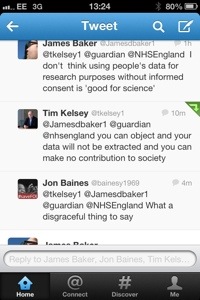
Someone who liked Toynbee’s post was Tim Kelsey, NHS National Director for Patients and Information, and former government “czar” for Transparency and Open Data. He described it as “seminal” on twitter. I’m sure Tim finds the constant questioning of the care:data plans irritating: his tweets are often replied to by people who are not as convinced as he is that it is unequivocally a Good Thing. An example of this irritation was his response to an observation by Calderdale councillor James Baker. James tweeted, in response to Tim’s “seminal” tweet

I don’t think using people’s data for research purposes without informed consent is ‘good for science’

This is unexceptional, and a fair comment. Tim’s reply* was certainly not

you can object and your data will not be extracted and you can make no contribution to society

I think that to suggest that someone who might object (in the context of a worrying lack of, er, transparency, about the details of care:data) to the extraction of their highly sensitive medical data is making “no contribution to society” is extraordinarily unfair, and, as James pointed out in reply

It’s an offensive thing to say to an elected representative who contributes a lot to society…It’s also using trying to use guilt and shame to persuade someone to partake in medical research. Unethical

I couldn’t agree more.

UPDATE:

*It appears the tweet has now been deleted. Tim did reply to James saying

offence not intended – I meant contribution to health improvement thru sharing non PID

but there’s been no explanation or apology for that original tweet

20130823-174459.jpg

3 Comments

Filed under Data Protection, NHS, Privacy, transparency

Pivot tables and databreaches

About a year ago I first became aware of reports of disturbing inadvertent disclosures of personal data (often highly sensitive) by public authorities who had intended only to disclose anonymous and/or aggregate data. These incidents were occurring both in the context of disclosures under the Freedom of Information Act 2000 (FOIA) and in the context of proactive disclosure of datasets. Mostly they were when what had been disclosed was not just raw data, but the spreadsheet in which the data was presented. Spreadsheet software is often very powerful, and not all users necessarily understand its capabilities (I don’t think I do). By use of pivot tables data can be sorted, summarised etc, but also, from the uninitiated or unwary, hidden. If the person who created or maintained a spreadsheet containing a pivot table is not involved in the act of publicly disclosing it it is possible that an apparently innocuous disclosure will contain hidden personal data.

Clearly such errors are likely to constitute breaches – sometimes very serious breaches – of the Data Protection Act 1998 (DPA) Those of us who were aware of a number of these inadvertent breaches were also aware that, if public authorities were not alerted to the risk a) the practice would continue and b) potentially large numbers of “disclosive” datasets would remain out in the open (in disclosure logs, on WhatDoTheyKnow, in open data sets etc). But we were also aware that, if the situation was not managed well and quietly, with authorities given the opportunity to correct/withdraw errors, inquisitive or even malicious sorts might go trawling open datasets for disclosures which could potentially be very damaging and distressing to data subjects.

It was with some relief, therefore that, following an earlier announcement by WhatDoTheyKnow, the Information Commissioner’s Office (ICO) finally gave a warning, and good guidance, on 28 June (although this relief was tempered by finding out, via Tim Turner, that the ICO had known about, and apparently done nothing about, the problem for three years). At the same time the ICO announced that it was “actively considering a number of enforcement cases on this issue”.

It appears that, according to an announcement on its own website, Islington Council is the first recipient of this enforcement. The Council says it has

accepted a £70,000 fine from the Information Commissioner’s Office (ICO) after a mistake led to personal data being released

after it

responded to a Freedom of Information (FOI) request asking for information including the ethnicity and gender of people the council had rehoused. The response, in the form of Excel spreadsheet tables, included personal information concealed behind the summary tables

Fair play to Islington for acknowledging this and agreeing immediately to pay the monetary penalty notice. And if some of the other reported breaches I heard about were as bad as they sounded £70,000 will be at the lower end of the scale.

(thanks to @owenboswarva on twitter for flagging this up)

UPDATE:

The ICO has now posted details of the MPN, and this clarifies that the disclosure was made on WhatDoTheyKnow and was only identifed when one of their site administrators noticed it.

Leave a comment

Filed under Breach Notification, Data Protection, Freedom of Information, Information Commissioner, monetary penalty notice, transparency

Monetary penalties – focus on the breach, not the incident

The Information Tribunal’s judgment in the successful appeal by Scottish Borders Council shows that the ICO needs to focus on the contravention itself, not an incident which might arise from it

looking at the facts of the case, what did happen was in our view a surprising outcome, not a likely one

Sections 55A-E of the Data Protection 1998 (DPA), inserted by the Criminal Justice and Immigration Act 2008, provide for the Information Commissioner (IC) to serve a data controller with a monetary penalty notice (MPN) to a maximum of £500,000 if

  • he is satisfied that there has been a serious contravention of the controller’s obligations to comply with the data protection principles in Schedule One of the DPA, and
  • the contravention was of a kind likely to cause substantial damage or substantial distress, and
  • the contravention was either deliberate or the controller either knew or ought to have known that there was a risk that the contravention of its occurring and that it would be of a kind likely to cause substantial damage or substantial distress, but failed to take reasonable steps to prevent the contravention.

In its judgment, handed down today, on what is effectively* a successful appeal by Scottish Borders Council, the First-tier Tribunal (Information Rights) (“FTT”) has given guidance on, what is required in order for the IC to be satisfied that a serious contravention was likely to cause substantial damage or substantial distress. In particular, the FTT has clarified that, where the DPA talks about a “serious contravention”, the IC must focus on that, and not on any incident which might follow.

The Monetary Penalty Notice

The events giving rise to the original MPN (still currently on the IC’s website) are laid out by the FTT in the first two paragraphs of the judgment

Outside Tesco in South Queensferry there are some bins for recycling waste paper. They are of the “post box” type. On 10 September 2011 a member of the public found that one of the bins was overflowing. The material at the top, easily accessible, consisted of files containing pension records kept by a local authority (“Scottish Borders”). It turned out that a data processing company had transferred the information from hard copy files to CDs at Scottish Borders’ request. The data processor had then disposed of about 1,600 manual files in the post box bins at Tesco and at another supermarket in the town.

The police took into their possession all those files which they could reach. They then secured the bins and, with the cooperation of Scottish Borders, it was ascertained that the files concerned had now either been pulped without manual intervention or were now back in the safe keeping of the council.

The IC imposed an MPN of £250,000, finding that there had been a serious contravention of the obligation to comply with the seventh data protection principle (DPP7) which states that

Appropriate technical and organisational measures shall be taken against unauthorised or unlawful processing of personal data and against accidental loss or destruction of, or damage to, personal data.

and that, where, as here, processing of personal data is carried out by a data processor on behalf of a data controller, the latter must choose as the former one who provides sufficient guarantees in respect of its data security measures, and ensure that such processing is carried out under a suitable written contract (I paraphrase).

The contravention here was the failure by the Council to ensure that it engaged an appropriate data processor (to dispose of the pensions records) in an appropriate way (by means of an adequate contract, properly monitored and adequately evidenced in writing).

The IC said that contravention was likely to cause substantial damage or substantial distress (query, which?) to those whose confidential data was seen by a member of the public and that

If the data has been disclosed to untrustworthy third parties then it is likely that the contravention would cause further distress and also substantial damage to the data subjects such as exposing them to identity fraud and possible financial loss

Arguments and findings

The FTT found that there was a contravention. The Council had a long-standing (some 25-30 years) agreement with the data processor but it appears that the contractual arrangement was largely based on informal agreements and assurances. Although it was to an extent evidence in writing, this was still inadequate. Accordingly

the arrangements made by Scottish Borders for processing pension records in July and August 2011 were in contravention of the DPA

Further, the FTT was satisfied that the contravention was serious

the duties in relation to data processing contracts in paras 11 and 12 of schedule 1 are at the heart of the system for protecting personal data under DPA. It is fundamental that the data controller cannot be allowed to contract out its responsibilities [and] the contravention was not an isolated human error. It was systemic

However, counsel for the IC, the redoubtable Robin Hopkins, reminded the FTT that they must focus on the contravention which gave rise to the MPN. In this case, this was distinguishable from the events described in the first two paragraphs of the judgment: the contravention was the breach of DPP7, not the discovery of the data. On this basis, the FTT did not accept that the contravention had been of a kind likely to cause substantial damage or substantial distress. Evidence was taken from David Smith, Deputy IC, and the IC developed an argument focusing on the risks of identity theft, but the FTT seems to have felt that the evidence was either unconvincing (regarding the likelihood of identity theft) or still focused wrongly on what it calls the “trigger point” (the disposal/finding of the files in the bin) rather than the contravention itself. As to the latter

it seems to us that the fact that the data processor was a specialist contractor with a history of 25-30 years of dealings with Scottish Borders carries weight. He was no fly by night. The council had good reason to trust the company.

And, therefore

Focussing on the contravention we have been unable to construct a likely chain of events which would lead to substantial damage or substantial distress. What did happen was of course startling enough. Again, though, looking at the facts of the case, what did happen was in our view a surprising outcome, not a likely one.

This illustrates a fundamental point, but one, it seems, of great significance. It will, no doubt, be seized upon eagerly by any data controller in receipt of a notice of intent to serve an MPN. (It was also, I should acknowledge, anticipated by observations by Tim Turner and Andrew Walsh, both former ICO employees). However, the FTT do stress that although this case did not involve a contravention of a kind likely to cause substantial damage or substantial distress

No doubt some breaches of the seventh DPP in respect of some data might be of such a kind

What now?

I said earlier this was “effectively a successful appeal”. It was in fact an appeal on a preliminary issue (on the liability of the Council to pay an MPN) and under the Data Protection (Monetary Penalties) Order 2010 the FTT may either allow the appeal or substitute such other notice or decision which could have been served or made by the IC. The FTT’s concerns about the Council’s procedures in relation to data processing contracts were “too serious” for them simply to allow the appeal, and they are – pending discussions between the IC and the Council – considering whether to issue an enforcement notice.

Notwithstanding the outcome of those discussions, this is an important judgment to be read alongside the unsuccessful MPN appeal by the Central London Community Healthcare NHS Trust. Until an MPN case gets appealed further we will not have binding authority, but the lines are perhaps becoming a bit clearer for data controllers, and, indeed for the ICO.

There were some interesting comments and observations by the FTT on “other issues canvassed in the course of [the] appeal but which it has not been necessary to resolve”. I hope to post a follow-up about these in due course.

Leave a comment

Filed under Data Protection, enforcement, Information Commissioner, Information Tribunal, monetary penalty notice

Data Protection audits in the NHS

Do the results of an anonymous survey into data protection practices and attitudes of junior doctors provide justification for compulsory audits?

Continue reading

4 Comments

Filed under Data Protection, Information Commissioner, NHS

An unshared perspective

Paul Gibbons, FOI Man, has blogged about data-sharing, questioning whether an over-cautious approach to sharing of health data is damaging. Paul says

What I’m increasingly worried about is what appears to be a widely held and instinctive view that any sharing of personal data – and even data that has been anonymised – is necessarily a “bad thing”.

I’ve got to say, in all the time I’ve worked in the field of information rights I’ve never come across anyone who actually thinks that, let alone articulates it (in my experience the only people who say it are those who seek to misrepresent it). The Data Protection Act 1998 (DPA) and EC Directive 95/46/EC to which it gives effect do not act as a default bar to sharing of data. There may be circumstances under which compliance with the law means that sharing of personal data cannot happen, but the converse is true – there will be times when sharing is lawful, necessary and proportionate.

Paul’s prime example of what he sees as (to adopt the title of his piece) “a disproportionate fear of ‘Big Brother’” preventing us from seeing the big picture” is the “predictable outcry” about the care:data programme, whereby the Health and Social Care Information Centre will, through the exercise of certain provisions in the Health and Social Care Act 2012, extract enormous amounts of health and social care information from local systems to centralised ones. The first step in this is the GP Extraction Service (GPES) whereby information relating to medical conditions, treatments and diagnosis, with each patient’s NHS number, date of birth, postcode, gender, ethnicity and other information will be uploaded routinely. The information will then be made available to a range of organisations, sometimes including private companies, sometimes in ostensibly anonymised, sometimes in identifiable, form, for a variety of purposes. This will happen to your medical records unless you opt-out (and if you think you’ve already done so, you probably haven’t – those who objected to the creation of a summary care record will have to go through another opt-out process). And this week we were informed that there will be no national campaign to alert patients to the GPES – the responsibility (and liability) will lie with GP practices themselves. (Anyone wanting to understand this complex and less-than-transparent process must read and follow the superb MedConfidential).

I accept that, on one view, this amassing of health and social care data could be seen as a good thing: as Paul suggests, medical research, for instance is a hugely important area. And the NHS Commissioning Board identifies the following desired outcomes from care:data

– support patients’ choice of service provider and treatment by making comparative data publicly available
– advance customer services, with confidence that services are planned around the patient
– promote greater transparency, for instance in support of local service planning
– improve outcomes, by monitoring against the Outcomes Frameworks
– increase accountability in the health service by making data more widely available
– drive economic growth through the effective use of linked data

But how realistic are these? And what are the attendant risks or detriments? Paul says

central medical records for all NHS patients…would mean that when you turned up at a hospital far from home, as I have done myself, doctors would have access to your medical records and history. Believe me, when you are in pain and desperate to be treated, the last thing that you want to do is to answer questions about your medical history

With great respect, the ideal of a centralised system whereby medics can provide emergency treatment to patients by accessing electronic records is never going to be more than a myth. Put another way – would Paul be happy trusting his life to the accuracy of an electronic record that might or might not say, for instance, whether he is allergic to aspirin? Treatment of patients is a matter of diagnosis, and emergency diagnoses will never be made solely, if at all, on the basis of records.

Security of information, and risks of identification of individuals are other key concerns. Paul says Daniel Barth-Jones identifies “deficiencies in [reidentification] studies” but I think what Barth-Jones is actually arguing is that the risks of reidentification are real, but they must be accurately reported and balanced against the likelihood of their happening.

But ultimately I have two major conceptual concerns about care:data and what it implies. The first is that, yes, I am instinctively distrusting of agglomeration of sensitive personal data in identifiable form in mass processing systems: history has taught us to be this way so I don’t see this, as Paul appears to, as a “fashionable” mistrust (and, for instance, the Joseph Rowntree Foundations’ exemplary Database State report is now over six years old). The second is that patient-medic confidentiality exists, and has existed for a very long time, for a reason: if patients are not certain that their intimate medical details are confidential, they might be reluctant to speak candidly to their doctor. In fact, they might not even visit their doctor at all.

3 Comments

Filed under Confidentiality, Data Protection, data sharing, human rights, Let's Blame Data Protection

Data Protection Act: little-known, well-known

According to Lord Justice Leveson

The UK data protection regime suffers from an unenviable reputation, perhaps not wholly merited, but nevertheless important to understand at the outset. To say that it is little known or understood by the public, regarded as a regulatory inconvenience in the business world, and viewed as marginal and technical among legal practitioners (including by our higher courts), might be regarded as a little unfair by the more well-informed, but is perhaps not so far from the truth. [page 999, of report of An inquiry into the culture, practices and ethics of the press]
But I’m not sure (thank to Gary Slapper for pointing this out)
dpa
And in fairness to Brian, he does go on to say
And yet the subject-matter of the data protection regime, how personal information about individuals is acquired, used and traded for business purposes, could hardly be more fundamental to issues of personal integrity, particularly in a world of ever-accelerating information technology capability [ibid]
Perhaps this is why data protection and its practical application appeal so much to some odd people, and why it is our littlest-known-most-requested piece of legislation.

Leave a comment

Filed under Data Protection, Leveson