Category Archives: Data Protection

Courts, Contempt and Data Protection

Can it be possible for HM Courts and Tribunals Service – who have responsibility for publishing court lists – to publish those same lists in an unlawful way?

Richard Taylor, a blogger and mySociety volunteer uploaded an intriguing blog post recently. Entitled Cambridge Magistrates Court Lists Obtained via Freedom of Information Request it described Richard’s request to HM Courts and Tribunals Service (HMCTS) for

 …the information which would be expected to appear on the full copy of the court list in relation to appearances, hearings, trials etc. currently scheduled to be held in Cambridge Magistrate’s Court [five specified days]

HMCTS, commendably, in Richard’s words (amazingly, in mine), responded to him within six days. The disclosure was, by any standards, extraordinary. Richard had made the request using the whatdotheyknow.com portal. This service means that any disclosure made by a public authority is by default uploaded to the internet for anyone to see. What was uploaded by HMCTS included

 …the identity of victims of crimes people were being charged with, including a girl under 14 who was named in relation to an indecent assault charge

As Richard points out, the anonymity of victims of alleged sexual offences is protected by law. Section 1 of the Sexual Offences (Amendment) Act 1992 (SO(A)A) provides that

neither the name nor address, and no still or moving picture, of [a victim of an alleged sexual offence] shall during that person’s lifetime…be published in England and Wales in a written publication available to the public

These necessary derogations from the principles of open justice cannot extend to complete anonymity. For obvious reasons, the name of a victim of an alleged sexual offence will need to be before a court in the event of a trial. So, the meaning of a “written publication available to the public” does not include (per s6 SO(A)A)).

an indictment or other document prepared for use in particular legal proceedings

It appears that the lists disclosed to Richard would fall into this category. However disclosure of such a document under FOIA, which is taken to be disclosure to the world at large (and, in the case of whatdotheyknow.com effectively is) would extend its “use” so far beyond those particular legal proceedings that it would undermine the whole intention of section of SO(A)A. It seems that HMCTS recognised this, because they subsequently contacted Richard and confirmed that the information was disclosed in error.

We believe the majority of the information in the Court Lists is exempt from disclosure under Section 32 (Court Records) and Section 40 (Personal Information) of the Freedom of Information Act. We also believe provision and publication of sensitive personal data may also breach The Data Protection Act.

Well, I hate to be a tell-tale, but this seems to be a tacit admission that the disclosure to Richard was an extremely serious breach of the Data Protection Act 1998 (DPA). It was also potentially in breach of SO(A)A and potentially an act of contempt under the Magistrates’ Courts Act 1980 (MCA), section 8(4) of which permits publication only of certain information relating to commital proceedings, before a trial, and the names of alleged victims certainly does not fall under that sub-section. But can a court (or at least, a court service) be in contempt of itself by digitally disclosing (publishing) to the world information which it is required otherwise to disclose publicly?

While distinction should be drawn between a “full” list, such as was inadvertently disclosed to Richard, and “noticeboard” lists, habitually stuck up outside the court room, the points raised by this incident exemplify some crucial considerations for the development of the justice system in a digital era. It seems clear that, even if a court were permitted to  this or similar information, the re-publication by others would infringe one or all of the SO(A)A, DPA and MCA. What this means for the advancement of open justice, the protection of privacy rights and indeed the rehabilitation of offenders is something I hope to try to grapple with in a future post (or posts).

3 Comments

Filed under Breach Notification, court lists, Data Protection, Open Justice, Rehabilitation of offenders

Opt Me Out! Please

Do some barriers to opting out of direct marketing risk a breach of the Data Protection Act?

I’m trying to open a credit card account: long interest-free periods are useful for those who are careful with their money. They’re also useful for people like me.

My application was going fine until the point at which I was asked to agree to their policy on the use of my information for marketing purposes. This says

[Generic Financial Services Company] may inform me of special offers, products and services, either by letter, telephone or e-mail. If I am a new GFSC customer and I do not wish to receive marketing material by letter, telephone or email, or any combination of these I can write to you at GFSC, Marketing opt-out, FREEPOST XXXX

Thanks GFSC, but I don’t have to send you snail mail to opt-out of marketing. Section 11 of the Data Protection Act 1998 (DPA) simply says I can serve a notice in writing requiring you to cease, or not to begin, processing my personal data for the purposes of direct marketing. “In writing” includes, by virtue of section 64 of the DPA, email.

So I agreed to the terms of their marketing statement (I didn’t have to do that by snail mail, of course – I just ticked a box) and then very cleverly emailed them serving a section 11 notice requiring them not to being marketing, and asking them to confirm receipt of the notice.

However, I’ve now received a friendly email saying

Thank you for your message. The email service you have used is not 100% secure and we’re unable to reply to you using this service.  Emails can be intercepted which is why we provide secure messaging within our Online Banking facility.  I’m unable to access your account details and provide the information you require. I want to answer your query, but in a secure environment…

I didn’t “require” any specific information (other than an acknowledgement of receipt) and I was not wishing to discuss any matters which required secure email correspondence (I had freely provided my name and address). And I don’t have account details, because they haven’t accepted me as a customer yet.

So now I’m in limbo. I agreed to receive direct marketing, by ticking an online box, but immediately served a section 11 notice which they presumably won’t pay any attention to.

However, in strict terms the fact I got a reply to my email confirms that my notice was received. It may not mean I won’t get direct marketing, but it does probably mean that any such marketing would be sent to me unlawfully, in breach of section 11 of the DPA, as well as the first, second and sixth principle in Schedule One, and (therefore) section 4(4).

Having said all this I’m not sure I should name this nation wide financial institution, because I still want the service, and my principles don’t quite extend to withdrawing my application under these circumstances. I’m left wondering what I should do?

2 Comments

Filed under Data Protection

A Fairy Tale of Wilmslow

A clunkingly fatuous fairy tale for Christmas

Once upon a time, in a land far away, there were villages where the villagers were told by the king to look after some valuable possessions of other people, and though they tried hard to protect these items, they had limited money with which to do so.

Most villagers did everything they could to protect these precious items, but sometimes the village elders overlooked the risks, or decided to spend some of the villages’ meagre earnings on other important things. And sometimes some of the stupid villagers took risks, or other villagers, thought they were not stupid, still took stupid risks. This all meant that, just sometimes, the valuable items got lost, or given to the wrong people, or maybe even stolen.

The Sheriff of the Land was a good and strong man, and he too was worried about these precious items. He encouraged village elders to tell him when something happened to the items. When he thought the villages had really been bad, or unwise, he would fine them, and so they had even less money. And the villages would try very hard to improve, and they would listen to all the Sheriff’s edicts, and try to do what was right.

Most people in the Land, and in the villages themselves, accepted this: they knew that it was important that the sheriff showed everyone he was strong, and wouldn’t tolerate loss of or risk to the precious items.

However, in the towns, there were people who had also been asked by the king to look after others’ valuable possessions. Some of these people were very irresponsible, and they often lost the items, or had them stolen, and, what was worse, they wouldn’t confess this to the sheriff. And even though the sheriff knew about this, he mostly allowed the lawlessness to continue, because it was so rife, and because some of the townspeople were very powerful.

And so it was that the villagers found it hard to bear when the Sheriff issued public proclamations that said how badly they – even those in villages which had never done anything wrong – protected the precious items. They found it especially hard to bear because it was their own precious items which were being treated with so little care in the Outlaw Towns.

Information Commissioner Christopher Graham said yesterday:

“We are fast approaching two million pounds worth of monetary penalties issued to UK councils for breaching the Data Protection Act, with nineteen councils failing to have the most straightforward of procedures in place

“It would be far too easy to consider these breaches as simple human error. The reality is that they are caused by councils treating sensitive personal data in the same routine way they would deal with more general correspondence. Far too often in these cases, the councils do not appear to have acknowledged that the data they are handling is about real people, and often the more vulnerable members of society.

“The distress that these incidents would have caused to the people involved is obvious. The penalties we have issued will be of little solace to them, but we do hope it will stop other people having to endure similar distress by sending out a clear message that this type of approach to personal data will not be tolerated.

“There is clearly an underlying problem with data protection in local government and we will be meeting with stakeholders from across the sector to discuss how we can support them in addressing these problems.”

2 Comments

Filed under Data Protection, Information Commissioner, satire

MPs and Data Protection Offences, part etc etc

In which I bore again by banging on about the ICO’s apparent non-action against MPs who might be committing Data Protection offences

I’ve blogged on this before. To recap: MPs have the same obligations as any other data controller under section 17 of the Data Protection Act 1998 (DPA) to notify the Information Commissioner’s Office (ICO) of their processing of personal data. Most do so, some appear not to. Processing personal data without a notification or a suitable exemption constitutes a criminal offence under section 18 of the DPA.

In my previous posts I’ve question why the ICO appears to take a lenient approach to MPs’ legal obligations. Maybe I’ve made more of it than I should, and I’m pleased to see that the majority I named in my second post on the subject have now put things right.

However, two of the names in that previous list continue not to have an entry on the ICO register. There may be a reason for this (the list may not, for instance, have been updated) but it suggests that Jim Shannon MP has processed personal data without an appropriate registration since his last notification expired on 29 November 2010 and Pat Doherty MP has similarly processed personal data since 20 January 2011.

It’s not as though the ICO never prosecutes for this offence. He announced on twitter today that there had been a successful prosecution of two spamming scumbags owners of a marketing company for non-notification (both received £2000 fines). While reading this, I noticed that there had also been, on 28 November, a successful prosecution (she pleaded guilty) of a barrister for the same offence. For reasons of mitigating circumstances she received an absolute discharge. However, the ICO reports that

the magistrate warned that those whose profession is to prosecute people for failing to comply with the law must meet their legal obligations

If this magistrate can warn lawyers to observe their legal obligations, because they (act for those who) prosecute offences, where is the warning from the prosecutor to those who actually make the laws?

1 Comment

Filed under Data Protection, Information Commissioner

An Irresponsible Press Release?

What is the basis for the ICO saying the private sector is better at data protection than the public?

I defended the Information Commissioner’s Office (ICO) today, over a poor Register headline which suggested they were “red-faced” about imposing monetary penalty notices on NHS bodies (of course they’re not). To their great credit, the Register reworded the headline. Shortly afterwards, the ICO issued a headline of their own in a press release

Private Sector leads the way on data protection compliance but room for improvement elsewhere

Behind this headline are four reports on the ICO’s Data Protection Act 1998 (DPA) audit activities over the last two years. Each report relates to a “sector”, so we have:

Audit outcomes, central government (February 2010 – July 2012)

Audit outcomes, local authorities (February 2010 – July 2012)

Audit outcomes, NHS (February 2010 – July 2012)

Audit outcomes, private sector (February 2010 – July 2012)

Ignore for a moment the fact that the distinction between “private” and “public” sector is increasingly an artificial one – what I want to focus on is the evidential basis for the assertions made by the ICO, and why I think they are potentially damaging to the interests of data subjects. The press release goes on to say

[the reports have] highlighted the positive approaches many private sector companies are adopting to look after people’s data. However concerns remain about data protection compliance within the local government sector and the NHS…Within the private sector, the ICO had a high level of assurance that 11 out of the 16 companies audited had policies and procedures in place to comply with the Act…In the health service only one of the 15 organisations audited provided a high level of assurance to the ICO, with the local government sector showing a similar trend with only one out of 19 organisations achieving the highest mark. Central government departments fair little better with two out of 11 organisations achieving the highest level of assurance.

Let’s stop for a second to consider the nature of the audits we are looking at. The ICO does not have a general power to audit data controllers without their consent, although he does have that power over central government data controllers. So how does a data controller come to consent to an ICO audit? Very commonly it’s a result of a self-reported data breach, or following an ICO investigation giving rise to DPA concerns. The three arms of the public sector represented in these reports are required or expected to comply with specific data protection guidance: for central government it is the Cabinet Office Data Handling Procedures, for Local Government the LGA/SOCITM Data Handling Guidelines (derived from the Cabinet Office procedures), and for the NHS, the very robust Information Governance Toolkit. Each of these contains explicit directions that a serious DPA breach be reported to the ICO.

There is, of course, no such guidance for the “private sector” (although the ICO encourages data controllers, whether public or private sector, to self-report breaches).

Similarly, public sector organisations are subject to public law obligations and public-law-based corporate governance procedures which create an expectation that any breaches be self-reported and an expectation that they will agree to a suggestion by the ICO of a consensual audit.

Private sector organisations, while they have corporate governance obligations, are quite different. Responsibility to shareholders or owners is not the same thing as a public obligation.

What this means is that there are huge questions about how representative is the sample of audited organisations cited by the ICO in support of the contention that the “private sector leads the way on data protection compliance”. Additionally, the numbers used to draw this conclusion are so small that, even if the sectors were fully comparable, I doubt whether they would have statistical significance.

I’m not going to list the numerous examples of private sector poor compliance which arguably give lie to the ICO’s contention. I’m not even going to moan much about the fact that we will see this headline unthinkingly regurgitated over the following weeks.

But what I am going to say is I think this was an irresponsible press release. It was irresponsible because I simply cannot accept the universal premise of a statement that “the private sector leads the way on data protection compliance”. And because I can imagine that, somewhere, while a public sector data protection officer is shrugging his or her shoulders and going about his or her task with an extra dose of world-weariness, somewhere else, a private sector management board is thinking that perhaps it doesn’t need to worry too much about data security, and regulation by the ICO.

UDPATE: 12.10.12

I’ve had an email from a nice spokesman from the ICO press office, who wanted to give some further context, and clarified one point. He said

Motivation for agreeing to audit is undoubtedly a relevant context to the results we published, particularly given that, as you highlight, the ICO doesn’t have the power to compel organisations to submit to an audit. It isn’t true, though, that public sector audits are often the result of self-reported data breaches. In fact, most of our audits come from the ICO writing to organisations and asking them to volunteer, not as a direct result of a breach being reported.

Fair point, and I’m happy to clarify that most times the ICO invites organisations to volunteer for an audit not as a direct result of a breach being self-reported. Although I am pretty certain the ICO would not be sending that invite if he hadn’t determined, either as a result of a self-reported breach, or a complaint from a data subject, that there had been a breach of the DPA.

The spokesman went on to say

This is much the same as our approach to the private sector, though fewer private sector firms take up the opportunity, as we highlight in our report (perhaps due to the responsibility to shareholders versus public obligation argument you highlight in your blog).

I’m glad that there is, there, an implicit admission that audited public and private sector data controllers are not directly comparable. I rather wish the press release had said this.

But this next bit I’m not sure about

One of the purposes of this type of press release is to increase that take up and share best practice, by highlighting the availability of our audits.

Now, I’ve often, when training external (public sector) organisations, suggested to them that, if they feel relatively confident about their data protection compliance, they should consider inviting the ICO to audit them, because their auditors are fair, thorough and experienced (by the way, I advise those who are not confident about their compliance to get a consultant in first…). However, I’m not sure I could so readily recommend the ICO audit now, given what I maintain are the unfair comparisons which were drawn in this press release. Indeed, two public sector officers have now stated to me on twitter that this has actively dissuaded them from volunteering for an audit. That cannot be good.

8 Comments

Filed under Breach Notification, Data Protection, Information Commissioner

Data Security and Churnalism

On the lazy reporting of a silly story about increases in data breaches

Over the past couple of days the following have all published stories on the fact that data breaches in the UK have “rocketed” or “spiked” by an “alarming” 1000% over the last five years.

Computer Business Review
Techweek Europe
The Nextweb
Public Service
Help Net Security
V3.co.uk
Computing.co.uk
SC Magazine
UKAuthority.com
The Register
Computer World UK
The BBC

These are mostly well-respected news sources, serving either the tech industries or the public sector. All of them report this story as though the news that self-reporting to the Information Commissioner of serious data breaches is a bad thing. I’ve given the links to the stories not because I want to increase their clicks, but to show the remarkable similarity between them. This is not surprising, as they are all picking up on a press release by Imation (ironically, as a non-hack, I don’t have access to it) which was issued following an FOI request to the Information Commissioner. The response to the request showed that, indeed, in 2007-08 the number of breaches reported to the ICO was 79, and in 2011-12 it was 828. But does that really mean that “Data breaches in the UK have increased tenfold in the past five years” as the BBC put it?

The answer, certainly, is “no”.

The reporting of breaches has increased by that proportion. But that is not particularly surprising. As far as I recall the first guidance issued by the ICO on reporting serious breaches was only issued in July 2010.  Before that while there may have been an inferrable assumption that serious breaches should be reported, there was not much in the way of clear direction or expectation until relatively recently. This expectation has become much more explicit since the ICO gained powers to issue civil monetary penalties for serious breaches. Now, all major data controllers know that when there is a serious breach of data security it needs to be reported to the ICO (and for telecoms providers, there is a lawful requirement to do so under the Privacy and Electronic Communications (EC Directive) Regulations 2003).

But is it a bad thing that numbers of reported incidents has increased? Of course not. All breaches of data security are to be regretted, and lessons learnt to avoid they don’t recur. But data controllers need to be encouraged to recognise breaches, and put their hands up when they happen. The ICO even considers self-reporting to be a mitigating factor when assessing what action he should take.

I doubt that many, if any of the people writing for the websites I link to above really think that data security breaches (rather than reports of breaches) have increased 1000% over five years. I’m sure their writers and reporters are very busy, and an eye-catching press release makes for easy copy. But these websites (with the execption of the BBC) are important and specialist sources of information. For them to resort to “churnalism” (a form of journalism in which press release…are used to create articles…without undertaking further research or checking) at the expense of common-sense, especially when it might lead to greater reluctance to self-report, is greatly to be regretted.


1 Comment

Filed under Breach Notification, Data Protection, Information Commissioner, PECR

What the Papers Say

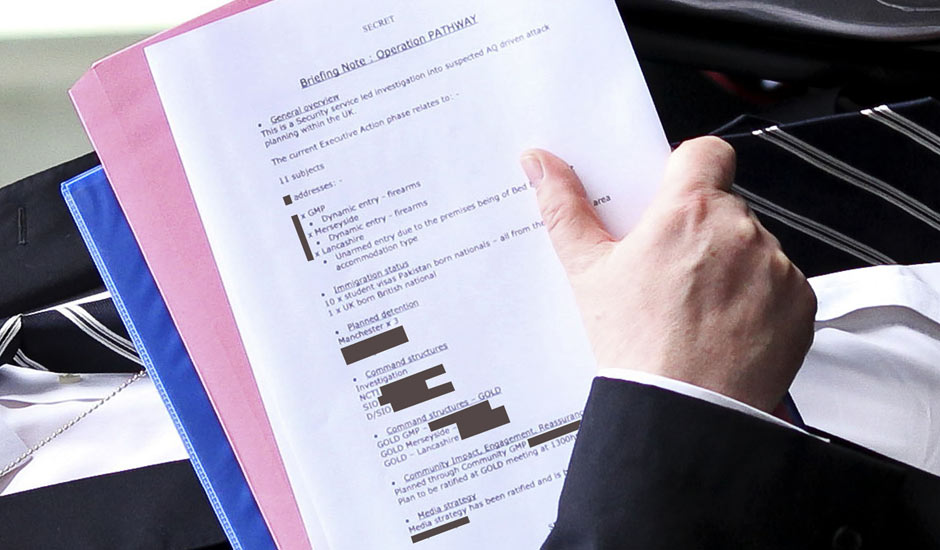
It appears that a police officer has inadvertently disclosed operational notes regarding arrangements for the arrest of Julian Assange. This is not the first time a blunder like this has happened, and it should serve as a reminder that physical data needs to handled just as securely as electronic data.

In 2009 Britain’s then most senior counter-terrorism officer, Bob Quick, arrived at Downing Street for an important meeting. He’d probably been reading up on the issues during the journey there, and was clutching a file as he emerged from his car. Unfortunately for him, photographers were able to capture the contents of the document he was holding face up. Marked “Secret” (the second highest category in the government protective marking Security Policy Framework) it contained information some of which still cannot be disclosed because a DA-Notice applies. It led to anti-terror raids being brought forward, and it also led to his resignation.

Now we learn that a rather less senior police officer has been photographed in similar circumstances, outside the Ecuadorian Embassy wherein lies the persecuted activist/suspected rapist (delete according to your leanings) Julian Assange. Apparently the information relates to possible arrest plans.

Now, when I have to carry papers from one building to another at work, I make damn sure that they’re secured in an opaque binder, and as far as I know the eyes of the world’s press are not on me when I’m doing so. Information security and data protection are not just about taking care with electronic data: I recently did a quick analysis of the monetary penalty notices handed down by the Information Commissioner, and found that around two-thirds arose from a breach of security involving physical data*.

Modern photographic developments mean that millions of people have the ability quickly to capture compromising or damaging information, and internet publishing means that the same information can be uploaded and circulated within seconds. The European Association for Visual Data Security (yep, there is one) recently produced a white paper on the subject. In its article about the white paper The Register gave some examples of shoulder-surfing, in addition to Bob Quick’s infamous incident

a senior UK civil servant at the department of Business, Innovation and Skills fell asleep on a commuter train, leaving highly sensitive information displayed on his screen. A fellow passenger took two photographs of the information while it was displayed on the screen, which made their way into a Daily Mail story about the breach…[and] in August 2011 the UK’s International Development Secretary was photographed leaving Number 10 Downing Street with sensitive government papers relating to Afghanistan on display. These papers were caught on camera by news photographers and film crews.

Any organisation which needs to handle data outside its own office walls should make very sure it can’t be seen by prying eyes.


*It’s difficult accurately to categorise them. For instance, a fax is both electronic and physical, and a lost hard-drive is loss of physical data, but seriousness is tied to the electronic contents of said drive.

Leave a comment

Filed under Confidentiality, Data Protection, Information Commissioner, monetary penalty notice, police, Uncategorized

NHS Trust Given £325k Penalty

In January this year I blogged about reports that the Information Commissioner (IC) had sent a notice of intent to serve a civil monetary penalty notice (CMP) of £375,000 on Brighton and Sussex University Hospitals NHS Trust. At the time I said

If this MPN is served, as intended, then the IC might be faced with headlines equating (for example) £375,000 to the amount it costs to employ a nurse, or a doctor or provide essentail but costly medical treatment. I hope (and I am sure) he has a strategy for such circumstances.

Well, it has been served, today. And though the amount has been slightly reduced – £325,000 – it is still by some way the largest CMP ever imposed by the IC. However, this case may be important for other reasons.

Firstly, it related to disposal of hardware containing sensitive personal data. As the IC’s press release says

It follows the discovery of highly sensitive personal data belonging to tens of thousands of patients and staff – including some relating to HIV and Genito Urinary Medicine (GUM) patients – on hard drives sold on an Internet auction site in October and November 2010.

The data included details of patients’ medical conditions and treatment, disability living allowance forms and children’s reports. It also included documents containing staff details including National Insurance numbers, home addresses, ward and hospital IDs, and information referring to criminal convictions and suspected offences

The IC has been running an “unscrubbed hard drives initiative” following a reported security breach in 2009 involving the sale of un-scrubbed hard drives on the internet containing personal data, and internal meeting minutes from January indicated that this initiative was nearing completion. It would not be surprising if some formal guidance on the subject was now issued.

Secondly, and more broadly, it is interesting and worrying to note the fact that a fundamental role in this data breach was played by a contractor appointed to securely destroy the hard drives. As a data processor (rather than the data controller) this contractor was not liable under the Data Protection Act 1998 (DPA) for any serious breaches: this is why the Trust takes the hit. However, the contractor in question was the Department of Health-accredited Sussex Health Informatics Service (SHIS). SHIS appears to have sub-contracted the work to “Company A” which in turn sub-contracted to a one-person “Company B”. This individual subsequently sold 232 hard drives on the internet auction site.

The contractual, and sub-contractual confusion appears to have been key: the Trust did not even know that the individual had been appointed, and did not know that he had been attending their offices, ostensibly to remove and securely destroy the drives. Data controllers need to be acutely aware of what is happening to the personal data they control, and this obligation cannot be overlooked when they feel the data, or the hardware containing it, has become obsolete.

The fact that SHIS was so involved is particularly worrying. Health Informatics Services are expected to be in the vanguard of data security in the NHS. They say

Keeping data safe and confidential is a core duty for health service providers – and a core THIS service. Our award-winning Confidentiality and IM&T Security service helps customers to fully comply with national and local standards.

Under current law the IC’s powers to take action against a data processor are limited. That may change when the European Data Protection Regulation is ultimately enacted. One would hope, however, that SHIS, and the Department of Health, are looking very closely at their own compliance and security.

UPDATE: 15:15

The Trust has now issued a statement, which to an extent attempts to deflect responsibility on to the contractor. Duncan Selbie, the Chief Executive has said

We arranged for an experienced NHS IT service provider to safely dispose of our redundant hard drives and acted swiftly to recover, without exception, those that their sub-contractor placed on eBay

The Information Commissioner has ignored our extensive representations.  It is a matter of frank surprise that we still do not know why they have imposed such an extraordinary fine despite repeated attempts to find out, including a freedom of information request which they interestingly refused on the basis that it would “prejudice the monetary penalty process”

He goes on to say

We simply cannot afford to pay a £325,000 fine and are therefore appealing to the Information Tribunal

If this transpires, it will be the second recent instance of an appeal of a CMP by an NHS body.

The Independent reports the Trust also saying

the fine would pay for the delivery of 300 babies, 50 hip operations, 30 heart bypasses and 360 chemotherapy treatments

This rather confirms what I predicted in January

the IC might be faced with headlines equating (for example) [an NHS CMP] to the amount it costs to employ a nurse, or a doctor or provide essential but costly medical treatment. I hope (and I am sure) he has a strategy for such circumstances

Perhaps this strategy will be revealed during any subsequent appeal proceedings.


2 Comments

Filed under Data Protection, Information Commissioner, monetary penalty notice

Equifax in breach of DPA and common law duties

(20.02.2013 – NB – this judgment was subsequently overturned in the Court of Appeal – please see my blog post here)

An interesting case has been heard in the High Court, before His Honour Judge Anthony Thornton QC, in which the claimant succeeded in showing breach of the Data Protection Act 1998 (DPA), as well as common law breach of a duty of care, on the part of the Credit Reference Agency Equifax. He also succeeded in showing this caused damage, because he was unable to access personal and company banking services.

Mr Smeaton, the claimant, had for complex and unusual reasons, been subject to a bankruptcy order which was made on 1 March 2001, but almost immediately stayed, on 10 March 2001, and rescinded on 22 May 2002.

Despite this, the records kept by Equifax relating to Mr Smeaton wrongly showed that between 12 March 2001 and 17 July 2006 he was subject to the bankruptcy order. In June and August 2006 Mr Smeaton had, on his own behalf and on behalf of his company, Ability Records Ltd, made applications to Nat West Bank for account and overdraft facilities. These applications were refused by Nat West, having consulted Mr Smeaton’s credit file held by Equifax.

The judge held that Equifax had never reviewed its procedures for recording and reviewing the accuracy of bankruptcy information: it relied entirely on information provided by consumers (or placed in the London Gazette by consumers) before reviewing or amending entries (and Mr Smeaton was heavily dyslexic and not aware of the existence of Equifax and other credit reference agencies, nor their procedures). Although Equifax had argued that it was “wholly impracticable to undertake the checks that would be necessary if it was to itself ascertain when a bankruptcy order was discharged or otherwise brought to an end or stayed”, it had failed to distinguish between the (very large) number of bankruptcies that were eventually discharged, and (the relatively tiny number of) those which were subject to annulment, rescission or stay:

Equifax should have considered whether it was possible to find a quick, reliable and cheap way of being informed of annulment, rescission and stay orders which did not rely exclusively on consumers drawing such orders to its attention

Equifax (as data controller) were in breach of the fourth data protection principle in part 1 of Schedule 1 of the DPA, which states that

Personal data shall be accurate and, where necessary, kept up to date

Although there is a proviso (at part II of Schedule 1) which says that a contravention of the fourth principle will not take place if the data controller has taken reasonable steps to ensure the accuracy of the data, Equifax’s failure to have considered a way of being informed of annulment, rescission or stay meant that they could not rely on this.

The judge held also that because of the liability imposed on Equifax by the DPA, it also assumed a duty to act with reasonable skill and care at common law, and it had acted in breach of that duty.

Finally, the judge held that it was

inescapable that the [bank] applications were refused on the sole ground of Mr Smeaton’s bankruptcy entry on his credit file

and that therefore his failure to obtain funding was

as a direct result of Equifax’s breach of the data protection principles and, in particular, as a direct result of its retaining on Mr Smeaton’s credit file details of his undischarged bankruptcy order between 12 March 2001 and 17 July 2006

Mr Smeaton claims that the result of this was that

His life descended into a tragic mixture of homelessness, living in a car on the streets, mental breakdown, impecuniosity and a consequent inability to progress his business affairs as a direct result of the enormous shock on discovering that he had had an adverse credit record for the last five years and that the bank on which he had pinned so much hope in providing Ability with the necessary step up to obtain the SFLGS, itself an essential feature of its business plan, prevented him from taking anything other than relatively modest steps to further that plan for many months

However, the trial on causation and damages will be heard separately at a later date. This is a claim based on section 13 of the DPA, which provides that

An individual who suffers damage [and distress if it arises from that damage] by reason of any contravention by a data controller of any of the requirements of this Act is entitled to compensation from the data controller for that damage

It is worth noting that since 2008 an electronic version of the Individual Insolvency Register has been provided to Equifax under s subscription arrangement between them and the Insolvency Service. As the judge said

Due to advances in the electronic processing of credit data and to legislative changes in the insolvency legislation concerning personal bankruptcies, it is very unlikely that the highly unusual facts of this case will ever re-occur in the future

However, it is not particularly common for a section 13 claim under DPA to succeed, especially given the difficulty of proving damage (see Johnson v Medical Defence Union [2007] EWCA Civ 262 for an example of the difficulty in making a successful claim) so this a case data protection practitioners should continue to keep an eye on.

1 Comment

Filed under Data Protection

Will NHS appeal ICO fine? Let’s hope so.

The Information Commissioner (ICO) today announced that it had imposed a monetary penalty notice (MPN), under section 55A of the Data Protection Act 1998 (DPA), against Central London Community Healthcare NHS Trust. The penalty was in the sum of £90,000, and was imposed after

patient lists from the Pembridge Palliative Care Unit, intended forSt John’sHospice, were faxed to the wrong recipient. The individual informed the Trust in June that they had been receiving the patient lists – around 45 faxes over a three month period – but had shredded them.

 The patient lists contained sensitive personal data relating to 59 individuals, including medical diagnoses and information relating to their domestic situations and resuscitation instructions”

 All very interesting, particularly because this was only the second MPN imposed on an NHS body, after one last month against the Aneurin Bevan Health Board.

 What was even more interesting, however, was to read on the publicservice.co.uk website that CLCH Trust are saying they will appeal the MPN. This would be the first such appeal, and would be very important in terms of getting some judicial opinion on the law and the ICO’s application of it.

 Section 55A of the DPA gives the ICO the power to impose an MPN, while section 55B provides that a person on whom the notice is served may appeal to the First Tier Tribunal (Information Rights) against both the issue of the notice and the amount.

 Regulations and an Order (the snappily-titled The Data Protection (Monetary Penalties) (Maximum Penalty and Notices) Regulations 2010 and The Data Protection (Monetary Penalties) Order 2010) make further provision for both the imposing of and appeal against an MPN. Additionally, under section 55C the ICO must issue guidance on “the circumstances in which he would consider it appropriate to issue a monetary penalty notice, and how he will determine the amount of the penalty”.

On appeal the Tribunal can consider both whether the MPN was in accordance with the law and whether, to the extent that it involved an exercise of discretion by the ICO, he ought to have exercised that discretion differently. The statutory section 55C guidance, and whether the ICO has adhered to it, will clearly be important, but so will, I would suggest, any evidence as to consistency of approach. An appellant would do well to submit evidence of examples where similar or worse apparent breaches of the Act have not resulted in an MPN. As Stewart Room wrote some months ago

 what is ICO’s plan? By this I mean, how does ICO arrive at its figures and how are they justified?

We’re probably not going to get to the bottom of this until someone takes a case on to appeal, but as we are nearly two years into the fining regime I think we’ve arrived at the point when we can legitimately expect ICO to explain where it is heading with the fine and what has driven it’s decisions so far.”

Perhaps we have indeed now arrived at that point.

EDIT, 7 August 2012:

The Trust are indeed appealing the MPN, and the Information Tribunal has listed it for a three-day-hearing in December. This will be a major case.

Leave a comment

Filed under Breach Notification, Data Protection, Information Commissioner