Category Archives: data security

MoD: “too costly” to find out if there have been further spreadsheet data breaches

Response to FOI request says it would take 237 hours to find out. How can ICO have confidence lessons have been learnt?

Anyone who’s ever had been responsible for compiling or overseeing a data breach log will know that one of the commonest incidents is the inadvertent disclosure of personal data. And since the time spreadsheets could first be sent via, or uploaded to, the internet people have mistakenly left personal data in them which should have been removed or otherwise masked. It’s not a new phenomenon: as long ago as 2013 I wrote for the Guardian about the risks, and what I perceived then as a lack of urgency by the Information Commissioner’s Office in addressing, and educating about, those risks.

So it might be found surprising that, two years after the most catastrophic data breach in UK history, in which the information of thousands of Afghan citizens was mistakenly disclosed, putting many lives directly at risk, the Ministry of Defence appears to have no process for identifying when or whether there have been recurrences of the issue.

Section 12 of the Freedom of Information Act 2000 permits a government department not to comply with a request where locating and retrieving any information held would take more than 24 hours. It’s not uncommon for it to be invoked where requests are formulated in too general a manner.

But when I made a request to the MoD for

the number of personal data breaches recorded between April 2023 to date which involved: a) disclosure of personal data to the wrong recipient; b) inadvertent disclosure of personal data contained in a spreadsheet

I imagined that this would be relatively easily located and extracted. Most data breach logs I’ve seen would be categorised in such a way as to enable this. However, the MoD instead informed me that it would take over 237 hours to do so.

Helpfully, the MoD said that if I restricted my request just to the first part (“disclosure of personal data to the wrong recipient”) they might be able to comply. But what this appears to indicate is that no, or no clear, record is being taken of whether there have been repeats of the spreadsheet error involving Afghan citizens.

The Information Commissioner’s Office (ICO) has come under some criticism – including from the leading academics, the Science, Innovation and Technology Committee, and me – for failing even to conduct a formal investigation into the Afghan spreadsheet data breach. Justifying that decision, the Commissioner himself said that

MoD has briefed us on the measures it has adopted since the breach, which seek to mitigate risk of such an incident occurring in future

But if the MoD cannot say (without it taking more than 237 hours) whether there have been further such incidents, how can they reassure themselves that the risk has been indicated?

And perhaps more pertinently, how can the ICO be satisfied of this?

The views in this post (and indeed most posts on blog) are my personal ones, and do not represent the views of any organisation I am involved with.

4 Comments

Filed under Data Protection, data security, Freedom of Information, Information Commissioner, Ministry of Defence, personal data breach

Is the legal sector really suffering a flood of databreaches?

[reposted from my LinkedIn account]

There have been various articles in the media recently, reporting a significant rise in personal data breaches reported by the legal sector to the Information Commissioner’s Office. I have some real doubts about the figures.

An example article says

A new analysis of data from the Information Commissioner’s Office (ICO) by NetDocuments has revealed a sharp increase in data breaches across the UK legal sector. In the period between Q3 2023 and Q2 2024, the number of identified data breaches in the UK legal sector rose by 39% (2,284 cases were reported to the ICO, compared to 1,633 the previous year)

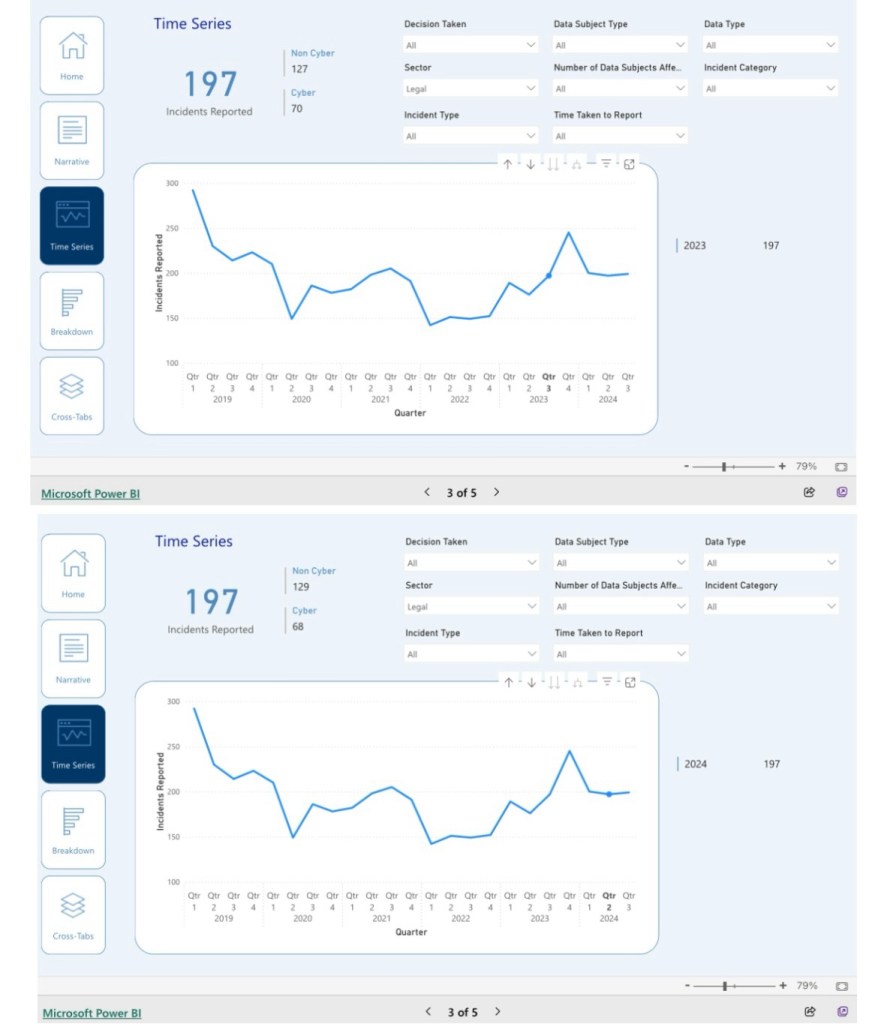
But something didn’t seem right about those numbers. The ICO say that they have received 60,607 personal data breach reports since their current reporting methods began in Q2 2019 (see their business intelligence visualised database), so it seemed remarkable to suggest that the legal sector was scoring so highly. And, indeed, when I look at the ICO BI data for self-reported personal data breaches, filtered for the legal sector, I see only 197 reported in Q3 2023, and, coincidentally, 197 in Q2 2024 (see attached visuals) – an increase from one relatively low number to another relatively low number of precisely 0%.

A serious question to those more proficient with data than I am – am I missing something?

If I’m not, I really think the ICO should issue some sort of corrective statement.

The views in this post (and indeed most posts on this blog) are my personal ones, and do not represent the views of any organisation I am involved with.

Leave a comment

Filed under Data Protection, data security, Information Commissioner, personal data breach

The demise of portmanteau data breach claims

Many defendants in data protection proceedings will have experienced claims which also plead a misuse of private information (MPI). Often, on the face of things, the latter appears to add nothing to the data protection claim, but there can be procedural and costs/other financial implications. Importantly, where claimants have secured after-the-event (ATE) insurance, premiums can be recovered from losing defendants (as there is an exception for certain claims, including MPI ones, to the general rule introduced by the Legal Aid, Sentencing and Punishment of Offenders Act 2012, by which ATE premiums became generally irrecoverable between parties). This can be perceived as a factor which might impel defendants to settle otherwise weak claims.

The practice of bundling data protection and MPI claims (sometimes with a bonus breach of confidence claim) in “data breach” proceedings was struck a blow in 2021, when Mr Justice Saini, in Warren v DSG, held that, as both MPI and breach of confidence require there to have been a “use”, a “positive action”, they do not impose a data security obligation on a defendant, or create liability where the defendant was, instead, alleged to have failed to do something.

This inevitably led to a drop in claims pleading MPI (and breach of confidence) in data security cases, but not a complete stop: after all – I imagine some claimant lawyers thought, a claim can still be pleaded as a MPI claim – even if it might not look like one (following Warren v DSG).

However, in a costs judgment from September last year, but only recently published, Deputy Costs Judge Roy held that a “spurious” (as opposed to a “genuine”) MPI claim (in Saini J’s characterisation “an unconvincing attempt to shoehorn the facts of the data breach into the tort of MPI”) can’t avail itself of the ATE premium irrecoverability exception. (The claim was against Equiniti, but seems to be separate to the recent attempted group litigation against the same defendant.)

I suspect the story is not entirely over. Claimants will quite possibly say “yes, spurious MPI claims can’t be shoehorned into data protection claims, but this one – Judge – is not spurious on the facts”. Nonetheless, the days of portmanteau data breach claims seem to disappearing into the past.

The views in this post (and indeed most posts on this blog) are my personal ones, and do not represent the views of any organisation I am involved with.

Leave a comment

Filed under Data Protection, data security, judgments, litigation

SNP MP private email hack

UPDATE 13.02.23: it’s been drawn to my attention that Mr McDonald says that his private account is “not used for constituency or parliamentary business” END UPDATE

It was reported last week that the email account of Stewart McDonald, an SNP MP, had been compromised in what he described as a “sophisticated and targeted spear phishing hack”. The BBC appeared to agree with him, describing it as a “highly targeted and sophisticated attack”.

Maybe it was, although surely MPs are told to be wary of unexpected email attachments, and not to put enter system passwords when asked to in palpably suspicious circumstances (McDonald had attempted to open a document apparently sent by a member of his staff, with a military update on Ukraine, and clicking on it brought up a login page for the email account he was using).

But what I haven’t seen raised much in the media is the fact that the account which was compromised appears to have been McDonald’s private email account, and that the offending attachment was sent (or was spoofed to make it look like it was sent) from his staffer’s private email account. The reporting has referred to “personal” email account, from which it is reasonable to infer that these are not official accounts (such as McDonald’s one given on his parliamentary page).

Only last year the Information Commissioner presented a report to Parliament on the use of private communications channels in government. Although the report was prompted by concerns about the use of such private channels within the Department for Health and Social Care, it made clear that it had general application in relation to the “adopting [of] new ways of working without sufficient consideration of the risks and issues they may present for information management”. The report stresses throughout the importance of “maintaining the security of personal and official information” and the risks that private channels present to such security.

Did Mr McDonald and his staff read it? If not, this tweet he made only a couple of years ago is ironic, to say the least.

The views in this post (and indeed most posts on this blog) are my personal ones, and do not represent the views of any organisation I am involved with.

Leave a comment

Filed under data security, Information Commissioner, national security, parliament, security

One third of personal data breaches reported “late” to ICO

By me, on the Mishcon de Reya website.

…a recent request to the ICO under the Freedom of Information Act 2000 (FOIA) has revealed that, from the available data, of the 21705 personal data breaches notified to the ICO since May 2018, 14,365 were notified within 72 hours, and 7340 were not – meaning that approximately one third of personal data breaches are reported later than within 72 hours

Leave a comment

Filed under Breach Notification, Data Protection, data security, GDPR, Information Commissioner

P@55w0rdz

A guest post by Danny Budzak.

Danny is the Senior Information Manager at the London Legacy Development Corporation and is involved in data protection and information security. He regularly delivers training and learns as much, if  not more, than he might teach. He has also worked with Silver Surfers, helping older people to get online. What he has learned makes him amazed and concerned in equal measure at the whole issue of ‘password management’.

In days gone by, confessions could be described as the aural equivalent of click-bait. Everyone wants to listen. I will start with mine. On a recent holiday, I found that space where work and the office and projects and PowerPoint presentations seemed far away. And at that point I realised I had forgotten my network password. I was convinced such a thing could never happen. I used it at least ten times a day to log on, unlock the screen, to log on, to unlock the screen. During lock-down I was probably using it more than in the office. But it had gone. Where that password should have been in my brain was nothing but a blank space. Being in the office would have mitigated the problem. It can be reset remotely. But it doesn’t work like that for many people when working remotely.

I do a lot of information security training and password training is a key part of this. I was used to watching people counting on their fingers how many characters their password had (usually eight), or counting on one hand the number of “different” passwords they use. Some could this with one finger. One password to rule them all.

Then I introduced a new exercise by asking people how many online accounts they had. Some said “about twenty…or maybe thirty”, others admitted, “I don’t have a clue”, two people with password managers knew exactly; 189, 233. Research shows that most people think they have around 20 – 30 online accounts, but they are more likely to have 120 – 130 accounts. Sit down and make a list. And that will just be the ones you can remember. What about that website where you bought tickets for an event ten years ago? It’s still there, even if you have forgotten. Just remember, the internet has a much better and far more comprehensive memory than you do.

And then the story goes like this. So if you have 120 – 130 accounts, how do you manage the passwords? “One key password with variations”, “the browser remembers them”, “I just re-set them each time”, “a small number which I swop and vary”. Why not write them down with invisible ink on a sheet of A4 and store the paper in the third book of the fourth shelf in the kitchen?

After a couple of  years I was puzzled why no-one ever asked me how I managed passwords. So I started telling them.

For my most important accounts – bank, email, social media, consumer sites – I write them down. In a book. These are long passwords – 25-30 characters long. But I write them down in such a way as they don’t look like passwords. Paradoxically, if you have a password of 1*EKLP&!!mm…!()??.< and write it down, it’s obvious it’s a password. But if you do have a password like that, you will never remember it.

For what I consider low-risk work applications (appraisal system, annual leave, bike shed booking) all the passwords are in a spreadsheet, that’s in a part of the network drive that only I can access, that is among 10,000 other files. That spreadsheet has a password on it. What could possibly go wrong?

And then the passwords for my social life – art galleries, books, music, exploring. These generally require accounts because it helps them sell to advertisers and they can do more fancy analysis of what you look at. Somewhere in the universe a database exists which shows I like the art of the Northern Renaissance, German electronic music and Italian food. It’s all a bit creepy that companies want to know this but I don’t care two hoots where that “web page usage” data goes and what Facebook or anyone else does with it. Good luck with anyone who manages to sell me anything based on that. An original Jan Van Eyck perhaps? But where there is a problem is if you use the same password for everything; because you are then at the mercy of the weakest system in which you have data. Does it matter if your password is the same for an obscure fan site of CAN as your social media account? Well yes, actually it does.

But there are already three systems here. Four if you include “saving passwords in the browser”. Five, if I have to accept that I get in a muddle with passwords sometimes and need to re-set them, or log in from a different machine. And yet the password is the key security element which we all hold and control.

I still had a vague sense that I was doing something wrong so I thought it might be worth asking my peers. I sent a very short questionnaire to two online communities which I thought might be interested. The Data Protection forum and Records Management forum on JISCmail. Nothing could have prepared me for what happened next.

This is not a scientific study, it was almost a bit of light-hearted fun. Some of the responses certainly made me laugh out loud, but for all the wrong reasons. There are no percentages or totals here, but I got the feeling that the 50 or so people who responded were a fairly representative sample. The responses very much reflected the sort of responses I have been getting in training for the past five years. “I have one password and no one will ever guess it.” Actually, it doesn’t really work like that. “I use 3 instead of E”. Wow! Don’t tell the hackers they would never think of such things. “All my passwords are in French.” That’s great. No hacking problems in France. “I use the same one but change the number at the end.” “I have a few which I interchange.” One person’s reply was so baroque that one felt like asking if they had taken part in the Napoleonic wars where cyphers and skull-duggery became ever more elaborate: “I use the names of the first team squad of  my favourite football team but I remove all the letters a and e”. This is fantastic, but it only provides 25 passwords. What about the 100 others?

Other responses made me gasp and some were so shocking that if I revealed the methods it would only help the bad people. I suspect the people who use Password1, TopCat2, OpenSesame and others kept their guilty heads down. So the problem is almost certainly worse than the responses received.

The other thing I noticed was that very few people displayed much confidence in their “methods” (although in many instances that is stretching the meaning of the word). The small minority who did display a certainty about what they did were those who were convinced that one password is enough, and those who use a password manager. And that got me thinking.

At a recent training session I started to go through password management. The different types of passwords for different types of systems; using reminders such as salsa sauce recipes (1 handful of basil, 2 tbsp lemon juice, a lot of parsley – they are actually good passwords); writing them down but also having a couple of characters which only you know; using the third page of a book. And half way through I stopped.

“This is madness”, I said, “get a password manager”.

I don’t know if they are the best way to do it, but it has got to be better than the Heath Robinson approach which so many people have.

As well as managing passwords, it will also help you understand how many accounts you have online. And if you don’t know that – which most people don’t – then how can you be in control of your own personal data?

Leave a comment

Filed under Data Protection, data security

Schrems II – what now?

A piece I have written with my Mishcon colleague Adam Rose, looking at the issues for businesses involved in international transfers (esp. to the US).

Make no mistake – the effect of Schrems II is to make bulk/regular transfers of personal data to the US problematic (putting it at its lowest). It arguably has the same effect in respect of transfers to most, if not all, third countries.

Leave a comment

Filed under adequacy, Data Protection, data security, Europe, facebook, GDPR, Information Commissioner, national security, privacy shield

A royal letter before claim

Media reports suggest a USB stick from Heathrow Airport containing security information, including details of measures used to protect the Queen has been found on a street


Letter before small claims court claim

Mrs E Windsor
Buckingham Palace
London
SW1A 1AA

The Chap in Charge of Security
Heathrow Airport
The Compass Centre,
Nelson Road,
Middlesex,
TW6 2GW

Dear Subject*

Reference: cock-up with one’s personal data

As it has not been possible to resolve this matter amicably, and it is apparent that court action may be necessary, We write in compliance with the Practice Direction on Pre-Action Conduct (we considered treason charges, but One wishes to be tolerant).

We are informed that Heathrow Airport says it has launched an internal investigation after a USB stick containing security information was reportedly found on the street. The beastly communist Sunday Mirror reported that the USB stick had 76 folders with maps, videos and documents, including details of measures used to protect Us. A subject found it in west London and handed it into the paper.

From you We are claiming fifty guineas for distress.

We have calculated this sum on the basis that section 13(1) of our Data Protection Act 1998 (DPA) provides that one can grab a bit of extra money for the races by showing that one has suffered damage cos of a cock-up with one’s personal data. When We agreed the old DPA by and with the advice and consent of the Lords Spiritual and Temporal, and Commons, in the then Parliament assembled, and by the authority of the same, We thought one couldn’t grab said moolah merely if one was a bit peeved, but thought one had to have suffered tangible harm first. However, some of Our ghastly judges [who the bleeding hell do they work for?] decided a while ago, on the basis of a law passed by one’s distant relations that they would simply disapply Our section 13(2) [arses]. Given that, We might as well chuck Our Crown into the ring.

Listed below are the documents on which We intend to rely in Our claim against you:

Beastly seditious rag
Jolly old skit from the chaps at 11 Kings [WHAT?] Bench Walk
Treason Act 1351 (no harm in a quick reminder eh?)

We can confirm that We would be agreeable to mediation and would consider any other system of Alternative Dispute Resolution (ADR) in order to avoid the need for this matter to be resolved by Our (n.b. “Our”) courts.

We would invite you to put forward any proposals in this regard.

In closing, We would draw your attention to paragraphs 15 and 16 of the Practice Direction which [should give Our courts the power to imprison grotty oiks] gives courts powers to impose sanctions on the parties if they fail to comply with the direction including failing to respond to this letter before claim.

We look forward to hearing from you within the next 28 days.

Should We not receive a response to my letter within this time frame then We anticipate that court action will be commenced with no further reference to you [where’s Albert Pierrepoint when you need him?]

Yours faithfully,

E.

*Not “data subject”, naturally. We are the data subject.


The views in this post (and indeed all posts on this blog) are my personal ones, and do not represent the views of any organisation I am involved with.

1 Comment

Filed under 7th principle, damages, Data Protection, data security, not-entirely-serious

This old world will never change

Complacency about data protection in the NHS won’t change unless ICO takes firm action

Back in September 2016 I spoke to Vice’s Motherboard, about reports that various NHS bodies were still running Windows XP, and I said

If hospitals are knowingly using insecure XP machines and devices to hold and otherwise process patient data they may well be in serious contravention of their [data protection] obligations

Subsequently, in May this year, the Wannacry exploit indicated that those bodies were indeed vulnerable, with multiple NHS Trusts and GP practices subject to ransomware demands and major system disruption.

That this had enormous impact on patients is evidenced by a new report on the incident from the National Audit Office (NAO), which shows that

6,912 appointments had been cancelled, and [it is] estimated [that] over 19,000 appointments would have been cancelled in total. Neither the Department nor NHS England know how many GP appointments were cancelled, or how many ambulances and patients were diverted from the five accident and emergency departments that were unable to treat some patients

The NAO investigation found that the Department of Health and the Cabinet Office had written to Trusts

saying it was essential they had “robust plans” to migrate away from old software, such as Windows XP, by April 2015. [And in] March and April 2017, NHS Digital had issued critical alerts warning organisations to patch their systems to prevent WannaCry

Although the NAO report is critical of the government departments themselves for failure to do more, it does correctly note that individual healthcare organisations are themselves responsible for the protection of patient information. This is, of course, correct: under the Data Protection Act 1998 (DPA) each organisation is a data controller, and responsible for, among other things, for ensuring that appropriate technical and organisational measures are taken against unauthorised or unlawful processing of personal data.

Yet, despite these failings, and despite the clear evidence of huge disruption for patients and the unavoidable implication that delays in treatment across all NHS services occurred, the report was greeted by the following statement by Keith McNeil, Chief Clinical Information Officer for NHS England

As the NAO report makes clear, no harm was caused to patients and there were no incidents of patient data being compromised or stolen

In fairness to McNeil, he is citing the report itself, which says that “NHS organisations did not report any cases of harm to patients or of data being compromised or stolen” (although that is not quite the same thing). But the report continues

If the WannaCry ransomware attack had led to any patient harm or loss of data then NHS England told us that it would expect trusts to report cases through existing reporting channels, such as reporting data loss direct to the Information Commissioner’s Office (ICO) in line with existing policy and guidance on information governance

So it appears that the evidence for no harm arising is because there were no reports of “data loss” to the ICO. This emphasis on “data loss” is frustrating, firstly because personal data does not have to be lost for harm to arise, and it is difficult to understand how delays and emergency diversions would not have led to some harm, but secondly because it is legally mistaken: the DPA makes clear that data security should prevent all sorts of unauthorised processing, and removal/restriction of access is clearly covered by the definition of “processing”.

It is also illustrative of a level of complacency which is deleterious to patient health and safety, and a possible indicator of how the Wannacry incidents happened in the first place. Just because data could not be accessed as a result the malware does not mean that this was not a very serious situation.

It’s not clear whether the ICO will be investigating further, or taking action as a result of the NAO report (their response to my tweeted question – “We will be considering the contents of the report in more detail. We continue to liaise with the health sector on this issue” was particularly unenlightening). I know countless dedicated, highly skilled professionals working in the fields of data protection and information governance in the NHS, they’ve often told me their frustrations with senior staff complacency. Unless the ICO does take action (and this doesn’t necessarily have to be by way of fines) these professionals, but also – more importantly – patients, will continue to be let down, and in the case of the latter, put at the risk of harm.

The views in this post (and indeed all posts on this blog) are my personal ones, and do not represent the views of any organisation I am involved with.

Leave a comment

Filed under 7th principle, Data Protection, data security, enforcement, Information Commissioner, NHS

Carphone Warehouse and the DPA risks

According to my less-than-reliable memory, I once purchased a mobile phone from Carphone Warehouse about twelve years ago. I seem to also remember buying a phone from a company with a name like mobiles.co.uk around the same time (we’re they even going then?). Since then, my telephone number, postal address and email address have all changed, but my main banking details have not. So when the news emerged in recent days that Carphone Warehouse and various subsidiaries and partners had been affected by a data security breach involving the data of 2.4m customers I was understandably concerned. I have asked Carphone Warehouse several times how far back they held data which has been compromised, and explained that my contact details will have changed from any they might hold, but I have just been referred to generic information on their website which says that affected customers will be sent an email or text message (which is clearly useless to me).

I think Carphone Warehouse need urgently to clarify how far back they were retaining customer data that was compromised in this incident: I will be extremely unhappy if my c.12 year old data was in fact involved, because as far as I can see there would have been no reason to retain it that long. The fifth principle in Schedule One of the Data Protection Act 1998 (DPA) states that personal data should not be kept for longer than is necessary to fulfil the original purpose for which it was gathered – I doubt that retaining for twelve-odd years would comply with Carphone Warehouse’s obligations under the DPA.

But on a more general, less personal, note, what might this incident mean in DPA terms for Carphone Warehouse and its customers? I note that the generic information referred to above states that the cause was “a sophisticated cyber-attack” and that such attacks are “part of the reality of the modern world”. This is true, but not all organisations suffer such a serious breach of their systems that more than two million people are affected. Carphone Warehouse, as a data controller with obligations to process customer data in accordance with their obligations under the DPA will have to satisfy the Information Commissioner’s Office (which is investigating) and its customers that it complied with the seventh data protection principle, and had appropriate technical and organisational measures in place to safeguard personal data. Failure to have done so would open Carphone Warehouse up to the risk of an ICO monetary penalty to a maximum of£500,000. But the reason I mentioned satisfying customers as to the appropriate measures in place is that the DPA affords individual data subjects the right to bring a compensation claim against a data controller for a contravention of the Act. Traditionally, this right only applied where the data subject had suffered quantifiable damage (in the form of monetary loss), but, since the decision of the Court of Appeal earlier this year in Google Inc v Vidal-Hall & ors. [2015] EWCA Civ 311, such claims can be made on the basis purely of the distress suffered as a result of the contravention. I’ve got to say, I’m feeling a certain level of distress just now at the thought that my data might have been compromised. If it transpires that it was, the distress will only increase. Although such distress payments are unlikely ever to be particularly large, when one then considers the emergence of group litigation of DPA claims, the financial risks to data controllers who suffer huge breaches of customer data is palpable: purely hypothetically, if Carphone Warehouse were found to have failed to comply with their DPA obligations, and half of the customers affected brought a money claim worth £100, they would be facing an exposure of more than £100 million. One wonders if the market’s continuing current confidence in the company allows for that.

Google has been granted permission to appeal Vidal-Hall to the Supreme Court, but pending that the Court of Appeal’s judgment remains good law. And, as I have predicted previously, I think there may be a number of law firms eyeing the case, and potential clients, expectantly.

The views in this post (and indeed all posts on this blog) are my personal ones, and do not represent the views of any organisation I am involved with.

Leave a comment

Filed under 7th principle, Data Protection, data security, Fifth principle, Information Commissioner