Tag Archives: data protection

Google’s Innuendo

If you search on Google for my name, Jon Baines, or the full version, Jonathan Baines, you see, at the foot of the page of search results

Some results may have been removed under data protection law in Europe. Learn more

Oh-ho! What have I been up to recently? Well, not much really, and certainly nothing that might have led to results being removed under data protection law. Nor similarly, have John Keats, Eleanor Roosevelt and Nigel Molesworth (to pick a few names at random), a search on all of whose names brings up the same message. And, of course, if you click the hyperlink marked by the words “Learn more” you find out in fact that Google has simply set its algorithms to display the message in Europe

when a user searches for most names, not just pages that have been affected by a removal.

It is a political gesture – one that reflects Google’s continuing annoyance at the 2014 decision – now forever known as “Google Spain” – of the Court of Justice of the European Union which established that Google is a data controller for the purpose of search returns containing personal data, and that it must consider requests from data subjects for removal of such personal data. A great deal has been written about this, some bad and some good (a lot of the latter contained in the repository compiled by Julia Powles and Rebekah Larsen) and I’m not going to try to add to that, but what I have noticed is that a lot of people see this “some results may have been removed” message, and become suspicious. For instance, this morning, I noticed someone tweeting to the effect that the message had come up on a search for “Chuka Umunna”, and their supposition was that this must relate to something which would explain Mr Umunna’s decision to withdraw from the contest for leadership of the Labour Party. A search on Twitter for “some results may have” returns a seething mass of suspicion and speculation.

Google is conducting an unnecessary exercise in innuendo. It could easily rephrase the message (“With any search term there is a possibility that some results may have been removed…”) but chooses not to do so, no doubt because it wants to undermine the effect of the CJEU’s ruling. It’s shoddy, and it drags wholly innocent people into its disagreement.

Furthermore, there is an argument that the exercise could be defamatory. I am not a lawyer, let alone a defamation lawyer, so I will leave it to others to consider that argument. However, I do know a bit about data protection, and it strikes me that, following Google Spain, Google is acting as a data controller when it processes a search on my name, and displays a list of results with the offending “some results may have been removed” message. As a data controller it has obligations, under European law (and UK law), to process my personal data “fairly and lawfully”. It is manifestly unfair, as well as wrong, to insinuate that information relating to me might have been removed under data protection law. Accordingly, I’ve written to Google, asking the message to be removed

Google UK Ltd
Belgrave House
76 Buckingham Palace Road
London SW1W 9TQ

16 May 2015

Dear Google

Complaint under Data Protection Act 1998

When a search is made on Google for my name “Jonathan Baines”, and, alternatively, “Jon Baines”, a series of results are returned, but at the foot of the page a message (“the message”) is displayed:

Some results may have been removed under data protection law in Europe. Learn more

To the best of my knowledge, no results have in fact been removed.

The first principle in Schedule One of the Data Protection Act 1998 (DPA) requires a data controller to process personal data fairly and lawfully. In the circumstances I describe, “Jonathan Baines”, “Jon Baines” and the message constitute my personal data, of which you are clearly data controller.

It is unfair to suggest that some results may have been removed under data protection law. This is because the message carries an innuendo that what may have been removed was content that was embarrassing, or that I did not wish to be returned by a Google search. This is not the case. I do not consider that the hyperlink “Learn more” nullifies the innuendo: for instance, a search on Twitter for the phrase “some results may have been removed” provides multiple examples of people assuming the message carries an innuendo meaning.

Accordingly, please remove the message from any page containing the results of a search on my name Jonathan Baines, or Jon Baines, and please confirm to me that you have done so. You are welcome to email me to this effect at [REDACTED]

With best wishes,
Jon Baines


The views in this post (and indeed all posts on this blog) are my personal ones, and do not represent the views of any organisation I am involved with. Some words may have been removed under data protection law.
7 Comments

Filed under Data Protection, Europe

Vidal-Hall v Google, and the rise of data protection ambulance-chasing

Everyone knows the concept of ambulance chasers – personal injury lawyers who seek out victims of accidents or negligence to help/persuade the latter to make compensation claims. With today’s judgment in the Court of Appeal in the case of Vidal-Hall & Ors v Google [2015] EWCA Civ 311 one wonders if we will start to see data protection ambulance chasers, arriving at the scene of serious “data breaches” with their business cards.

This is because the Court has made a definitive ruling on the issue, discussed several times previously on this blog, of whether compensation can be claimed under the Data Protection Act 1998 (DPA) in circumstances where a data subject has suffered distress but no tangible, pecuniary damage. Section 13 of the DPA provides that

(1)An individual who suffers damage by reason of any contravention by a data controller of any of the requirements of this Act is entitled to compensation from the data controller for that damage.

(2)An individual who suffers distress by reason of any contravention by a data controller of any of the requirements of this Act is entitled to compensation from the data controller for that distress if—

(a)the individual also suffers damage by reason of the contravention

This differs from the wording of the European Data Protection Directive 95/46/ec, which, at Article 23(1) says

Member States shall provide that any person who has suffered damage as a result of an unlawful processing operation or of any act incompatible with the national provisions adopted pursuant to this Directive is entitled to receive compensation from the controller for the damage suffered

It can be seen that, in the domestic statutory scheme “distress” is distinct from “damage”, but in the Directive, there is just a single category of “damage”. The position until relatively recently, following Johnson v Medical Defence Union [2007] EWCA Civ 262, had been that it meant pecuniary damage, and this in turn meant, as Buxton LJ said in that case, that “section 13 distress damages are only available if damage in the sense of pecuniary loss has been suffered”. So, absent pecuniary damage, no compensation for distress was available (except in certain specific circumstances involving processing of personal data for journalistic, literary or artistic purposes). But, this, said Lord Dyson and Lady Justice Sharp, in a joint judgment, was wrong, and, in any case, they were not bound by Johnson because the relevant remarks in that case were in fact obiter.  In fact, they said, section 13(2) DPA was incompatible with Article 23 of the Directive:

What is required in order to make section 13(2) compatible with EU law is the disapplication of section 13(2), no more and no less. The consequence of this would be that compensation would be recoverable under section 13(1) for any damage suffered as a result of a contravention by a data controller of any of the requirements of the DPA

As Christopher Knight says, in a characteristically fine and exuberant piece on the Panopticon blog, “And thus, section 13(2) was no more”.

And this means a few things. It certainly means that it will be much easier for an aggrieved data subject to bring a claim for compensation against a data controller which has contravened its obligations under the DPA in circumstances where there is little, or no, tangible or pecuniary damage, but only distress. It also means that we may well start to see the rise of data protection ambulance chasers – the DPA may not give rise to massive settlements, but it is a relatively easy claim to make – a contravention is often effectively a matter of fact, or is found to be such by the Information Commissioner, or is conceded/admitted by the data controller – and there is the prospect of group litigation (in 2013 Islington Council settled claims brought jointly by fourteen claimants following disclosure of their personal data to unauthorised third parties – the settlement totalled £43,000).

I mentioned in that last paragraph that data controller sometimes concede or admit to contraventions of their obligations under the DPA. Indeed, they are expected to by the Information Commissioner, and the draft European General Data Protection Regulation proposes to make it mandatory to do so, and to inform data subjects. And this is where I wonder if we might see another effect of the Vidal-Hall case – if data controller know that by owning up to contraventions they may be exposing themselves to multiple legal claims for distress compensation, they (or their shareholders, or insurers) may start to question why they should do this. Breach notification may be seen as even more of a risky exercise than it is now.

There are other interesting aspects to the Vidal-Hall case – misuse of private information is, indeed, a tort, allowing service of the claims against Google outside jurisdiction, and there are profound issues regarding the definition of personal data which are undecided and, if they go to trial, will be extremely important – but the disapplying of section 13(2) DPA looks likely to have profound effects for data controllers, for data subjects, for lawyers and for the landscape of data protection litigation in this country.

The views in this post (and indeed all posts on this blog) are my personal ones, and do not represent the views of any organisation I am involved with.

17 Comments

Filed under Breach Notification, damages, Data Protection, Directive 95/46/EC, GDPR, Information Commissioner

A data protection justice gap?

On the 4th March the Supreme Court handed down judgment in the conjoined cases of Catt and T v Commissioner of Police of the Metropolis ([2015] UKSC 9). Almost unanimously (there was one dissenting opinion in Catt) the appeals by the Met were allowed. In brief, the judgments held that the retention of historical criminal conviction data was proportionate. But what I thought was particularly interesting was the suggestion (at paragraph 45) by Lord Sumption (described to me recently as “by far the cleverest man in England”) that T‘s claim at least had been unnecessary:

[this] was a straightforward dispute about retention which could have been more appropriately resolved by applying to the Information Commissioner. As it is, the parties have gone through three levels of judicial decision, at a cost out of all proportion to the questions at stake

and as this blog post suggests, there was certainly a hint that costs might flow in future towards those who choose to litigate rather than apply to the Information Commissioner’s Office (ICO).

But I think there’s a potential justice gap here. Last year the ICO consulted on changing how it handled concerns from data subjects about handling of their personal data. During the consultation period Dr David Erdos wrote a guest post for this blog, arguing that

The ICO’s suggested approach is hugely problematic from a rule of law point of view. Section 42 of the Data Protection Act [DPA] is crystal clear that “any person who is, or believes himself to be, directly affect by any processing of personal data” may make a request for assessment to the ICO “as to whether it is likely or unlikely that the processing has been or is being carried out in compliance with the provisions” of the Act. On receiving such a request the Commissioner “shall make an assessment” (s. 42 (1)) (emphasis added). This duty is an absolute one

but the ICO’s response to the consultation suggested that

We are…planning to make much greater use of the discretion afforded to us under section 42 of the legislation…so long as a data controller has provided an individual with a clear explanation of their processing of personal information, they are unlikely to need to describe their actions again to us if the matter in question does not appear to us to represent a serious issue or we don’t believe there is an opportunity for the data controller to improve their information rights practice

which is problematic, as section 42 confers a discretion on the ICO only as to the manner in which an assessment shall be made. Section 42(3) describes some matters to which he may have regard in determining the manner, and these include (so are not exhaustive) “the extent to which the request appears to him to raise a matter of substance”. I don’t think “a matter of substance” gets close to being the same as “a serious issue”: a matter can surely be non-serious yet still of substance. So if the discretion afforded to the ICO under section 42 as to the manner of the assessment includes a discretion to rely solely on prior correspondence between the data controller and the data subject, this is not specified in (and can only be inferred from) section 42.

Moreover, and interestingly, Article 28(4) of the European Data Protection Directive, which is transposed in section 42 DPA, confers no such discretion as to the manner of assessment, and this may well have been one of the reasons the European Commission began protracted infraction proceedings against the UK (see Chris Pounder blog posts passim).

Nonetheless, the outcome of the ICO consultation was indeed a new procedure for dealing with data subjects’ concerns. Their website now says

Should I raise my concern with the ICO?

If the organisation has been unable, or unwilling, to resolve your information rights concern, you can raise the matter with us.  We will use the information you have provided, including the organisation’s response to your concerns, to decide if your concern provides an opportunity to improve information rights practice.

If we think it does provide that opportunity, we will take appropriate action

“Improving information rights practice” refers to the ICO’s general duties under section 51 DPA, but what is notable by its absence there, though, is any statement that the ICO’s general duty, under section 42, to make an assessment as to whether it is likely or unlikely that the processing has been or is being carried out in compliance with the provisions of the DPA.

Lord Sumption in Catt (at 34) also said that “Mr Catt could have complained about the retention of his personal data to the Information Commissioner”. This is true, but would the ICO have actually done anything? Would it have represented a “serious issue”? Possibly not  – Lord Sumption describes the background to Mrs T’s complaints as a “minor incident” and the retention of her data as a “straightforward dispute”. But if there are hints from the highest court of the land that bringing judicial review proceedings on data protection matters might results in adverse costs, because a complaint to the ICO is available, and if the ICO, however, shows reluctance to consider complaints and concerns from aggrieved data subjects, is there an issue with access to data protection justice? Is there a privacy justice gap?

The views in this post (and indeed all posts on this blog) are my personal ones, and do not represent the views of any organisation I am involved with.

9 Comments

Filed under Data Protection, Directive 95/46/EC, Information Commissioner

Parties, party leaders and data protection registration

UPDATE 24.03.15 The ICO has confirmed to me that none of George Galloway, the Respect Party and Nigel Farage has an entry on the statutory register of data controllers (section 19 of the Data Protection 1998 refers). Might they, therefore, be committing a criminal offence? Natalie Bennett, not being an elected representative, does not necessarily need to register. END UPDATE

George Galloway, the Respect Party, Nigel Farage and Natalie Bennett all appear not to have an entry in the ICO’s online register of data controllers. Failure to have an entry in the actual register constitutes a criminal offence if no exemption can be claimed.

I’ve written before on the subject of politicians and notification under the Data Protection Act 1998 (DPA). To recap:

Section 17 of the DPA states in broad terms that a data controller (a person who solely or jointly “determines the purposes for which and the manner in which any personal data are, or are to be, processed”) must not process personal data unless “an entry in respect of the data controller is included in the register maintained by the [Information] Commissioner” (IC) or unless a relevant exemption to registration applies. Accordingly (under section 18) a relevant data controller must make a notification to the IC stating (again in broad terms) what data it is processing and for what purposes, and must pay a fee of either £35 or £500 (depending on the size of the organisation which is the controller). Section 19 describes the register itself and also provides that registration lasts for twelve months, after which a renewed notification must be made, with payment of a further fee.

Section 21 creates an offence the elements of which will be made out if a data controller who cannot claim an exemption processes personal data without an entry being made in the register. Thus, if a data controller processes personal data and has not notified the IC either initially or at the point of renewal, that controller will be likely to have committed a criminal offence (there is a defence if the controller can show that he exercised all due diligence to comply with the duty).

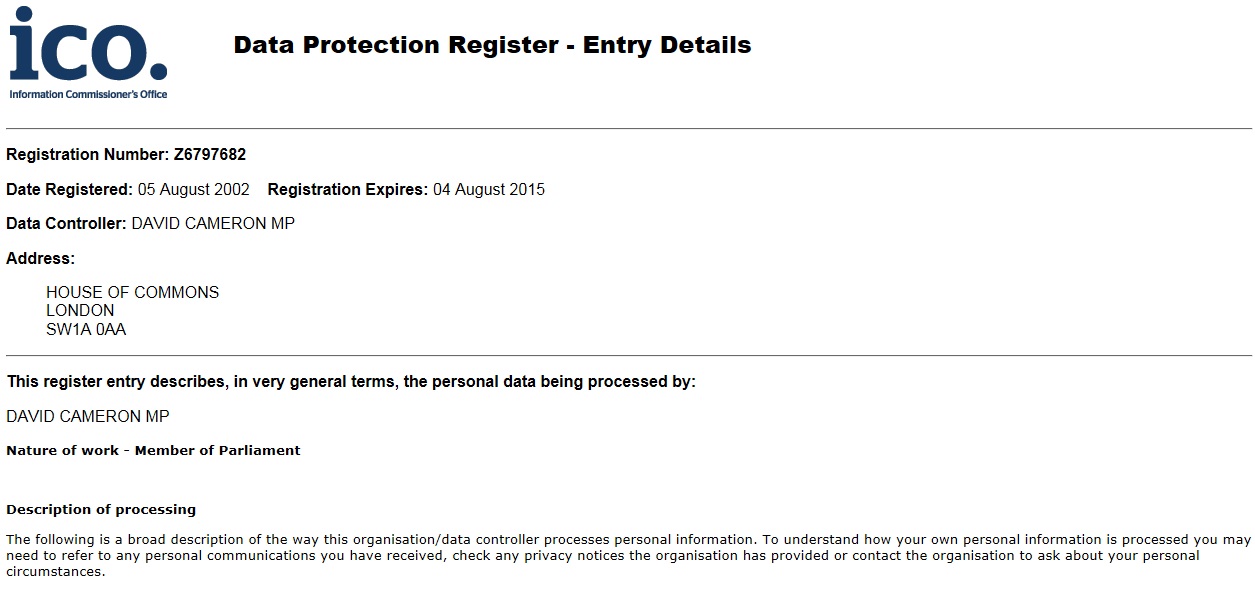
Political parties, and members of parliaments process personal data (for instance of their constituents) in the role of data controller, and cannot avail themselves of an exemption. Thus, they have an obligation to register, and thus it is, for example, that the Prime Minister has this entry in the register

Untitled

and so it is that Stuart Agnew, UKIP Member of the European Parliament, has this entry

Untitled2

and so it is that the Liberal Democrats have this entry

Untitled2

(all the entries have more information in them than those screenshots show).

But, as I have written before, not all politicians appear to comply with these legal obligations under the DPA. And this morning I noticed lawyer Adam Rose tweeting about the fact that neither George Galloway MP, nor his Respect Party appeared to have an entry on the IC register. This certainly seems to be the case, and I took the opportunity to ask Mr Galloway whether it was correct (no response as yet). It is also worth noting that back in 2012 the IC stated that

it appears that the Respect Party has not notified under the DPA at any time since its formation in November 2004….[this has] been brought to the attention of our Non-Notification Team within our Enforcement Department. They will therefore consider what further action is appropriate in the circumstances

It must be born in mind, however, that non-appearance on the online searchable register is not proof of non-appearance on the actual register. The IC says

It is updated daily. However, due to peaks of work it may be some time before new notifications, renewals and amendments appear in the public register. Please note data controllers are deemed notified from the date we receive a valid form and fee. Therefore the fact that an entry does not appear on the public register does not mean that the data controller is committing a criminal offence

Nonetheless, the online register is there for a purpose – it enables data subjects to get reassurance that those who process their personal data do so lawfully. Non-appearance on the online register is at least cause for concern and the need for clarification from the IC and/or the data controller.

And it is not just Mr Galloway and the Respect Party who don’t appear on the online register. I checked for registrations for some of the other main party leaders: David Cameron, Ed(ward) Miliband and Nick Clegg all have registrations, as do Nicola Sturgeon and Peter Robinson, but Nigel Farage, Leader of UKIP and Natalie Bennett, Leader of the Green Party appear not to.

At all times, but especially in the run up to the general election, voters and constituents have a right to have their personal information handled lawfully, and a right to reassurances from politicians that they will do so. For this reason, it would be good to have clarification from Mr Galloway, the Respect Party, Mr Farage and Ms Bennett, as to why they have no entry showing in the IC’s online register. And if they do not have an entry in the register itself, it would be good to have clarification from the IC as to what action might be taken.

The views in this post (and indeed all posts on this blog) are my personal ones, and do not represent the views of any organisation I am involved with.

3 Comments

Filed under Data Protection, Information Commissioner

Praise where it’s due, but the senior people aren’t listening

A few months ago I had to attend a clinic at a large hospital (nothing embarrassing, nothing serious, but I’m not going to disclose my sensitive personal data). Said hospital is, as are so many these days, crumbling under a lack of resources. In the past I’ve been to other clinics at the same hospital and been concerned to note that they are often run from areas that are little better than corridors, with no real physical data security measures in place – files left out on tables, computer screens open to view by bystanders etc.

However, on this occasion as I approached the healthcare assistant – let’s call her “Anne” – who appeared to be running the clinic (sure enough effectively in a corridor), I notice she kept the clinic list carefully shielded from my eyes, and when I gave my name she retrieved my file from a row of all the others hidden under a long strip of blue hospital paper (you know, the stuff on big rolls like kitchen towels).

I said how impressed I was at her simple but effective attempt to protect patient confidentiality under difficult circumstances, and said I was chairman of NADPO so knew a bit whereof I spoke. A little bit later Anne called me from my seat and I thought it was to take me to my appointment. However, she took me to her manager, and they explained that Anne had previously been criticised by one of the clinic consultants, who felt the blue paper was inconveniencing him, and who would at times remove it and throw it away.

So, I thought I’d write a letter – to the Chief Executive of the NHS Trust, copied to its Medical Records Manager, and Anne herself – praising her actions.

I completely forgot about it but yesterday out of nowhere received a card. It was from Anne saying that she’d received my copy letter, although she hadn’t heard from anyone else (not the Chief Executive nor the Medical Records Manager). She said that the letter was the nicest thing that had happened to her at work in 16 years.

I think this illustrates several things: 1) the NHS, and the public sector in general, are overstretched and confidentiality is potentially compromised as a result, 2) even in times of austerity low-cost information security measures can be effectively implemented, 3) sometimes people lower down are frustrated by, or even undermined by, those above them, 4) compliments are enormously valuable, and too rarely offered.

But there’s one final point. Anne had said in her card to me “I hope [the Chief Executive] wrote and thanked you”. Well no, she didn’t. And nor did the Medical Records Manager nor anyone else in the Hospital Trust. Only Anne had the courtesy to do so, and she was not the one who the message needed to get through to. I’d like to name (and slightly shame) the Trust, but I’d then identify “Anne”, and I don’t want to do that.

The views in this post (and indeed all posts on this blog) are my personal ones, and do not represent the views of any organisation I am involved with.

2 Comments

Filed under Confidentiality, Data Protection, NHS

A bad day in court

If the Information Commissioner (IC) reasonably requires any information for the purpose of determining whether a data controller has complied or is complying with the data protection principles, section 43 of the Data Protection Act 1998 (DPA) empowers him to serve a notice on the data controller requiring it to furnish him with specified information relating to compliance with the principles. In short, he may serve an “information notice” on the data controller which requires the latter to assist him by providing relevant information. A data controller has a right of appeal, to the First-tier Tribunal (Information Rights) (FTT), under section 48 DPA.

These provisions have recently come into play in an appeal by Medway Council of an IC Information Notice. That it did not go well for the former is probably rather understating it.

It appears that, back in 2012, Medway had a couple of incidents in which sensitive personal data, in the form of special educational needs documents, was sent in error to the wrong addresses. Medway clearly identified these as serious incidents, and reported themselves to the IC’s Office. By way of part-explanation for one of incidents (in which information was sent to an old address of one of the intended recipients), they pointed to “a flaw in the computer software used”.  Because of this explanation (which was “maintained in detail both in writing and orally”) the ICO formed a preliminary view that there had been a serious contravention of the seventh data protection principle (which is, let us remind ourselves “Appropriate technical and organisational measures shall be taken against unauthorised or unlawful processing of personal data and against accidental loss or destruction of, or damage to, personal data”). Moreover, the ICO served a Notice of Intent to serve a Monetary Penalty Notice (MPN). Upon receipt of this, it appears that Medway changed their explanation and said that the incident in question was a result of human error and that there was “no evidence of a ‘system glitch’”. It appears, however, that the ICO was concerned about discrepancies, and insufficient explanation of the change of position, and served a section 43 information notice requiring Medway to “provide a full explanation of how the security breach on 10 December 2012 occurred”. This was the notice appealed to the FTT.

However, during the FTT proceedings a third explanation for the incidents emerged, which seemed to combine elements of human error and system glitches. This was, observed the FTT, most unsatisfactory, saying, at paragraphs 28 and 29:

not only is this a third explanation of the breach but it is inconsistent with the other 2 explanations and is internally incoherent… The Tribunal is satisfied that there is still no reliable, clear or sufficiently detailed explanation of the incident to enable the Commissioner to be satisfied of:

a) what went wrong and why,
b) whether there was any prior knowledge of the potential for this problem,
c) what if any procedures were in place to avoid this type of problem at the relevant date,
d) why the Commissioner and the Tribunal have been provided with so many inaccurate and inconsistent accounts.

But even more ominously (paragraph 30)

The evidence provided to the Commissioner and the Tribunal has been inconsistent and unreliable and the Tribunal agrees with the Commissioner that it is reasonable that he should utilize a mechanism that enables him to call the Council to account if they recklessly [make] a statement which is false in a material respect  in light of the various contradictory and conflicting assertions made by the Council thus far

The words in italics are from section 47(2)(b) DPA, and relate to the potential criminal offence of recklessly making a material false statement in purported compliance with an information notice.

Finally, Medway’s conduct of the appeal itself came in for criticism: inappropriate, inconsistent and insufficient redactions were made in some materials submitted, and some evidence was sent in with no explanation of source, date or significance.

It is rare that information notices are required – most data controllers will comply willingly with an ICO investigation. It is even more rare that one is appealed, and maybe Medway’s recent experience shows why it’s not necessarily a good idea to do so. Medway may rather regret their public-spirited willingness to own up to the ICO in the first place.

The views in this post (and indeed all posts on this blog) are my personal ones, and do not represent the views of any organisation I am involved with.

1 Comment

Filed under Breach Notification, Data Protection, enforcement, Information Commissioner, information notice, Information Tribunal, monetary penalty notice

Helping the ICO with databreach alerts?

Last weekend I noticed some tweets from the ever-vigilant Dissent Doe. She said

I’ve spent 5 min on NHS’s web site and still can’t figure out how/where to report or question an IT security issue. Anyone?…It’s 2015. It really shouldn’t be so hard to find a contact email to use to notify an entity of a security breach or vulnerability…So I finally said, “screw this waste of my time,” and emailed @ICOnews to alert them and ask them to pass the notification to #NHS

Knowing that she wouldn’t tweet this without good reason I made contact, and she referred me to a list of what looked like serious data security vulnerabilities on a range of NHS websites. The list had been posted openly on the internet by a well-known hacker (for obvious reasons I won’t link to it).

In response, I contacted an NHS Information Governance professional, who quickly pointed me towards the IG Alliance. I sent emails to two people, but have not yet had a reply. I even tweeted Tim Kelsey, the NHS’s National Director for Patients and Information, but he didn’t reply. Eventually, a contact managed to contact someone else (I’m being deliberately vague) and I have some reassurance that action will now be taken.

But when I told Dissent Doe this, earlier today (06.02.15) she, although pleased at that outcome, expressed surprise that she had not heard anything from the Information Commissioner’s Office (ICO), whom she had alerted last Sunday. I told her that this had been my, and others’, experience when reporting serious concerns about data protection and data security. The ICO is tremendously over-stretched, and can’t immediately respond to all queries and concerns raised, but there is a community of knowledgeable and dedicated professionals who can help. One of the ICO’s main regulatory roles is, after all

to promote the following of good practice by data controllers and, in particular, so to perform his functions under this Act as to promote the observance of the requirements of this Act by data controllers

Indeed, I’ve written on the subject before, and suggested this

I think the ICO should consider operating a priority alert system when well-informed third-parties alert them to exposures of personal data. They certainly shouldn’t leave those third parties to do in-depth investigation.

I didn’t get a comment from the ICO when I wrote that previous post, but I also didn’t ask them for one. This time I will, and I’ll report back on what their response is.

The views in this post (and indeed all posts on this blog) are my personal ones, and do not represent the views of any organisation I am involved with.

Leave a comment

Filed under Breach Notification, Data Protection, Information Commissioner

Online privacy – a general election battleground

It’s becoming increasingly clear that one of the key battlegrounds in the 2015 General Election will be online. The BBC’s Ross Hawkins reports that the Conservatives are spending large amounts each month on Facebook advertising, and Labour and UKIP, while not having the means to spend as much, are ramping up their online campaigning. But, as Hawkins says

the aim is not to persuade people to nod thoughtfully while they stare at a screen. They want consumers of their online media to make donations or, even better, to get their friends’ support or to knock on doors in marginal constituencies…[but] for all the novelties of online marketing, email remains king. Those Tory Facebook invoices show that most of the money was spent encouraging Conservative supporters to hand over their email addresses. Labour and the Conservatives send emails to supporters, and journalists, that appear to come from their front benchers, pleading for donations

I know this well, because in July last year, after growing weary of blogging about questionable compliance with ePrivacy laws by all the major parties and achieving nothing, I set a honey trap: I submitted an email address to the Conservative, Labour, LibDem, Green, UKIP, SNP and Plaid Cymru websites. In each case I was apparently agreeing with a proposition (such as the particularly egregious LibDem FGM example)  giving no consent to reuse, and in each case there was no clear privacy notice which accorded with the Information Commissioner’s Office’s Privacy Notices Code of Practice (I do not, and nor does the ICO, at least if one refers to that Code, accept that a generic website privacy policy is sufficient in case like this). Since then, the fictional, and trusting but naive, Pam Catchers (geddit??!!) has received over 60 emails, from all parties contacted. A lot of them begin, “Friend, …” and exhort Pam to perform various types of activism. Of course, as a fictional character, Pam might have trouble enforcing her rights, or complaining to the ICO, but the fact is that this sort of bad, and illegal, practice, is rife.

To be honest, I thought Pam would receive more than this number of unsolicited emails (but I’m probably more cynical than her). But the point is that each of these emails was sent in breach of the parties’ obligations under the Privacy and Electronic Communications (EC Directive) Regulations 2003 (PECR) which demands that recipients of electronic direct marketing communications must have given explicit consent prior to the sending. By extension, therefore, the parties are also in breach of the Data Protection Act 1998 (DPA), which, when requiring “fair” processing of personal data, makes clear that a valid privacy notice must be given in order to achieve this.

The ICO makes clear that promotion by a political party can constitute direct marketing, and has previously taken enforcement action to try to ensure compliance. It has even produced guidance for parties about their PECR and DPA obligations. This says

In recent years we have investigated complaints about political parties and referendum campaigners using direct marketing, and on occasion we have used our enforcement powers to prevent them doing the same thing again. Failure to comply with an enforcement notice is a criminal offence.

But by “recent” I think they are referring at least six years back.

A data controller’s compliance, or lack thereof, with data protection laws in one area is likely to be indicative of its attitude to compliance elsewhere. Surely the time has come for the ICO at least to remind politicians that online privacy rights are not to be treated with contempt?

The views in this post (and indeed all posts on this blog) are my personal ones, and do not represent the views of any organisation I am involved with.

2 Comments

Filed under consent, Data Protection, enforcement, Information Commissioner, marketing, PECR, privacy notice

No data protection “fines” for audited NHS bodies

UPDATE: 03.02.15 GPOnline have commendably now amended their piece on this END UPDATE

GPOnline warns its readers today (02.02.15) that

GP practices face compulsory audits from this month by the information commissioner to check their compliance with data protection laws, and could be fined heavily if they are found to have breached rules.

While it’s good that it is on the ball regarding the legal change to the Information Commissioner’s Office (ICO) audit powers, it is, in one important sense, wrong: I can reassure GP practices that they are not risking “fines” (more correctly, monetary penalty notices, or MPNs) if breaches of the law are found during an ICO audit. In fact, the law specifically bars the ICO from serving an MPN on the basis of anything discovered in the process of an audit.

Under s41A of the Data Protection Act 1998 (DPA) the ICO can serve a data controller with a notice “for the purpose of enabling the Commissioner to determine whether the data controller has complied or is complying with the data protection principles”. Until yesterday, this compulsory audit power was restricted to audits of government departments. However, the Data Protection (Assessment Notices) (Designation of National Health Service Bodies) Order 2014, which commenced on 1 February 2015, now enables the ICO to perform mandatory data protection audits on NHS bodies specified in the schedule to the Order.  Information Commissioner Christopher Graham has said

We fine these organisations when they get it wrong, but this new power to force our way into the worst performing parts of the health sector will give us a chance to act before a breach happens

And I think he chose those words carefully (although he used the legally inaccurate word “fine” as well). Section 55A of the DPA gives the ICO the power to serve a monetary penalty notice, to a maximum of £500,000, if he is “satisfied” that – there has been a serious contravention of the DPA by the data controllers and it was of a kind likely to cause substantial damage or substantial distress and the data controller knew or ought to have known that this would happen. However section 55A(3A) provides that the ICO may not be so “satisfied”

by virtue of any matter which comes to the Commissioner’s attention as a result of anything done in pursuance of…an assessment notice

This policy reason behind this provision is clearly to encourage audited data controllers to be open and transparent with the ICO, and not be punished for such openness. GP practices will not receive an MPN for any contraventions of the DPA discovered during or as a result of a section 41A audit.

The views in this post (and indeed all posts on this blog) are my personal ones, and do not represent the views of any organisation I am involved with.

1 Comment

Filed under Data Protection, Information Commissioner, monetary penalty notice, NHS

Abuse survivors’ names published on home affairs committee website

Last week, in a testy exchange with Ben Emmerson QC, the Chairman of the House of Commons’ home affairs select committee, Keith Vaz, trumpeted his committee’s commitment to transparency. The committee was taking evidence on the Independent panel inquiry into child sexual abuse and, at one point, Mr Emmerson QC, who had been heavily criticised by panel member Sharon Evans at a previous committee session, was keen to known whether a letter she had written had been, as Mr Vaz had previously indicated, published on the committee’s website. Mr Vaz replied (at 16:34:46)

Yes, yes, all letters that we receive – we don’t believe in suppressing information. This is Parliament so we put everything on the website

However, it now transpires that, when he said “everything”, this might have been taken too literally. It appears that not just correspondence might have been published, but, also, the names of four survivors of abuse. Sky News reports that

Survivors of child sex abuse have received death threats after their personal details and confidential communications with an abuse inquiry were published online.

Members of the group have written to the Home Secretary expressing “grave concern” about the publication of documents they say were leaked by a member of an abuse inquiry panel

In response, Mr Vaz, the Telegraph reports, said “The names of all these individuals were already in the public domain”.

However, just because names of victims or alleged victims of sexual offences are in the public domain does not provide a defence, for instance, to a charge under section 5 of the Sexual Offences (Amendment) Act 1992, (SO(A)A) which provides lifetime anonymity for such people, insofar as no publication may be made of their name, or address, or a still or moving picture of them.

Moreover, even if personal data is in the public domain, the provisions of the Data Protection Act 1998 (DPA) apply, and in the absence of a legal basis for publication, there will be a contravention of that Act if personal data is published unfairly. Given that complaints have been made about this publication, it certainly seems to be the case that the data subjects did not consent to such publication, and would not have had a reasonable expectation that it would happen. That would tend to suggest unfair processing.

I have written before about the dangers of inadvertently disclosing personal data in pursuance of an over-eager transparency agenda. It may be that Mr Vaz’s commitment to transparency on the part of his committee has realised these dangers.

However (and contrary to what I suggested in the first draft of this post – thanks Rich Greenhill) it appears that information published by a parliamentary committee is likely to be covered by parliamentary privilege (pages 58-59 of the Select Committee Red Book), and Greg Callus informs me that I failed to check the early-Victorian statute book – the Parliamentary Papers Act 1840 lays the basis for parliamentary privilege. This would probably provide a defence to charge of breach of SO(A)A, but it wouldn’t necessarily completely oust the regulatory jurisdiction of the Information Commissioner, in the event that the publication was inadvertent, as opposed to deliberate, and to the extent that it evinced a lack of organisational and technical measures to safeguard against unlawful or unfair processing of personal data (in contravention of the seventh data protection principle). This is because the DPA exemption (section 35A) applying to parliamentary privilege does not cover the seventh principle.However, I’m sure this is purely an academic question.

The views in this post (and indeed all posts on this blog) are my personal ones, and do not represent the views of any organisation I am involved with.

6 Comments

Filed under Data Protection, sexual offences amendment act, transparency