Tag Archives: data protection

Naming and shaming no shows is a no-no

I know a couple who run a restaurant. And I know how the problem of no-shows can cause great economic damage to restaurants. Failing to show up, or to cancel in advance, is, moreover, incredibly rude. But the response, which I only became aware of today, of naming and shaming the no-show customers on twitter is a risky and probably unlawful one for restaurateurs to take.

In the instance I saw this morning a London restaurant had apparently searched for the twitter account of a person who they thought had failed to show, and had openly tweeted their displeasure. He, however, had email proof that he had cancelled in advance. The restaurant investigated, accepted this, and apologised (and the customer accepted, so I’m not going to name either of the parties).

However, the restaurant was processing the personal data of the customer when it took his booking, and their use of that data would be limited to what the customer was told at the time, or what he might reasonably expect. So, unless they had a very odd privacy notice, their permitted processing purposes would not have extended to the naming and shaming of him for failing to turn up. Thus, it would seem to be a breach of at least the both the first and the second data protection principle. Moreover, the rather cavalier approach to customer data wouldn’t make one confident about other aspects of data protection compliance.

I really do sympathise with restaurateurs: one of the alternative approaches to no-shows and late cancellers is punitive cancellation fees but that also has its drawbacks and detractors. However, there are not many areas of commerce where companies would be able to get away with such apparently unfair and unlawful processing of their customer’s personal data: announcing that someone has failed to attend at a certain restaurant potentially indicates quite a bit about the person’s tastes, means and location. It’s a risky thing for a restaurateur to do, especially when, as with the restaurant I saw tweeting earlier today, they haven’t registered their processing with the Information Commissioner’s Office (which, I would emphasise, is a criminal offence).



Leave a comment

Filed under Data Protection, Information Commissioner, privacy notice, social media

Political attitudes to ePrivacy – this goes deep

With the rushing through of privacy-intrusive legislation under highly questionable procedures, it almost seems wrong to bang on about political parties and their approach to ePrivacy and marketing, but a) much better people have written on the #DRIP bill, and b) I think the two issues are not entirely unrelated.

Last week I was taking issue with Labour’s social media campaign which invited people to submit their email address to get a number relating to when they were born under the NHS.

Today, prompted by a twitter exchange with the excellent Lib Dem councillor James Baker, in which I observed that politicians and political parties seem to be exploiting people’s interest in discrete policy issues to harvest emails, I looked at the Liberal Democrats’ home page. It really couldn’t have illustrated my point any better. People are invited to “agree” that they’re against female genital mutilation, by submitting their email address.

libdem

There’s no information whatsoever about what will happen to your email address once you submit it. So, just as Labour were, but even more clearly here, the Lib Dems are in breach of the The Privacy and Electronic Communications (EC Directive) Regulations 2003 and the Data Protection Act 1998. James says he’ll contact HQ to make them aware. But how on earth are they not already aware? The specific laws have been in place for eleven years, but the principles are much older – be fair and transparent with people’s private information. And it is not fair (in fact it’s pretty damn reprehensible) to use such a bleakly emotive subject as FGM to harvest emails (which is unavoidably the conclusion I arrive at when wondering what the purpose of the page is).

So, in the space of a few months I’ve written about the Conservatives, Labour and the Lib Dems breaching eprivacy laws. If they’re unconcerned about or – to be overly charitable – ignorant of these laws, then is it any wonder that they railroad each other into passing “emergency” laws (which are anything but) with huge implications for our privacy?

UPDATE: 13.07.14

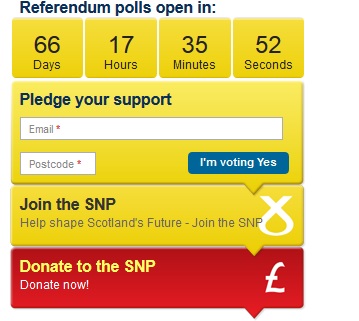
Alistair Sloan draws attention to the Scottish National Party’s website, which is similarly harvesting emails with no adequate notification of the purposes of future use. The practice is rife, and, as Tim Turner says in the comments below, the Information Commissioner’s Office needs to take action.

snp

7 Comments

Filed under consent, Data Protection, PECR, Privacy, transparency

Police building register of domestic CCTV for crime investigation purposes?

This is a flyer apparently being distributed by Thames Valley Police (TVP).

flyer

It invites householders who have private CCTV systems to register with TVP, who want to use those systems “in order to assist us in future investigations”.

Surveillance camera footage can undoubtedly be of great use in the investigation and prosecution of crime. But there is a potential problem for householders who decided to register with TVP, and I’d be interested to know if the latter have taken this into account.

The problem is this: CCTV cameras involve the processing of data, and where they capture images of identifiable individuals, it is personal data that they are processing. Purely domestic processing of personal data is exempt from all of the obligations under the Data Protection Act 1998, but when the processing is no longer purely for domestic purposes, then legal obligations potentially attach themselves to those doing the processing. The Information Commissioner’s Office (ICO) CCTV Code of Practice (both the current 2008 version and an updated version currently in draft) explains

The use of cameras for limited household purposes is exempt from the DPA. This applies where an individual uses CCTV to protect their home from burglary, even if the camera overlooks the street or other areas near their home

But the corollary of this is that if its use is not purely for the “household purposes” of protecting one’s home from bulgary, then the exemption no longer applies. If householders are determining that the purpose for which they will process personal data is to assist TVP in criminal investigations, then they are data controllers.

This can’t simply be TVP wanting a register of CCTV-operating households to assist them if a crime happens on those specific premises, because that would be pointless: in those circumstances the householder would draw the footage to the police’s attention. No, this must be that TVP want to be able to access footage of relevant incidents outwith the individual household. 

I’ve asked TVP if they have any policy statement or guidelines on this initiative, and will update as and when they reply.

1 Comment

Filed under Data Protection, police, Privacy, surveillance, surveillance commissioner

Privacy issues with Labour Party website

Two days ago I wrote about a page on the Labour Party website which was getting considerable social media coverage. It encourages people to submit their date of birth to find out, approximately, of all the births under the NHS, what number they were.

I was concerned that it was grabbing email address without an opt-out option. Since then, I’ve been making a nuisance of myself asking, via twitter, various Labour politicians and activists for their comments. I know I’m an unimportant blogger, and it was the weekend, but only one chose to reply: councillor for Lewisham Mike Harris, who, as campaign director for DontSpyOnUs, I would expect to be concerned, and, indeed, to his credit, he said “You make a fair point, there should be the ability to opt out”. Mike suggested I email Labour’s compliance team.

In the interim I’d noticed that elsewhere on the Labour website there were other examples of emails being grabbed in circumstances where people would not be sure about the collection. For instance: this “calculator” which purports to calculate how much less people would pay under Labour for energy bills, which gives no privacy notice whatsoever. Or even this, on the home page, which similarly gives no information about what will happen with your data

homepage

Now, some might say that, if you’re giving your details to “get involved”, then you are consenting to further contact. This is probably true, but it doesn’t mean the practice is properly compliant with data collection laws. And this is not unimportant; as well as potentially contributing to the global spam problem, poor privacy notices/lack of opt-out facilities at the point of collection of email address contribute to the unnecessary amassing of private information, and when it is done by a political party, this can even be dangerous. It should not need pointing out that, historically, and elsewhere in the world, political party lists have often been used by opposition parties and repressive governments to target and oppress activists. Indeed, the presence of one’s email on a party marketing database might well constitute sensitive personal data – as it can be construed as information on one’s political opinions (per section 2 of the Data Protection Act 1998).

So, these are not unimportant issues, and I decided to follow Mike Harris’s suggestion to email Labour’s compliance unit. However, the contact details I found on the overarching privacy policy merely gave a postal address. I did notice though that that page said

If you have any questions about our privacy policy, the information we have collected from you online, the practices of this site or your interaction with this website, please contact us by clicking here

But if I follow the “clicking here” link, it takes me to – wait for it – a contact form which gives no information whatsoever about what will happen if I submit it, other than the rather stalinesque

The Labour Party may contact you using the information you supply

And returning to the overarching privacy policy didn’t assist here – none of the categories on that page fitted the circumstances of someone contacting the party to make a general enquiry.

I see that the mainstream media have been covering the NHS birth page which originally prompted me to look at this issue. Some, like the Metro, and unsurprisingly, the Mirror, are wholly uncritical. The Independent does note that it is a clever way of harvesting emails, but fails to note the questionable legality of the practice. Given that this means that more and more email addresses will be hoovered up, without people fully understanding why, and what will happen with them, I really think that senior party figures, and the Information Commissioner, should start looking at Labour’s online privacy activities.

(By the way, if anyone thinks this is a politically-motivated post by me, I would point out that, until 2010, when I voted tactically (never again), I had only ever voted for one party in my whole life, and that wasn’t the Conservatives or the Lib Dems.)

6 Comments

Filed under Data Protection, Information Commissioner, marketing, PECR, Privacy, privacy notice, social media, tracking

We’re looking into it

The news is awash with reports that the UK Information Commissioner’s Office (ICO) is “opening an investigation” into Facebook’s rather creepy research experiment, in conjunction with US universities, in which it apparently altered the users’ news feeds to elicit either positive or negative emotional responses. Thus, the BBC says “Facebook faces UK probe over emotion study”, SC Magazine says “ICO probes Facebook data privacy” and the Financial Times says “UK data regulator probes Facebook over psychological experiment”.

As well as prompting one to question some journalists’ obsession with probes, this also leads one to look at the basis for these stories. It appears to lie in a quote from an ICO spokesman, given I think originally to the online IT news outlet The Register

The Register asked the office of the UK’s Information Commissioner if it planned to probe Facebook following widespread criticism of its motives.

“We’re aware of this issue, and will be speaking to Facebook, as well as liaising with the Irish data protection authority, to learn more about the circumstances,” a spokesman told us.
So, the ICO is aware of the issue and will be speaking to Facebook and to the Irish Data Protection Commissioner’s office. This doesn’t quite match up to the rather hyperbolic news headlines. And there’s a good reason for this – the ICO is highly unlikely to have any power to investigate, let alone take action. Facebook, along with many other tech/social media companies, has its non-US headquarters in Ireland. This is partly for taxation reasons and partly because of access to high-skilled, relatively low cost labour. However, some companies – Facebook is one, LinkedIn another – have another reason, evidenced by the legal agreements that users enter into: because the agreement is with “Facebook Ireland”, then Ireland is deemed to be the relevant jurisdiction for data protection purposes. And, fairly or not, the Irish data protection regime is generally perceived to be relatively “friendly” towards business.
 
These jurisdictional issues are by no means clear cut – in 2013  a German data protection authority tried to exercise powers to stop Facebook imposing a “real name only” policy.
 
Furthermore, as the Court of Justice of the European Union recognised in the recent Google Spain case, the issue of territorial responsibilities and jurisdiction can be highly complex. The Court held there that, as Google had
 
[set] up in a Member State a branch or subsidiary which is intended to promote and sell advertising space offered by that engine and which orientates its activity towards the inhabitants of that Member State
 
it was processing personal data in that Member State (Spain). Facebook does have a large UK corporate office with some responsibility for sales. It is just possible that this could give the ICO, as domestic data protection authority, some power to investigate. And if or when the draft European General Data Protection Regulation gets passed, fundamental shifts could take place, extending even, under Article 3(2) to bringing data controllers outside the EU within jurisdiction, where they are offering goods or services to (or monitoring) data subjects in the EU.
 
But the question here is really whether the ICO will assert any purported power to investigate, when the Irish DPC is much more clearly placed to do so (albeit it with terribly limited resources). I think it’s highly unlikely, despite all the media reports. In fact, if the ICO does investigate, and it leads to any sort of enforcement action, I will eat my hat*.
 
*I reserve the right to specify what sort of hat

Leave a comment

Filed under Data Protection, Directive 95/46/EC, enforcement, facebook, journalism, social media, Uncategorized

I DON’T KNOW WHAT I’M DOING

As surprising as it always is to me, I’m occasionally reminded that I don’t know everything. But when I’m shown not to know how my own website works, it’s more humbling.

A commenter on one of my blog posts recently pointed out the number of tracking applications which were in operation. I had no idea. (I’ve disabled (most of) them now).

And someone has just pointed out (and some others have confirmed) that, when visiting my blog on their iphone, it asks them whether they want to tell me their current location. I have no idea why. (I’m looking into it).

These two incidents illustrate a few things to me.

Firstly, for all my pontificating about data protection, and – sometimes – information security, I’m not particularly technically literate: this is a wordpress.com blog, which is the off-the-peg version, with lots of things embedded/enabled by default. Ideally, I would run and host my own site, but I do this entirely in my own time, with no funding at all.

Secondly, and following on from the first,  I am one among billions of people who run web applications without knowing a great deal about the code that they’re based on. In a world of (possibly deliberately coded) back-door and zero day vulnerabilities this isn’t that surprising. If even experts can be duped, what hope for the rest of us?

Thirdly, and more prosaically, I had naively assumed that, in inviting people to read and interact with my blog, I was doing so in a capacity of data controller: determining the purposes for which and the manner in which their personal data was to be processed. (I had even considered notifying the processing with the Information Commissioner, although I know that they would (wrongly) consider I was exempt under section 36 of the Data Protection Act 1998)). But if I don’t even know what my site is doing, in what way can I be said to determine the data processing purposes and manner? But if I can’t, then should I stop doing it? I don’t like to be nominally responsible for activities I can’t control.

Fourthly, and finally, can anyone tell me why my out-of-control blog is asking users to give me their location, and how I can turn the damned thing off?

UPDATE: 30.06.14

The consensus from lots and lots of helpful and much-appreciated comments seems to be a) that this location thingy is embedded in the wordpress software (maybe the theme software), and b) I should migrate to self-hosting.

The latter option sounds good, but I have to remind people that I DON’T KNOW WHAT I’M DOING.

UPDATE:05.07.14

The rather excellent Rich Greenhill seems to have identified the problem (I trust his judgement, but haven’t confirmed this). He says “WordPress inserts mobile-only getCurrentPosition from aka-cdn-nsDOTadtechusDOTcom/…DAC.js via adsDOTmopubDOTcom in WP ad script”…”Basically, WordPress inserts ads; but, for mobile devices only, the imported ad code also attempts to detect geo coordinates”.

So it dooes look like I, and other wordpress.com bloggers, who can’t afford the “no ads” option, are stuck with this unless or until we can migrate away.

UPDATE: 11.07.14

We are informed that the code which asks (some) mobile users for their location when browsing this blog has now been corrected. Please let me know if it isn’t.

3 Comments

Filed under Data Protection, Information Commissioner, Personal, social media, tracking

Google is not a library, Dr Cavoukian

The outgoing Ontario Information and Privacy Commissioner Ann Cavoukian, whose time in office has been hugely, and globally, influential (see in particular Privacy by Design) has co-written (with Christopher Wolf) an article strongly criticising the judgment of the Court of Justice of the European Union (CJEU) in the Google Spain case.

For anyone who has been in the wilderness for the last few weeks, in Google Spain the CJEU ruled that Google Spain, as a subsidiary of Google inc. operating on Spanish territory, was covered by the obligations of the European Data Protection Directive 95/46/EC, that it was operating as an entity that processed personal data in the capacity of a data controller, and that it was accordingly required to consider applications from data subjects for removal of search returns. Thus, what is loosely called a “right to be forgotten” is seen already to exist in the current data protection regime.

Many have written on this landmark CJEU ruling (I commend in particular Dr David Erdos’s take, on the UK Constitutional Law Blog) and I am not here going to go into any great detail, but what I did take issue with in the Cavoukian and Wolf piece was the figurative comparison of Google with a public library:

A man walks into a library. He asks to see the librarian. He tells the librarian there is a book on the shelves of the library that contains truthful, historical information about his past conduct, but he says he is a changed man now and the book is no longer relevant. He insists that any reference in the library’s card catalog and electronic indexing system associating him with the book be removed, or he will go to the authorities…

…The government agent threatens to fine or jail the librarian if he does not comply with the man’s request to remove the reference to the unflattering book in the library’s indexing system.

Is this a scenario out of George Orwell’s Nineteen Eighty-Four? No, this is the logical extension of a recent ruling from Europe’s highest court

(I pause briefly to say that if I never see another reference to Orwell in the context of privacy debate I will die a happy man).

I’m fond of analogies but Cavoukian’s and Wolf’s one (or maybe it’s a metaphor?) is facile. I think it could more accurately say

A man walks into a library. He sees that, once again, the library has chosen, because of how it organises its profit-making activities, to give great prominence to a book which contains information about his past conduct, which is no longer relevant, and which it is unfair to highlight. He asks them to give less prominence to it.

Cavoukian and Wolf accept that there should be a right to remove “illegal defamatory” content if someone posts it online, but feel that the issue of links to “unflattering, but accurate” information should be explored using “other solutions”. (I pause again to note that “unflattering” is an odd and loaded word to use here: Mr Gonzalez, in the Google Spain case, was concerned about out-of-date information about bankruptcy, and other people who might want to exercise a right to removal of links might be concerned by much worse than “unflattering” information).

I don’t disagree that other solutions should be explored to the issue of the persistence or reemergence of old information which data subjects reasonably no longer wish to be known, but people are entitled to use the laws which exist to pursue their aims, and the application by the CJEU of data protection law to the issues pleaded was, to an extent, uncontroversial (is Google a data controller? if it is, what are its obligations to respect a request to desist from processing?)

Cavoukian and Wolf criticise the CJEU for failing to provide sufficient instruction on how “the right to be forgotten” should be applied, and for failing to consider whether “online actors other than search engines have a duty to ‘scrub’ the Internet of unflattering yet truthful facts”, but a court can only consider the issues pleaded before it, and these weren’t. Where I do agree with them is in their criticism of the apparent failure by the CJEU, when giving effect to the privacy rights in Article 8 of the European Convention on Human Rights, and Articles 7 and 8 of the Charter of Fundamental Rights of the European Union, to consider adequately, if at all, the countervailing rights to freedom of expression in Article 10 of the former and Article 11 of the latter. In this respect, the prior Opinion of the Advocate General was perhaps to be preferred.

The key word in my replacement library ananolgy above is “chosen”. Google is not a passive and inert indexing system. Rather, it is a dynamic and commercially-driven system which uses complex algorithms to determine which results appear against which search terms. It already exercises editorial control over results, and will remove some which it is satisfied are clearly unlawful or which constitute civil wrongs such as breach of copyright. Is it so wrong that (if it gives appropriate weight to the (sometimes) competing considerations of privacy and freedom of expression) it should be required to consider a request to remove unfair and outdated private information?


2 Comments

Filed under Data Protection, Directive 95/46/EC, Europe, human rights, Privacy