Category Archives: access to information

Unreasonably accessible – ICO and misapplication of s21?

I’ll start with a simple proposition: if a dataset is made publicly available online by a public authority, but some information on it is withheld – by a deliberate decision – from publication, then the total dataset is not reasonably accessible to someone making an FOI request for information from it.

I doubt that any FOI practitioners or lawyers would disagree.

Well, sit back and let me tell you a story.

In November 2023 the Information Commissioner’s Office (ICO) refused to disclose information in response to a Freedom of Information request, on the grounds that the exemption at section 21 of the Freedom of Information Act 2000 (FOIA) applied: the information was “reasonably accessible to the applicant” without his needing to make a FOIA request.

The request was, in essence, for “a list…of the names of all the UK parish councils that have received 20 or more ICO Decision Notices (for FOIA cases only) since 1st January 2014”. The refusal by the ICO was on the basis that

the search function on the decision notice section of the ICO website returned 415 decision notices falling within the scope of the complainant’s request…[therefore] it is possible to place the names of the parish councils into an Excel sheet and then establish quickly how many decision notices relate to each individual parish council.

The ICO noted that, when it comes to the application of section 21

It is reasonable for a public authority to assume that information is reasonably accessible to the applicant as a member of the general public until it becomes aware of any particular circumstances or evidence to the contrary [emphasis added]

On appeal to the Information Tribunal, the ICO maintained reliance on the exemption, saying that all the applicant needed to do was to go to the ICO website and “look at each entry and count-up [sic] the numbers of [Decision Notices] against each parish council”. The Tribunal agreed: the ICO had provided the requester

with a link to the correct page of the ICO website, and instructing him how to use the search function. These instructions have enabled him to identify from the tens of thousands of published decision notices those 415-420 notices which have been issued to parish councils over the past decade or so

All straightforward, if one’s analysis is predicated on an assumption that the ICO’s public Decision Notice database is a complete record of all decision notices.

But it isn’t.

I made an FOI request of my own to the ICO; for how many Decision Notices do not appear on the database. And the answer is 45. A number of possible reasons are given (such as that sensitive information was involved, or that there was agreement by the parties not to publish). But the point is stark: the Decision Notice database is not a complete record of all Decision Notices issued. And I do not see how it is possible for the ICO to rely on section 21 FOIA in circumstances like those in this case. It is plainly the case that the ICO knew (or was likely reckless in not knowing) that there were “particular circumstances or evidence” which showed that the information could not have been reasonably accessible to the applicant.

Of course, it is quite likely (perhaps inevitable) that the 45 unpublished Decision Notices would make no difference at all to a calculation of how many UK parish councils have received 20 or more Decision Notices since 1st January 2014. But that really isn’t the point. The ICO could have come clean – could have done the search itself and added in the 45 unpublished notices. It knew they existed, but for some reason thought it didn’t matter.

The ICO is the regulator of FOIA, as well as being a public authority itself under FOIA. It has to get these things right. Otherwise, why should any other public authority feel the need to comply?

The views in this post (and indeed most posts on this blog) are my personal ones, and do not represent the views of any organisation I am involved with.
4 Comments

Filed under access to information, datasets, Freedom of Information, Information Commissioner, Information Tribunal, section 21

FOI and government/ministerial WhatsApps

[reposted from LinkedIn]

An important Information Tribunal (T) judgment on a FOIA request, by Times journalist George Greenwood, to DHSC for gov-related correspondence between Matt Hancock (MH) and Gina Coladangelo (GC), grappling with issues regarding modern messaging methods in government and how they fit into the FOIA scheme.

Two requests were made. The first was for government-related correspondence between MH and GC using departmental email accounts, and any private email account MH had used for government business. The second was for all correspondence between them using other methods, such as WhatsApp.


Request 1

DHSC had found four emails and by the time of the hearing had disclosed them. It maintained that no further info was held.

However DHSC argued that emails sent by MH’s private secretaries and not by MH himself were out of scope. Not so, said the T: “even if a private office email account is operated by a private secretary…correspondence with a private office email account ought to be regarded as correspondence with the relevant minister”. Accordingly, they upheld that part of the appeal and ordered further searches.


Request 2

DHSC had initially said, and ICO had agreed(!), that government-related WhatsApp messages sent from MH’s personal device were not “held” for the purposes of FOIA because they were not held “as part of the official record”. By the time of the hearing, all of the parties were agreed that this was an error, and the T ruled that section 3(2)(b) FOIA applied, and that “WhatsApp messages from Mr Hancock’s personal device were held [by MH] on a computer system on [DHSC’s] behalf”.

DHSC then sought to argue that WhatsApp messages in a group were not “correspondence” between MH and GC, saying (in the T’s formulation of DHSC’s argument) “unless correspondence consists of one person corresponding directly with another, it is not ‘true’ correspondence”. The T was dismissive of this: “correspondence in the age of multiple methods of electronic communication can take different forms…the fact that simply because one or other of the relevant parties did not respond or may not have responded to a particular message does not mean that communications within a WhatsApp group cannot be considered to be correspondence”. The T also rejected the related submission that a person posting a message to a WhatsApp group is “broadcasting”, rather than “corresponding”

(I have to say that I think the T probably overstepped here. I would tend to think that whether information in a WhatsApp group is correspondence or not should be determined on the facts, and not as a matter of general principle.)

Finally, the T did not warm to the evidence from an otherwise unidentified “Mr Harris” for the DHSC, to the effect that the request was vexatious on grounds of the burden. They therefore held that it was not. (As the messages were subsequently disclosed into the public domain during the Covid inquiry, not much turns on this.)

The views in this post (and indeed most posts on this blog) are my personal ones, and do not represent the views of any organisation I am involved with.

Leave a comment

Filed under access to information, Freedom of Information, Information Commissioner, Information Tribunal, journalism

An EIR judgment as long as a novel

Those who think the data protection statutory regime is complex might want to consider how it compares to that under the Environmental Information Regulations 2004 (EIR).

So if you fancy spending the day reading a judgment that is (by my calculations) longer than George Orwell’s 1984, now’s your chance.

A number of personal search companies, who undertake different types of searches for use in real property sale and purchase transactions, are bringing a claim in restitution regarding the charges they’ve paid to defendant water companies for reports under the CON29DW Drainage and Water Enquiry process. Their argument is that information responsive to a CON29DW is “environmental information” (EI) within the meaning of the EIR and that the water companies in question were obliged to make EI available for free or for no more than a reasonable charge. Accordingly, the charges levied by the water companies were unlawful and/ or paid under a mistake of law and that the water companies have been unjustly enriched to the extent of those charges.

The water companies, in turn, say that information responsive to a CON29DW was not EI, and/or that the information was not ‘held’ by them at the time the relevant request was made and/or that they were otherwise entitled under the EIR to refuse its disclosure.

Mr Justice Richard Smith’s magnum opus of a judgment bears close reading (closer than I’ve yet been able to give it), but it contains some notable findings, such as: not all of the information responsive to a CON29DW is EI; not all of the information was held for the purposes of the EIR and not by all of the defendants; information responsive to a CON29DW about internal flooding to a property is personal data (there’s an interesting discussion on the definition of personal data, touching on Durant, Edem, Ittihadieh and Aven v Orbis – but I think this part of the judgment is flawed – just because information about internal flooding could be personal data doesn’t mean it always is (which is what the judge appears to hold) – what about where a residential property is unoccupied and owned by a company?)

It seems to me that the effect of the judgment is to fracture the claim into small bits – some of the info is EI, some is held, by some defendants, some is exempt, etc. – and may well have the effect of damaging the chances of the claim progressing.

The judge ends by imploring the parties to try to resolve the issue other than through the court process. So let’s see if there’s an appeal.

The views in this post (and indeed most posts on this blog) are my personal ones, and do not represent the views of any organisation I am involved with.

Leave a comment

Filed under access to information, Data Protection, Environmental Information Regulations, judgments

A violation of the presumption of innocence

This may not be a post directly related to information rights (although it does involve disclosure of information in response to a parliamentary question – which is a potential route to access to information which should never be underestimated). But I’m writing more because it’s on a topic of considerable public interest, and because the efforts and the campaigning of the applicants, and of Appeal, deserve support.

The Grand Chamber of the European Court of Human Rights (ECtHR) has held that the scheme in England and Wales for assessing whether people whose criminal convictions are subsequently overturned is compatible with the European Convention on Human Rights (the “Convention”).

Regardless of whether the ECtHR was correct or not, the underlying issue is, in my view, a national scandal and one that any incoming government should set right as a matter of priority.

Under Section 133(1ZA) of the Criminal Justice Act 1988 (as amended in 2018) the state must pay compensation where a new or newly discovered fact shows beyond reasonable doubt that there has been a miscarriage of justice. But a miscarriage of justice will only have occurred “if and only if the new or newly discovered fact shows beyond reasonable doubt that the person did not commit the offence”. This reverses what would be the normal burden of proof in criminal justice matters, and in effect requires the wrongfully convicted person to prove their innocence to gain compensation, despite the fact that their conviction has been overturned.

Figures given in response to a parliamentary question last year revealed that an extraordinary 93% of cases did not warrant compensation under the scheme. 

At the ECtHR, the applicants contended that the domestic scheme infringed Article 6(2) of the Convention, which provides that “Everyone charged with a criminal offence shall be presumed innocent until proved guilty according to law”. Although the ECtHR noted “the potentially devastating impact of a wrongful conviction” it also held that the UK was

free to decide how “miscarriage of justice” should be defined for these purposes, and to thereby draw a legitimate policy line as to who out of the wider class of people who had had their convictions quashed on appeal should be eligible for compensation…, so long as the policy line was not drawn in such a way that the refusal of compensation in and of itself imputed criminal guilt to an unsuccessful applicant

It was not, said the ECtHR, its role “to determine how States should translate into material terms the moral obligation they may owe to persons who have been wrongfully convicted”.

Although there was a strong dissenting opinion which would have held that the compensation scheme resulted in a violation of the presumption of innocence, it must now fall to the next Parliament to take forward the “moral obligation” and put right where a previous Parliament went wrong. This does not, and should not, need to wait for the outcome of the Malkinson Inquiry. That inquiry may well have things to find out, and things to say, in general, about miscarriages of justice but it is not in its remit to consider the compensation point: that can, and should, be resolved sooner.

The views in this post (and indeed most posts on this blog) are my personal ones, and do not represent the views of any organisation I am involved with.

1 Comment

Filed under access to information, Article 6, Europe, human rights, Ministry of Justice, parliament, Uncategorized

Drones and freedom of expression

Article 10 of the European Convention on Human Rights provides that everyone has the (qualified) right to freedom of expression, which includes the freedom to receive and impart information. And section 12(4) of the Human Rights Act 1998 requires a court: i) to have regard to the importance of freedom of expression, when considering whether to grant any relief which, if granted, might affect the exercise of the right to freedom of expression, and ii) where the proceedings relate to material which appears to the court, to be journalistic, literary or artistic material (or to conduct connected with such material), to have regard to the extent to which the material has, or is about to, become available to the public, or the extent to which it is, or would be, in the public interest for the material to be published.

In a recent case in the High Court – sitting in Manchester – an application for an interim injunction was granted against one named and a number of unknown respondents preventing them from entering the site of the former St Joseph’s seminary in Up Holland, but also preventing the flying of drones over the site. There is already a large amount of footage taken previously by such drones on the various online video-sharing sites, and some of them are fascinating and informative. The future of the site is evidently a matter of significant local interest.

The concerns of the applicants for the injunction are compelling: there have been numerous incidents of trespass on the site, and it is in a very dangerous condition.

The only published judgment I have been able to find is on the website of the chambers of the barrister representing the applicant. It appears to be a transcript of an ex tempore judgment. The judge notes that section 76 of the Civil Aviation Act 1982 provides that

No action shall lie in respect of trespass or in respect of nuisance, by reason only of the flight of an aircraft over any property at a height above the ground which, having regard to wind, weather and all the circumstances of the case is reasonable

A piece on the website of the solicitors acting for the applicants indicates that the judge proceeded on the assumption that section 76 applied to drones and that the drone operator had complied with the requirements of the Air Navigation Order 2016. He then said that either i) section 76 did not apply, because the flight involved the taking of footage for its presumed purpose of encouraging trespass (and presumably therefore it was not “by reason of the flight only” for section 76 purposes), or, ii) if section 76 did apply, then the height of the drones could not be reasonable, because of the taking of the footage.

However, nowhere in the judgment is there any indication that the judge has had regard to the court’s duties under section 12 of the Human Rights Act. It strikes me that there are clear freedom of expression issues raised. A large number of people are interested in general in abandoned buildings, and there is an enormous amount of online attention to this subject, and, more locally, there is clearly notable interest in the fate of a grade 2 listed building: the drone footage must, surely, play a part in meeting this public interest.

So it strikes me that it was incumbent on the court to conduct the balancing exercise inherent in Article 10, which provides that the exercise of freedom of expression may be

subject to such formalities, conditions, restrictions or penalties as are prescribed by law and are necessary in a democratic society, in the interests of national security, territorial disorder or crime [and] for the protection of health…

The respondents in this case did not attend the hearing but the judge was satisfied that notice had been given to them (although the judgment does not explain how notice was given to the persons unknown). Perhaps, though, if they had attended, and been represented, their counsel might have drawn the court’s attention to its section 12 duty.

In a letter to The Times in 1987 (quoted here), Lord Scarman deprecated a decision of the House of Lords, and commented that

their Lordships have, with great respect, overlooked the more fundamental law providing the right of the public to access to information … and the public right of free speech…Old ingrained habits die hard. We are not yet able to abandon the traditional emphasis of our law on private rights …

Might he have found himself writing a similar letter today?

The views in this post (and indeed most posts on this blog) are my personal ones, and do not represent the views of any organisation I am involved with.

4 Comments

Filed under access to information, Article 10, drones, human rights, journalism

EIR and sewage discharges: a shift in the ICO’s position

It’s interesting (and encouraging) to see that, in a notable shift of position, the Information Commissioner’s Office (ICO) is now ordering water companies to disclose data relating to allegedly unlawful discharges of dry spillage sewage.

Previously, the ICO had tended to agree with the companies’ arguments that disclosure would adversely affect investigations by Ofwat and the Environment Agency, and the information was, therefore, exempt from disclosure under regulation 12(5)(b) of the Environmental Information Regulations 2004 (EIR). Those arguments were rather forcefully undermined by a statement to the Public Accounts Committee by the CEO of Ofwat last November that

We do not think that the investigation itself is a good reason for companies not to provide data. They have some legal obligations to disclose information, and there is a process for working that through. That process does not involve Ofwat directly, but we would encourage companies to be open and transparent about their environmental performance.

Additionally, the ICO has taken note of the judgment of the Information Tribunal in the recent Lavelle case.

This Decision Notice neatly summarises the issues and the ICO’s new position.

The views in this post (and indeed most posts on this blog) are my personal ones, and do not represent the views of any organisation I am involved with.

Leave a comment

Filed under access to information, Environmental Information Regulations, Information Commissioner, Uncategorized

A sad procedural judgment

In 1973, Pat Campbell, a Catholic factory worker from Banbridge, Northern Ireland, was shot and killed in front of his wife and children, at their family home.

No one was ever convicted of Pat Campbell’s murder, but for many years it has been believed that the killer was senior Ulster Volunteer Force member Robin “The Jackal” Jackson. Jackson – suspected of being responsible for, but never convicted of, at least 50 killings during the Troubles – was also suspected of having links with British military intelligence agencies.

In 2022 Pat Campbell’s widow reached a settlement with the Police Service of Northern Ireland, or PSNI (successor to the Royal Ulster Constabulary, or RUC) of a civil claim for damages, in which she alleged negligence and misfeasance in public office. The BBC reported at the time that “a former RUC officer and two ex-military intelligence officers were set to give evidence about Jackson’s alleged role”.

In the same year as Pat Campbell was murdered, a British intelligence officer wrote a report which is understood to have proposed increasing the RUC’s special branch’s intelligence gathers capabilities.

In 2021 journalist Phil Miller took a case under the Freedom of Information Act 2000 (FOIA) to the Information Tribunal, seeking disclosure by the PSNI of the Morton Report. However, the Tribunal upheld the Information Commissioner’s decision that PSNI were entitled to withhold the report because of the FOIA absolute exemption in relation to information supplied to a public authority by the Security Service.

Mrs Campbell, herself, however, still sought to get hold of the Morton Report. I know this because of a sad procedural judgment from the Information Tribunal.

She is identified as the appellant in case EA/2023/0276, an appeal from ICO decision notice IC-173342-D4D8. But as the judgment explains, she has since died, and the Tribunal has accordingly struck out the proceedings, under rule 8(2) of the procedure Rules, for want of jurisdiction. This is because, although The Law Reform (Miscellaneous Provisions) Act 1934 permits a “cause of action” to proceed after a claimant has died, for the benefit of the deceased’s estate, the Tribunal held, applying the same approach the Upper Tribunal took in a previous case in relation to data protection rights, a FOIA appeal is not a “cause of action” (Letang v Cooper [1965] 1 QB 232 applied). Instead, “‘[the] procedure is no more than a statutory appeal route, a procedural mechanism, for challenging’, in this case, the issue of the decision notice by the Information Commissioner”.

It seems doubtful, in any case, that Mrs Campbell would have succeeded: the exemption at section 23 is effectively insuperable.

But, of course, the PSNI has discretion to disclose information. As the ICO’s decision notice notes, the PSNI previously decided to disclose a redacted version of the 1980 Walker Report on RUC Special Branch informant handling, after the Committee on Administration of Justice took another FOIA case to the Information Tribunal.

There is no reason to suggest the same would happen if another case involving a request for the Morton Report reached the Tribunal again, but someone might consider it worth trying.

The views in this post (and indeed most posts on this blog) are my personal ones, and do not represent the views of any organisation I am involved with.

Leave a comment

Filed under access to information, Freedom of Information, Information Commissioner, Information Tribunal, police

John Edwards evidence to the Angiolini inquiry

On 29 February Lady Elish Angiolini published the first report from her inquiry into how off-duty Metropolitan police officer Wayne Couzens was able to abduct, rape and murder Sarah Everard.

Information Commissioner John Edwards contributed to the inquiry, and his evidence is cited at 4.320 (the paragraph is quoted below). It deals with the profoundly important (and perennially misunderstood) issue of data-sharing within and between police forces.

Although for obvious reasons the identity and content of some witness evidence to the inquiry is being kept anonymous, there should be no obvious reason that Mr Edwards’s is, and I hope that the Information Commissioner’s Office will, in addition to publishing his press statement, also publish any written evidence he submitted. It would also be good to know the details of the work Mr Edwards says his office is doing, and continuing, with the police, in this context.

In discussions with senior leaders of relevant organisations, the Inquiry was told that gaps in information-sharing between human resources, recruitment, professional
standards and vetting teams – and, indeed, between forces themselves – were a
significant barrier to capturing a clear picture of officers. The Inquiry heard from different sources, including senior leaders, that there are significant barriers to
information-sharing. Some cite data privacy and protection laws as a reason not to
share information. However, in a discussion with the Information Commissioner, John Edwards, the Inquiry was assured that data protection law recognises that there are legitimate reasons for information-sharing, particularly given the powers attributed to police officers. Indeed, Mr Edwards suggested that data protection law is widely misunderstood and misconstrued, and highlighted a failure of training in this regard.

The views in this post (and indeed most posts on this blog) are my personal ones, and do not represent the views of any organisation I am involved with.

Leave a comment

Filed under access to information, Data Protection, data sharing, Information Commissioner, police

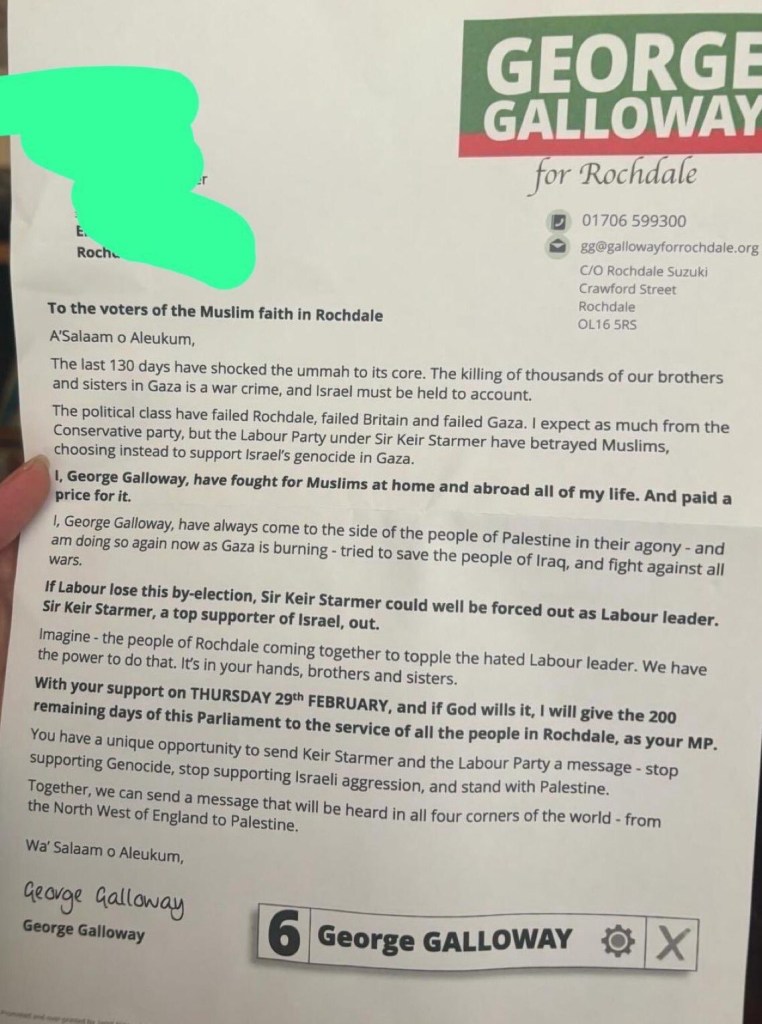
How did George Galloway come to send different canvassing info to different electors?

As electors went to the polls in the Rochdale by-election on 29 February, a few posts were made on social media showing the disparity between letters sent to different electors by candidate George Galloway. An example is here

On the face of it, Galloway appears to have hoped to persuade Muslim voters to vote for him based on his views on a topic or topics he felt would appeal to them, and others to vote for him based on his views on different topics.

It should be stressed that there is nothing at all wrong that in principle.

What interests me is how Galloway identified which elector to send which letter to.

It is quite possible that a candidate might identify specific roads which were likely to contain properties with Muslim residents. And that, also would not be wrong.

But an alternative possibility is that a candidate with access to the full electoral register, might seek to identify individual electors, and infer their ethnicity and religion from their name. A candidate who did this would be processing special categories of personal data, and (to the extent any form of automated processing was involved) profiling them on that basis.

Article 9(1) of the UK GDPR introduces a general prohibition on the processing of special categories of personal data, which can only be set aside if one of the conditions in Article 9(2) is met. None of these immediately would seem available to a candidate who processes religious and/or ethnic origin data for the purposes of sending targeted electoral post. Article 9(2)(g) provides a condition for processing necessary for reasons of substantial public interest, and Schedule One to the Data Protection Act 2018 gives specific examples, but, again, none of these would seem to be available: paragraph 22 of the Schedule permits such processing by a candidate where it is of “personal data revealing political opinions”, but there is no similar condition dealing with religious or ethnic origin personal data.

If such processing took place in contravention of the prohibition in Article 9, it would be likely to be a serious infringement of a candidate’s obligations under the data protection law, potentially attracting regulatory enforcement from the Information Commissioner, and exposure to the risk of complaints or legal claims from electors.

To be clear, I am not saying that I know how Galloway came to send different letters to different electors, and I’m not accusing him of contravening data protection law. But it strikes me as an issue the Information Commissioner might want to look into.

The views in this post (and indeed most posts on this blog) are my personal ones, and do not represent the views of any organisation I am involved with.

3 Comments

Filed under access to information, Data Protection, Data Protection Act 2018, data sharing, Information Commissioner, political parties, UK GDPR

EIR you sure you got that right?

Someone said they’d read this post if I wrote it. That’s miles more encouragement than I normally need, so here goes.

The other day, Tim Turner’s FOIDaily account pointed out how, after twenty-odd years, some public authorities still fail to identify when a request for information should be dealt with under the Environmental Information Regulations 2004 (EIR), rather than the Freedom of Information Act 2000 (FOIA). An example was given of Information Commissioner’s Office (ICO) identifying where a public authority had got this wrong.

As any fule kno, the two laws operate in parallel to create a regime for access to information held by public authorities, and it’s Regime 101 for a public authority to be able to know, and identify, when each applies. But, in short, if requested information is on, for instance, “measures (including administrative measures), such as policies, legislation, plans, programmes, environmental agreements, and activities affecting or likely to affect…the state of the elements of the environment, such as air and atmosphere, water, soil, land, landscape…” then the EIR, and not FOIA, apply.

I pointed out in the comments to the FOIDaily post that I’d seen a case where everyone, from the requester, to the public authority, to the ICO, to the First-tier Tribunal, had failed to deal with a case under the correct scheme.

This was it.

The case was about a request to a district council for information about whether a councillor had (in a private capacity) been required to pay any money to the council in relation to a fly-tipping incident or incidents. The request itself even referred to the Environmental Protection Act 1990, which was a very big hint that environmental information might be at issue.

What appears to have happened is that everyone jumped to the issue of whether disclosure of the requested information would contravene the councillor’s data protection rights. As most similar discussions take place in relation to the provisions of section 40 FOIA, the public authority, the ICO and the Tribunal (and presumably even the requester) all appear to have gravitated towards FOIA, without asking the correct first question: what is the applicable law? The answer to which was, clearly, EIR.

Regulation 13 of the EIR deals with personal data, and is cast in very similar terms to section 40 FOIA. It is, then, strongly arguable that, given that similarity, both the ICO and the Tribunal would have arrived at the same decision whichever regime applied. But Parliament has chosen to have two separate laws, and this is because they have a different genesis (EIR emanate from EU law which in turn emanates from international treaty obligations). Additionally, where all things are otherwise equal, the EIR contain an express presumption in favour of disclosure (something that is not the case in relation to personal data under the FOIA regime – see Lord Hope’s opinion in Common Services Agency v Scottish Information Commissioner).

As Tim implies in his post, the EIR have always been seen as somehow inferior, or subservient, to FOIA. No doubt this is because they are in the form of secondary legislation, rather than statute. This is more an accident of history, rather than of constitutional significance, and is never going to be relevant in most practice. But if the ICO and the courts continue to miss their relevance, it shouldn’t be that surprising that some public authorities will also do so.

The views in this post (and indeed most posts on this blog) are my personal ones, and do not represent the views of any organisation I am involved with.

Leave a comment

Filed under access to information, Environmental Information Regulations, Freedom of Information, Information Commissioner, Information Tribunal