Category Archives: Information Commissioner

Attend ICO DP conference, get unsolicited marketing from a hotel…

I greatly enjoyed yesterday’s (2 March 2015) Data Protection Practitioner Conference run by the Information Commissioner’s Office. I was representing NADPO on our stand, and the amount of interest was both gratifying and illustrative of the importance of having a truly representative body for professionals working in the field of information rights. NADPO were at pains – in running our prize draw (winners picked at random on stage by Information Commissioner Christopher Graham) – to make sure we let participants know what would or would not happen with their details. Feedback from delegates about this was also positive, and I’m pleased at least one privacy professional picked up on it.  Therefore the irony of the following events is not lost on me.

I’d stayed overnight on Sunday, in a Macdonald hotel I booked through the agency Expedia. Naturally, I’m not one to encourage the sending to me of direct electronic marketing, and as the unsolicited sending of such marketing is contrary to regulation 22 of the Privacy and Electronic Communications (EC Directive) Regulations 2003 I didn’t expect to receive any, either from the agent or the hotel. Yet yesterday I did receive some, from the hotel group. So I’ve sent them this complaint:

I booked the hotel through your agent, Expedia.co.uk. As a professional working in the field of privacy and data protection I always make sure I opt out of any electronic marketing. Hence, when making my booking, I checked the Expedia box which said

“Check the box if you do not want to receive emails from Expedia with travel deals, special offers, and other information”.

However, I also consulted their privacy policy, which says:

“Expedia.co.uk may share your information with [suppliers] such as hotel, airline, car rental, and activity providers, who fulfill your travel reservations. Throughout Expedia.co.uk, all services provided by a third-party supplier are described as such. We encourage you to review the privacy policies of any third-party travel supplier whose products you purchase through Expedia.co.uk. Please note that these suppliers also may contact you as necessary to obtain additional information about you, facilitate your travel reservation, or respond to a review you may submit.”

I then consulted Macdonald Hotels’ privacy policy, but this seems to relate only to your website, and is silent on the use of clients’ data passed on by an agent.

Accordingly, I cannot be said to have consented to the sending by you to me of electronic marketing. Yet yesterday at 13.07 I received an email saying “Thank you for registering with Macdonald Hotels and Resorts…As a member of our mailing list you will shortly start to receive [further unsolicited electronic marketing].”

Ironically enough, I was in Manchester to attend the annual Data Protection Practitioners’ Conference run by the Information Commissioner’s Office (ICO). As you will be aware, the ICO regulates compliance with the Privacy and Electronic Communications (EC Directive) Regulations 2003 (PECR). Before I raise a complaint with the ICO I would appreciate a) your removing me from any marketing database b) not receiving any further unsolicited marketing, and c) receiving your comments regarding your apparent breach of your legal obligations.

Each instance of unsolicited marketing is at best one of life’s minor irritants, but I have concerns that, because of this, some companies treat compliance with legal obligations as, at best, a game in which they try to trick customers into agreeing to receiving marketing, and at worst, as unnecessary. It may be that I received this particular unsolicited marketing from Macdonald Hotels by mistake (although that in itself might raise data protection concerns about the handling of and accuracy of customer data) but it happens too often. The media have rightly picked up on the forthcoming changes to PECR which will make it easier for the ICO to take enforcement actions regarding serious contraventions, but, sadly, I don’t see the lower level, less serious contraventions, decreasing.

The views in this post (and indeed all posts on this blog) are my personal ones, and do not represent the views of any organisation I am involved with.
Leave a comment

Filed under consent, Data Protection, Information Commissioner, marketing, PECR

ACPO encourage the sending of identity documents over insecure connection

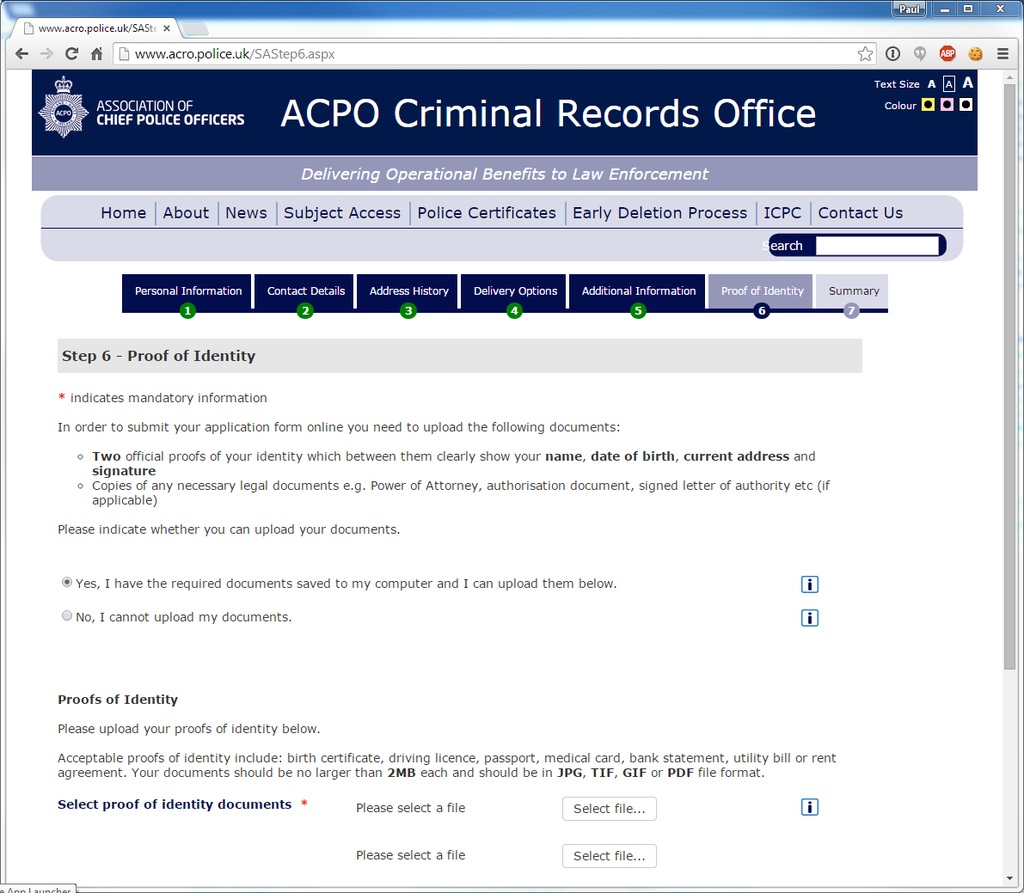
ACPO – the Association of Chief Police Officers – are inviting people to send online data protection subject access request including copies of proof of identity, such as passports or bank statements over an insecure http connection. This is almost certainly in breach of ACPOs obligations under the Data Protection Act.

One of the most important rights under data protection law is that of “subject access”. Section 7 of the Data Protection Act 1998 (DPA) provides, in broad terms, that a person may require an organisation to say whether it is processing data about that person, and if so, to be given a copy of it. It was, for instance, through exercise of this subject access right that six journalists recently discovered that they were on the National Domestic Extremism and Disorder Intelligence database. The DPA recognises the importance of this right by enshrining it in its Schedule One Principles – the sixth principle obliges data controllers to process personal data in accordance with data subjects’ rights under the Act.

The following principle – the seventh – is the one which deals with data security, and it requires data controllers to have appropriate measures in place to safeguard against loss of personal data. The Information Commissioner’s Office (ICO) explains why this is important:

Information security breaches may cause real harm and distress to the individuals they affect – lives may even be put at risk. Examples of the harm caused by the loss or abuse of personal data (sometimes linked to identity fraud) include
– fake credit card transactions;
– witnesses at risk of physical harm or intimidation;
– offenders at risk from vigilantes;
– exposure of the addresses of service personnel, police and prison officers, and women at risk of domestic violence…

But a tweet yesterday (22.02.15) by Information Security consultant Paul Moore alerted that ACPO’s criminal records office has a website which invites data subjects to make an online request but, extraordinarily, provides by an unencrypted http rather than encrypyted https connection.

image1

This is such a basic data security measure that it’s difficult to understand how it has happened – and to confirm their identity people are being encouraged to send highly confidential documents, such as passports, over an unsecure connection. The ICO points out that

Failure to provide the first assurance (encryption) means that any sensitive information transmitted will be viewable via any computer system on the route between the two systems

At a time when there are moves to encrypt all web traffic, the failure to offer encryption on such profoundly sensitive issues as information held by police, and identity documents, is jaw-dropping. The ICO was copied in to subsequent tweets, and it will be interesting to see what action they take.

The views in this post (and indeed all posts on this blog) are my personal ones, and do not represent the views of any organisation I am involved with.

6 Comments

Filed under Data Protection, data security, Information Commissioner, police

What’s happening with changes to anti-spam laws?

In October last year the Department for Culture Media and Sport (DCMS) announced a consultation to lower, or even remove, the threshold for the serving financial penalties on those who unlawfully send electronic direct marketing. I wrote at the time that

There appears to be little resistance (as yet, at least) to the idea of lowering or removing the penalty threshold. Given that, and given the ICO’s apparent willingness to take on the spammers, we may well see a real and significant attack on the scourge

The Information Commissioner’s Office (ICO) and DCMS both seemed at the time to be keen to effect the necessary legislative changes to amend the Privacy and Electronic Communications (EC Directive) Regulations 2003 (PECR) so that, per the mechanism at section 55A of the Data Protection Act 1998 (DPA), adopted by PECR by virtue of regulation 31, either a serious contravention alone of PECR, or a serious contravention likely to cause annoyance, inconvenience or anxiety, could give rise to a monetary penalty without the need to show – as now – likely substantial damage or substantial distress.

However, today, the Information Commissioner himself, Christopher Graham, gave vent to frustrations about delay in bringing about these changes:

Time and time again the Government talks about changing the law and clamping down on this problem, but so far it’s just that – talk. Today they are holding yet another roundtable to discuss the issue, and we seem to be going round in circles. The Government need to lay the order, change the law and bring in a reform that would make a real difference

So what has happened? Have representatives of direct marketing companies lobbied against the proposals? It would be interesting to know who was at today’s “roundtable” and what was said. But there was certainly an interesting tweet from journalist Roddy Mansfield. One hopes a report will emerge, and some record of the meeting.

One wonders why – if they are – marketing industry bodies might object to the proposed changes. The financial penalty provisions would only come into play if marketers failed to comply with the law. Spammers would get punished – the responsible companies would not.

The views in this post (and indeed all posts on this blog) are my personal ones, and do not represent the views of any organisation I am involved with.

1 Comment

Filed under Data Protection, Information Commissioner, marketing, monetary penalty notice, PECR, spam texts

A bad day in court

If the Information Commissioner (IC) reasonably requires any information for the purpose of determining whether a data controller has complied or is complying with the data protection principles, section 43 of the Data Protection Act 1998 (DPA) empowers him to serve a notice on the data controller requiring it to furnish him with specified information relating to compliance with the principles. In short, he may serve an “information notice” on the data controller which requires the latter to assist him by providing relevant information. A data controller has a right of appeal, to the First-tier Tribunal (Information Rights) (FTT), under section 48 DPA.

These provisions have recently come into play in an appeal by Medway Council of an IC Information Notice. That it did not go well for the former is probably rather understating it.

It appears that, back in 2012, Medway had a couple of incidents in which sensitive personal data, in the form of special educational needs documents, was sent in error to the wrong addresses. Medway clearly identified these as serious incidents, and reported themselves to the IC’s Office. By way of part-explanation for one of incidents (in which information was sent to an old address of one of the intended recipients), they pointed to “a flaw in the computer software used”.  Because of this explanation (which was “maintained in detail both in writing and orally”) the ICO formed a preliminary view that there had been a serious contravention of the seventh data protection principle (which is, let us remind ourselves “Appropriate technical and organisational measures shall be taken against unauthorised or unlawful processing of personal data and against accidental loss or destruction of, or damage to, personal data”). Moreover, the ICO served a Notice of Intent to serve a Monetary Penalty Notice (MPN). Upon receipt of this, it appears that Medway changed their explanation and said that the incident in question was a result of human error and that there was “no evidence of a ‘system glitch’”. It appears, however, that the ICO was concerned about discrepancies, and insufficient explanation of the change of position, and served a section 43 information notice requiring Medway to “provide a full explanation of how the security breach on 10 December 2012 occurred”. This was the notice appealed to the FTT.

However, during the FTT proceedings a third explanation for the incidents emerged, which seemed to combine elements of human error and system glitches. This was, observed the FTT, most unsatisfactory, saying, at paragraphs 28 and 29:

not only is this a third explanation of the breach but it is inconsistent with the other 2 explanations and is internally incoherent… The Tribunal is satisfied that there is still no reliable, clear or sufficiently detailed explanation of the incident to enable the Commissioner to be satisfied of:

a) what went wrong and why,
b) whether there was any prior knowledge of the potential for this problem,
c) what if any procedures were in place to avoid this type of problem at the relevant date,
d) why the Commissioner and the Tribunal have been provided with so many inaccurate and inconsistent accounts.

But even more ominously (paragraph 30)

The evidence provided to the Commissioner and the Tribunal has been inconsistent and unreliable and the Tribunal agrees with the Commissioner that it is reasonable that he should utilize a mechanism that enables him to call the Council to account if they recklessly [make] a statement which is false in a material respect  in light of the various contradictory and conflicting assertions made by the Council thus far

The words in italics are from section 47(2)(b) DPA, and relate to the potential criminal offence of recklessly making a material false statement in purported compliance with an information notice.

Finally, Medway’s conduct of the appeal itself came in for criticism: inappropriate, inconsistent and insufficient redactions were made in some materials submitted, and some evidence was sent in with no explanation of source, date or significance.

It is rare that information notices are required – most data controllers will comply willingly with an ICO investigation. It is even more rare that one is appealed, and maybe Medway’s recent experience shows why it’s not necessarily a good idea to do so. Medway may rather regret their public-spirited willingness to own up to the ICO in the first place.

The views in this post (and indeed all posts on this blog) are my personal ones, and do not represent the views of any organisation I am involved with.

1 Comment

Filed under Breach Notification, Data Protection, enforcement, Information Commissioner, information notice, Information Tribunal, monetary penalty notice

Helping the ICO with databreach alerts?

Last weekend I noticed some tweets from the ever-vigilant Dissent Doe. She said

I’ve spent 5 min on NHS’s web site and still can’t figure out how/where to report or question an IT security issue. Anyone?…It’s 2015. It really shouldn’t be so hard to find a contact email to use to notify an entity of a security breach or vulnerability…So I finally said, “screw this waste of my time,” and emailed @ICOnews to alert them and ask them to pass the notification to #NHS

Knowing that she wouldn’t tweet this without good reason I made contact, and she referred me to a list of what looked like serious data security vulnerabilities on a range of NHS websites. The list had been posted openly on the internet by a well-known hacker (for obvious reasons I won’t link to it).

In response, I contacted an NHS Information Governance professional, who quickly pointed me towards the IG Alliance. I sent emails to two people, but have not yet had a reply. I even tweeted Tim Kelsey, the NHS’s National Director for Patients and Information, but he didn’t reply. Eventually, a contact managed to contact someone else (I’m being deliberately vague) and I have some reassurance that action will now be taken.

But when I told Dissent Doe this, earlier today (06.02.15) she, although pleased at that outcome, expressed surprise that she had not heard anything from the Information Commissioner’s Office (ICO), whom she had alerted last Sunday. I told her that this had been my, and others’, experience when reporting serious concerns about data protection and data security. The ICO is tremendously over-stretched, and can’t immediately respond to all queries and concerns raised, but there is a community of knowledgeable and dedicated professionals who can help. One of the ICO’s main regulatory roles is, after all

to promote the following of good practice by data controllers and, in particular, so to perform his functions under this Act as to promote the observance of the requirements of this Act by data controllers

Indeed, I’ve written on the subject before, and suggested this

I think the ICO should consider operating a priority alert system when well-informed third-parties alert them to exposures of personal data. They certainly shouldn’t leave those third parties to do in-depth investigation.

I didn’t get a comment from the ICO when I wrote that previous post, but I also didn’t ask them for one. This time I will, and I’ll report back on what their response is.

The views in this post (and indeed all posts on this blog) are my personal ones, and do not represent the views of any organisation I am involved with.

Leave a comment

Filed under Breach Notification, Data Protection, Information Commissioner

Online privacy – a general election battleground

It’s becoming increasingly clear that one of the key battlegrounds in the 2015 General Election will be online. The BBC’s Ross Hawkins reports that the Conservatives are spending large amounts each month on Facebook advertising, and Labour and UKIP, while not having the means to spend as much, are ramping up their online campaigning. But, as Hawkins says

the aim is not to persuade people to nod thoughtfully while they stare at a screen. They want consumers of their online media to make donations or, even better, to get their friends’ support or to knock on doors in marginal constituencies…[but] for all the novelties of online marketing, email remains king. Those Tory Facebook invoices show that most of the money was spent encouraging Conservative supporters to hand over their email addresses. Labour and the Conservatives send emails to supporters, and journalists, that appear to come from their front benchers, pleading for donations

I know this well, because in July last year, after growing weary of blogging about questionable compliance with ePrivacy laws by all the major parties and achieving nothing, I set a honey trap: I submitted an email address to the Conservative, Labour, LibDem, Green, UKIP, SNP and Plaid Cymru websites. In each case I was apparently agreeing with a proposition (such as the particularly egregious LibDem FGM example)  giving no consent to reuse, and in each case there was no clear privacy notice which accorded with the Information Commissioner’s Office’s Privacy Notices Code of Practice (I do not, and nor does the ICO, at least if one refers to that Code, accept that a generic website privacy policy is sufficient in case like this). Since then, the fictional, and trusting but naive, Pam Catchers (geddit??!!) has received over 60 emails, from all parties contacted. A lot of them begin, “Friend, …” and exhort Pam to perform various types of activism. Of course, as a fictional character, Pam might have trouble enforcing her rights, or complaining to the ICO, but the fact is that this sort of bad, and illegal, practice, is rife.

To be honest, I thought Pam would receive more than this number of unsolicited emails (but I’m probably more cynical than her). But the point is that each of these emails was sent in breach of the parties’ obligations under the Privacy and Electronic Communications (EC Directive) Regulations 2003 (PECR) which demands that recipients of electronic direct marketing communications must have given explicit consent prior to the sending. By extension, therefore, the parties are also in breach of the Data Protection Act 1998 (DPA), which, when requiring “fair” processing of personal data, makes clear that a valid privacy notice must be given in order to achieve this.

The ICO makes clear that promotion by a political party can constitute direct marketing, and has previously taken enforcement action to try to ensure compliance. It has even produced guidance for parties about their PECR and DPA obligations. This says

In recent years we have investigated complaints about political parties and referendum campaigners using direct marketing, and on occasion we have used our enforcement powers to prevent them doing the same thing again. Failure to comply with an enforcement notice is a criminal offence.

But by “recent” I think they are referring at least six years back.

A data controller’s compliance, or lack thereof, with data protection laws in one area is likely to be indicative of its attitude to compliance elsewhere. Surely the time has come for the ICO at least to remind politicians that online privacy rights are not to be treated with contempt?

The views in this post (and indeed all posts on this blog) are my personal ones, and do not represent the views of any organisation I am involved with.

2 Comments

Filed under consent, Data Protection, enforcement, Information Commissioner, marketing, PECR, privacy notice

No data protection “fines” for audited NHS bodies

UPDATE: 03.02.15 GPOnline have commendably now amended their piece on this END UPDATE

GPOnline warns its readers today (02.02.15) that

GP practices face compulsory audits from this month by the information commissioner to check their compliance with data protection laws, and could be fined heavily if they are found to have breached rules.

While it’s good that it is on the ball regarding the legal change to the Information Commissioner’s Office (ICO) audit powers, it is, in one important sense, wrong: I can reassure GP practices that they are not risking “fines” (more correctly, monetary penalty notices, or MPNs) if breaches of the law are found during an ICO audit. In fact, the law specifically bars the ICO from serving an MPN on the basis of anything discovered in the process of an audit.

Under s41A of the Data Protection Act 1998 (DPA) the ICO can serve a data controller with a notice “for the purpose of enabling the Commissioner to determine whether the data controller has complied or is complying with the data protection principles”. Until yesterday, this compulsory audit power was restricted to audits of government departments. However, the Data Protection (Assessment Notices) (Designation of National Health Service Bodies) Order 2014, which commenced on 1 February 2015, now enables the ICO to perform mandatory data protection audits on NHS bodies specified in the schedule to the Order.  Information Commissioner Christopher Graham has said

We fine these organisations when they get it wrong, but this new power to force our way into the worst performing parts of the health sector will give us a chance to act before a breach happens

And I think he chose those words carefully (although he used the legally inaccurate word “fine” as well). Section 55A of the DPA gives the ICO the power to serve a monetary penalty notice, to a maximum of £500,000, if he is “satisfied” that – there has been a serious contravention of the DPA by the data controllers and it was of a kind likely to cause substantial damage or substantial distress and the data controller knew or ought to have known that this would happen. However section 55A(3A) provides that the ICO may not be so “satisfied”

by virtue of any matter which comes to the Commissioner’s attention as a result of anything done in pursuance of…an assessment notice

This policy reason behind this provision is clearly to encourage audited data controllers to be open and transparent with the ICO, and not be punished for such openness. GP practices will not receive an MPN for any contraventions of the DPA discovered during or as a result of a section 41A audit.

The views in this post (and indeed all posts on this blog) are my personal ones, and do not represent the views of any organisation I am involved with.

1 Comment

Filed under Data Protection, Information Commissioner, monetary penalty notice, NHS

The ICO and records management

The Tribunal is an unusual position in respect of this Appeal…”

The Freedom of Information Act 2000 (FOIA) requires a public authority, when someone makes a request for information, to say whether or not it holds it, and if it does, to disclose that information to the requester (subject to the application of any exemption). But what if it doesn’t know whether it holds it or not? What if, after it has said it can’t find the information, and after the Information Commissioner’s Office (ICO) has accepted this and issued a decision notice upholding the authority’s approach, it then discovers it held it all along? This is the situation the First-tier Tribunal (FTT) recently found itself faced with.

The facts of the case are relatively complex, but the issues turned on whether briefing notes, prepared for the Mayor of Doncaster Metropolitan Borough Council (DMBC) in the lead-up to a decision to withdraw funding for DMBC’s United Nations Day, could be found. The ICO had determined, in Decision Notice FS50503811 that

Ultimately the Commissioner had to decide whether a set of briefing notes were held by the Council. His decision, on the balance of probabilities, is that it does not

The requester appealed to the FTT, which, after initially considering the matter on the papers, ordered an oral hearing because of some apparent inconsistencies in DMBC’s evidence (I have to be frank, what exactly these were is not really clear from the FTT’s judgment (at paragraph 27). However, prior to that oral hearing DMBC located the briefing notes in question, so

the focus of the oral hearing was limited simply to establishing whether, at the time of the information request by the Appellant, DMBC knew that it held the information in the light of the searches that it had made in response to the Information Commissioner’s enquiries prior to his issuing the Decision Notice

In determining that it was satisfied that DMBC did not know, at the time of the request, that it held the information, the FTT was swayed by the fact that DMBC “even during the Information Commissioner’s enquiries, DMBC had maintained it had nothing to gain from ‘hiding’ the briefing notes” but also by the fact that DMBC owned up to poor records management practice in the period leading up to the request

In many senses it is more embarrassing for DMBC now to admit the truth that it had, historically, an unreliable and ineffective Records Management system than to continue to maintain that it could not find the requested information

It doesn’t surprise me that the FTT found as it did. What does surprise me, however, is that records management is not given a greater focus by the ICO. Although FOIA is not, primarily, a records management act, it does contain provisions relating to records management. Powers do exist both to help improve practice both generally (through guidance) and specifically (through the use of practice recommendations). As I’ve written before

section 46 of FOIA [requires] the Lord Chancellor to issue a code of practice for management of records. Section 9 of that Code deals with the need to keep records in systems that enable records to be stored and retrieved as necessary, and section 10 with the need to know what records are held and where they are.

Under section 47 of FOIA the [ICO] must promote the following of good practice by public authorities and perform his functions so as to promote the observance by authorities of the section 46 Code, as well as the requirements of the Act in general. And under section 48 he may issue a “practice recommendation” if it appears to him that the authority has not conformed with the section 46 Code. In investigating compliance with the Code he has the power (section 51) to issue an “information notice” requiring the authority to furnish him with the information. Failure to comply with an information notice can, ultimately, constitute contempt of court.

I appreciate that the ICO has a lot on its hands, but good records management is so very integral not just to good FOIA compliance, but also to good compliance with the other major statute the ICO oversees – the Data Protection Act 1998. Greater focus on records management could drive better overall compliance with information rights law.

The views in this post (and indeed all posts on this blog) are my personal ones, and do not represent the views of any organisation I am involved with.

1 Comment

Filed under Data Protection, Freedom of Information, Information Commissioner, records management

The monetary penalty notice is in the post

UPDATE: 29.01.15 The BBC now reports that files relating to the role of the police in the deaths of two other members of the public have apparently been “lost in the post”. This starts to look very serious.  END UPDATE

I once heard a rumour that the famous lost HMRC disks of 2007 were not in fact lost after all: the person tasked with posting the disks had, so the rumour went, forgotten to do so, and when the intended recipient, the National Audit Office, had complained, had used the time-honoured excuse “they must be lost in the post”, thinking that this was better than owning up, and that no one would be particularly bothered. I have no idea whether this is true (quite possibly not – the subsequent Poynter report was comprehensive and might have been expected to flush something like that out) but what I think is interesting is that, even if it were, it would not have excused HMRC. The Data Protection Act 1998 (DPA) – which largely languished unloved at the time – requires (by virtue of the seventh principle in Schedule One) a data controller not to prevent specific instances of data loss, but, rather, to take appropriate organisational and technical measures to safeguard against such loss – a contravention of the Act lies in the failure to have these measures in place, not (necessarily) in the failure to prevent a specific incident. The fact that HMRC operated procedures which allowed the sending of huge and excessive amounts of sensitive personal data  by post, without encryption measures being used, meant that HMRC were manifestly in contravention of the DPA.

Fast forward seven years or so to the present, and, we hear, the Ministry of Justice (MoJ) appear to have lost a highly sensitive computer disk in the post. The Mail on Sunday reports that

The Government has been hit by a new data security scandal after a secret file on the fatal shooting of Mark Duggan by police went missing.

A computer disk containing details of the case which triggered Britain’s worst riots in a generation is thought to have been lost in the post by the Ministry of Justice.

Details are, of course, relatively scant at the moment, but it is worth noting that there is no mention of whether the disk in question was encrypted. If it wasn’t, it would be extremely hard for the MoJ to argue that it was in compliance with its DPA obligations: the view of the Information Commissioner (ICO) is that

portable and mobile devices including magnetic media, used to store and transmit personal information, the loss of which could cause damage or distress to individuals, should be protected using approved encryption software which is designed to guard against the compromise of information.

and

where such losses occur and where encryption software has not been used to protect the data, regulatory action may be pursued.

The data protection regulatory landscape was very different in 2007, and the ICO did not then have powers to serve monetary penalty notices. A serious contravention of the DPA of a kind likely to cause substantial damage or substantial distress can now result in a “fine” of up to £500,000.

The ICO is, we are told, “examining the case”. He will, no doubt, be wanting to know not only about encryption measures, but, more simply, what procedures were in place which allowed such sensitive data to be sent by post. He will also, again no doubt, bear in mind that in recent years he has already served on the MoJ, in the last eighteen months, two monetary penalties totalling £320,000 for not dissimilar failures to have appropriate safeguards in place to protect sensitive personal data.

The views in this post (and indeed all posts on this blog) are my personal ones, and do not represent the views of any organisation I am involved with.

1 Comment

Filed under Data Protection, Information Commissioner, Ministry of Justice, monetary penalty notice

UKIP Dartford and data protection compliance

The Telegraph recently highlighted a rather bizarre incident involving the sending of a letter by the secretary of UKIP’s Dartford branch. The letter purports to be from a Simon Blanchard in his capacity as, or as a representative of UKIP Dartford. It appears that Mr Blanchard had taken offence at what he said was a verbal insult directed at him by the recipient of the letter, a Mr Kemp, and chose to write expressing his annoyance both at this, and also expressing his rather extraordinary interpretation of the effect of European Union laws on the UK. But Mr Blanchard did something else – he sent copies of the letter to Mr Kemp’s neighbours. In doing so it is questionable whether Mr Blanchard, and UKIP Dartford, have complied with their obligations under the Data Protection Act 1998 (DPA).

I am presuming that UKIP Dartford is the local constituency association for UKIP. As such, to the extent that it processes personal data of people of identifiable individuals, and determines the purposes for which and the manner in which the processing occurs, it is a data controller. Constituency associations of political parties are distinct from their national parties (they are often at odds with their national parties) and many Labour and Conservative constituency associations recognise this, by registering their processing with the Information Commissioner’s Office (ICO). Indeed, as data controllers not otherwise exempt, they have a legal obligation (section 18 of the Data Protection Act 1998 (DPA)) to do so, and failing to do so, in circumstances where they are processing personal data and cannot avail themselves of an exemption, is a criminal offence (section 21 DPA). I note that UKIP Dartford don’t have an entry on the ICO’s online register – this (and the broader issue of constituency association registration) might be something the ICO should consider investigating.

Furthermore, if it is a data controller, UKIP Dartford will have a statutory obligation (section 4(4) DPA) to comply with the data protection principles. The first of these is that personal data should be processed “fairly and lawfully”. It is not immediately obvious how Blanchard came to have Mr Kemp’s name and address, but, assuming they were gathered lawfully, the sending of the letter itself may well have been fair and lawful. But where problems would be more likely to emerge, I would suggest, would be in the sending by Blanchard of copies of the letter – containing as it did Mr Kemp’s personal data – to neighbours. “Fairness” in the DPA depends a lot on data subjects’ expectations, and it is hard to believe that the recipient of such a letter would have expected it to be circulated among his neighbours.

It is possible that Mr Blanchard came about the name and address details under regulation 105 of the Representation of the People (England and Wales) Regulations 2001 (as amended), whereby local constituency parties may apply for a copy of the full electoral register. It is important to note, however that, by regulation 105(4), the register can only be used for “electoral purposes or the purposes of electoral registration”. Although one can see that “electoral purposes” might be construed broadly, it is difficult to construct an argument that the sending of the copy-letters, containing the original recipient’s personal data, could possibly have been for electoral purposes. For these reasons, a contravention of the second DPA principle would appear to be likely. That principle restricts further processing of personal data in a manner incompatible with the original purposes.

It may be that there is more to this story than is immediately apparent. Perhaps Mr Blanchard and UKIP Dartford acquired Mr Kemp’s data in a different manner. Perhaps they thought they had consent to send it his neighbours (although given that Mr Kemp’s wife complained – and received the peremptory response “There was no error made on the envelope and hope your neighbours had a good read as well” – this seems unlikely). If more details emerge I will update this post, but in the interim, I can say that the story certainly raises questions about DPA compliance.

The forthcoming general election is likely to see battles fought in many fields (I’ve already drawn attention to the possibility that the legal boundaries of electronic marketing may get pushed to the point of breach on these battlegrounds). One hopes that the ICO will be robust enough to deal with the data protection issues which will emerge, which might include excessive or disproportionate use of people’s personal electoral data.

The views in this post (and indeed all posts on this blog) are my personal ones, and do not represent the views of any organisation I am involved with.

Leave a comment

Filed under Data Protection, Information Commissioner