Category Archives: subject access

Chief Constable in contempt over body-worn-video footage disclosure failures

The Court of Appeal has handed down an extraordinary judgment (Buzzard-Quashie v Chief Constable of Northamptonshire Police [2025] EWCA Civ 1397) in which the Chief Constable of Northamptonshire was forced to admit civil contempt of court, after camera footage, which the police force had repeatedly insisted, including before the lower courts, and also in response to an express order of the county court, did not exist, was found to exist just before the appeal hearing.

The appellant/applicant, Ms Buzzard-Quashie, had been arrested and initially charged with an offence in 2021. The arrest had involved three officers, all of whom had deployed body-worn-video cameras. Ms Buzzard-Quashie had complained about the arrest very shortly afterwards, and had sought copies of the footage. Although the charge was dropped, the force made only “piecemeal” disclosure, before determining that there was no further footage, or what there had been, had been destroyed.

At that point, she complained to the Information Commissioner’s Office, who told her that it had told the force “to revisit the way it handled your request and provide you with a comprehensive disclosure of the personal data to which you would be entitled as soon as possible”. (Here, the court – I believe – slightly misrepresents this as an “order” by the ICO. The ICO has the power to make an order, by way of an enforcement notice, but it does not appear to have issued a notice (and it would be highly unusual for it to do so in a case like this).)

The force did not do what the ICO had told it to do, so Ms Buzzard-Quashie issued proceedings in the Brentford County Court and obtained an order requiring the force to deliver up to her any footage in its possession or, if none was available or disclosable, to provide a statement from an officer “of a rank no lower than Inspector” explaining why it could not. It also required the force to pay her costs.

Remarkably, the force did not comply with any element of this order. This failure led to Ms Buzzard-Quashie initiating contempt proceedings in the High Court. At that hearing the Chief Constable, in evidence, maintained that that a full search had already been performed; all the footage had been produced; no other footage existed; and he was not in contempt. The judge found that Ms Buzzard-Quashie had not succeeded in establishing to the criminal standard that the Chief Constable was in contempt.

Upon appeal, and just before the hearing, primarily through the efforts of Ms Buzzard-Quashie and her lawyers (acting pro bono), the force was compelled to admit that footage did still exist: its searches had been manifestly inadequate.

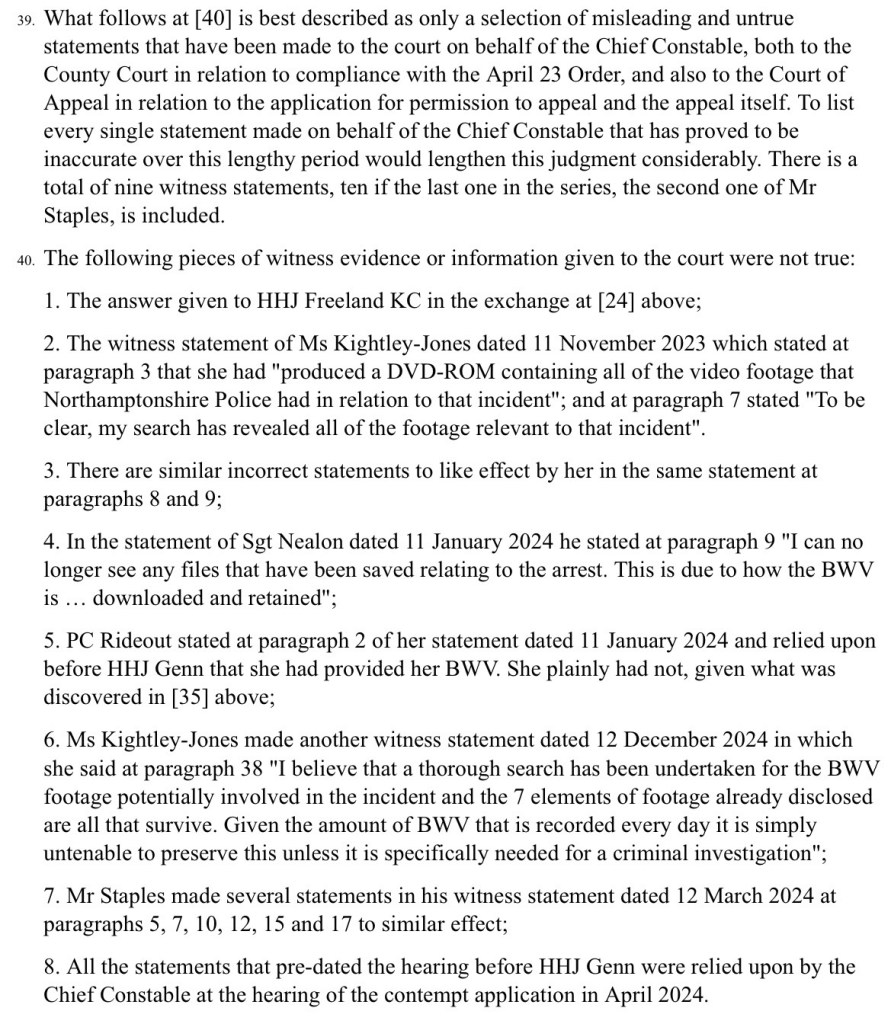
The CoA found that eight pieces of information and evidence (and this was “only a selection”) had not been true, and that “the Chief Constable had not only failed to comply with the [County Court] Order in both substance and form, but had advanced a wholly erroneous factual case before that court, and before this court as well”. Ms Buzzard-Quashie clearly succeeded in her appeal.

The judgment records that the issue of sanction for the contempt found “must wait until the next round of the process”, which presumably will be a further (or perhaps remitted) hearing.

There are any number of issues arising from this. It is, for example, notable that the data protection officer for the force was involved in the searches (and, indeed, she gave the initial statement that the County Court had ordered be given by an Inspector or above).

But a standout point for me is how incredibly difficult it was for Ms Buzzard-Quashie to vindicate her rights: the police force, for whatever reason, felt able to disregard both the statutory regulator and an order of a court. She and her pro bono lawyers showed admirable tenacity and skill, but those features (and that pro bono support) are not available to everyone. One welcomes the fact that all three judges noted her efforts and those of the lawyers.

The force has referred itself to the Independent Office of Police Conduct, and the Court of Appeal has reinforced that by making the referral part of its own order.

In this post I’ve tried to summarise the judgment, but I would strongly encourage its reading. The screenshot here is merely part of the damning findings.

The views in this post (and indeed most posts on blog) are my personal ones, and do not represent the views of any organisation I am involved with.
Leave a comment

Filed under access to information, Body worn video, Data Protection, Information Commissioner, judgments, police, subject access

Recital 63 of the GDPR is nonsensical

[reposted from my LinkedIn account]

I’m sure I’ve mentioned this before (but that sort of thing never stops me banging on about stuff) but whenever I read recital 63 of the GDPR it irritates me, because a comma is in the wrong place. The result is that the clause in question is slightly nonsensical. It reads:

A data subject should have the right of access to personal data which have been collected concerning him or her, and to exercise that right easily and at reasonable intervals, in order to be aware of, and verify, the lawfulness of the processing.

The literal reading of that clause is that the right of access exists in order that a data subject can be “aware of the lawfulness” of processing and “verify the lawfulness” of processing. The latter is fine on its own but what does the former mean? And if one becomes “aware of the lawfulness” of the processing then why should one then “verify” it?

Surely the need is to be aware of the processing, and then verify its lawfulness?

Clearly, the comma should be moved, so it says

…in order to be aware of, and verify the lawfulness of, the processing.

And when I’m Prime Minister a UK GDPR (Recital 63 Correction) Amendment Bill is the first thing I will table.

The views in this post (and indeed most posts on blog) are my personal ones, and do not represent the views of any organisation I am involved with.

2 Comments

Filed under Data Protection, GDPR, nonsense, subject access, UK GDPR

Subject access, Leeds United, and ****

[reposted from my LinkedIn account]

You’d have thought most football fans would be keen to prove they’d not attended a Leeds United match [#bantz], but when Melvyn Flower was told by the club he couldn’t renew his season ticket for next season, because he’d not used his current one often enough, he resorted to data protection law to vindicate his support for the club.

The information disclosed to him showed that he attended matches on all the occasions the club had said he hadn’t.

I don’t quite understand how the club searched for and disclosed his personal data, without (when doing so) realising its mistake (maybe he asked for footage from a specific camera near his reserved seat). But in any case, it’s a nice little story, and topped off with an excellent point from Mr Flower:

Why would I buy a season ticket and not go this season, of all seasons, given the **** I’ve sat through since 1978?

1 Comment

Filed under Data Protection, not-entirely-serious, Sport, subject access

A new data protection duty?

I’ve been looking in more detail at the recent subject access judgment in Ashley v HMRC. One key point of general application stands out for me, and that is that it states that in some cases (i.e. where it is necessary for intelligibility purposes) a controller has a duty to provide contextual information in addition to copies of personal data.

As the judge put it

Article 15(1) and 15(3), read with Article 12(1) and (2) of the UK GDPR, did require the Defendant to go beyond providing a copy of the Claimant’s personal data where contextual information was necessary for that personal data to be intelligible in the sense of enabling the data subject to exercise their rights conferred by the UK GDPR effectively. It follows that insofar as the Defendant did not adopt this approach, it was in breach of this duty.

And although she couched the following as “guidance” for the HMRC when reconsidering the request, I feel it has general application:

…it is unlikely that providing an extract that simply comprises the Claimant’s name or his initials or other entirely decontextualised personal data of that sort, will amount to compliance with this obligation.

In arriving at this conclusion the judge drew in part on both pre- and post-Brexit case law of the Court of Justice of the European Union. Most notably she decided to have regard to case C-487/21. Even though this does not bind the domestic courts, the effect of section 6(2) of European Union (Withdrawal) Act 2018 is that courts may have regard to EU case law where it is relevant to the matter before them.

Of course, there are also times when merely providing a snippet in the form of a name constitutes a failure to provide all of the personal data in scope (omitting the final five words of “Jon Baines works at Mishcon de Reya” would be to omit some of my personal data). But the “context duty” seems to me to go further, and creates, where it is necessary, an obligation to provide information beyond what is in the source documents.

Most of the other points in the judgment, as important as they were to the facts, and as interesting they are, particularly on the concept of “relating to” in the definition of “personal data”, will not necessarily change things for most data subjects and controllers.

But this “context duty” feels to me to be an advancement of the law. And I suspect controllers can now expect to see data subjects and their lawyers, when making subject access requests (or when challenging responses), begin to argue that the “context duty” applies.

The views in this post (and indeed most posts on blog) are my personal ones, and do not represent the views of any organisation I am involved with.

Leave a comment

Filed under Data Protection, GDPR, judgments, subject access, UK GDPR

Can a data subject inspect withheld information in court proceedings?

When a controller, in response to a subject access request, has withheld personal data on the grounds of an exemption or exemptions, the data subject can apply to the court for a compliance order, under section 167 of the Data Protection Act 2018. That application will be determined by a judge who must determine whether the personal data was properly withheld or not. But general rules in adversarial proceedings do not permit one side and the judge to have access to material when the other side does not. So can the claimant and his/her lawyers therefore have access to the withheld information? Of course not – you all say – that would be absurd. However, the picture is not quite as clear as one might think.

Section 15(2) of the Data Protection Act 1998 specifically dealt with this issue: it said that the information should “be made available for [the judge’s] own inspection but shall not, pending the determination of that question in the applicant’s favour, require the information sought by the applicant to be disclosed to him or his representatives”.

But no such provision is contained in the equivalent sections of the 2018 Act. That appears to have been a drafting error.

The issue came up in X -v- The Transcription Agency LLP [2024] 1 WLR 33, and the court there held that

it would defeat the purpose of the legislation if a person challenging the application of an exemption were to be given sight of the material for the purpose of advancing his or her arguments…It would bring about a situation in which a party seeking personal data “would have obtained the very thing which the hearing was designed to decide”

As a result, I imagine, of the X case, Parliament moved to address the lacuna in the law: the Data Protection and Digital Information Bill contained a clause which would have given the court the express power contained in section 15(2) of the 1998 Act. That Bill was, of course, dropped just before the 2024 General Election, but the Data (Use and Access) Bill, now speeding through the Commons, contains something similar, at clause 103.

And so it was that the issue again arose in recent proceedings – Cole v Marlborough College [2024] EWHC 3575 (KB) – involving a former pupil who is seeking information through subject access regarding an investigation into a disciplinary matter in his former school.

As in X, the judge noted the absence of any express power to inspect the materials without permitting their disclosure to the claimant. But, relying on X, the judge held that there was an implied power (either implied within section 167) and/or in exercise of the court’s inherent jurisdiction.

Given the impending amendment of the statute to make the power express, rather than implied, these cases will probably just become footnotes, rather than landmark judgments. But they’re interesting for illustrating how courts will find implied powers and procedures where justice demands it.

The views in this post (and indeed most posts on this blog) are my personal ones, and do not represent the views of any organisation I am involved with.

4 Comments

Filed under access to information, Data Protection Act 2018, judgments, subject access

Can directors and trustees of charities be controllers?

[reposted from LinkedIn]

Savva v Leather Inside Out & Ors [2024] EWHC 2867 (KB), Sam Jacobs of Doughty Street Chambers, instructed by Forsters LLP for the defendants (the applicant in the instant application)

Is it the case that a director or trustee of a charity (which is a controller) cannot be a controller? That, in effect, was one of the grounds of an application by two defendants to strike out and grant summary judgment in a claim arising from alleged failures to comply with subject access requests.

The claim arises from a dispute between the claimant, a former prisoner, employed by a subsidiary of a charity (“Leather Inside Out” – currently in administration), and the charity itself. The claim is advanced against the charity, but also against the charity’s founder and two trustees, who are said on the claim form to be controllers of the claimant’s data, in addition to, or jointly with, the charity.

In a solid judgment, Deputy Master Alleyne refused to accept that such natural persons were not capable of being a controller: the term is given a broad definition in Article 4(7) UK GDPR, and “includes a natural or legal person, public authority, agency or other body and that there may be joint controllers. On plain reading of the provisions, it is incorrect to suggest that an allegation of joint controllers is, per se, not a legally recognisable claim” (re Southern Pacific Loans applied).

However, on the specific facts of this case, the pleading of the claimant (the respondent to the strike out application) failed “to allege any decisions or acts in respect of personal data which were outside the authority of the trustees as agents for [the charity]…the Respondent’s submissions demonstrated he wrongly conflated the immutable fact that a legal person must have a natural person through whom its decisions are carried into effect, with his case that the natural person must be assuming the defined status of data controller in their personal capacity”. That was not the case here – the founder and the trustees had not acted other than as agents for the charity.

Accordingly, the strike out application succeeded (notably, though, there Deputy Master said he had reached his conclusion
“not without some caution”).

Assuming the claim goes forward to trial, therefore, it can only be advanced against the charity, as sole controller.


The views in this post (and indeed most posts on this blog) are my personal ones, and do not represent the views of any organisation I am involved with.

Leave a comment

Filed under charities, controller, Data Protection, judgments, subject access, UK GDPR

Data (Use and Access) Bill – some initial thoughts

By me, on the Mishcon de Reya website.

Leave a comment

Filed under Data Protection, Data Protection Bill, Information Commissioner, Open Justice, ROPA, subject access

Subject access: recipients, and motive

A very significant subject access judgment has been handed down in the High Court. Key rulings have been made to the effect that 1) requesters are entitled, in principle, to be informed of the identities of the recipients of their personal data (not just the categories of recipient), and 2) the subject access regime has a “specific and limited purpose, which is to enable a person to check whether a data controller’s processing of his or her personal data unlawfully infringes privacy rights and, if so, to take such steps as the data protection law provides.

The underlying details of the case are interesting and alarming in themselves. A director of a gardening company (Mr Cameron) had covertly recorded threatening calls made by a wealthy homeowner working in the property investment industry (Mr Harrison) with whom the company was coming into dispute, and subsequently circulated the recordings to a limited number of unnamed family members and others.

The recordings found their way to a wider circle of people, including some of Mr Harrison’s peers and competitors in the property investment sector. Mr Harrison contended that the circulation of the recordings had caused his own company to lose out on a significant property acquisition. Accordingly, he made subject access requests, under Article 15 of the UK GDPR both to and Cameron and to Mr Cameron’s company (“ACL”). Those requests were rejected on the grounds that i) Mr Cameron, when circulating the recordings, was processing Mr Harrison’s personal data in a “purely personal and household” context, and so the processing was out of scope of the UK GDPR, ii) Mr Cameron was not personally a controller under the UK GDPR, iii) ACL could rely on the exemption to disclosure where it would involve disclosing information relating to another individual who did not consent to disclosure, and where – in the absence of such consent – it was not reasonable in the circumstances to disclose (see Article 15(4) UK GDPR and paragraph 16 of Schedule 2 to the Data Protection Act 2018).

In a lengthy judgment (dealing mostly with the facts and evidence) Mrs Justice Steyn held that Mr Cameron’s processing was not for purely personal and household reasons: he was clearly acting as a director of ACL in making the recordings and circulating them. However, she agreed that he was not a controller – he was acting in his capacity as a director, and – following Ittihadieh and In re Southern Pacific Loans – a director processing data in the course of their duties for their company is not a controller; the company is.

A crucial part of the judgment, in terms of wider relevance, is on the interpretation of Article 15(1)(c) of the UK GDPR. This provides that a data subject should be given information on “the recipients or categories of recipient” to whom personal data have been or will be disclosed. Many practitioners, and lawyers, have taken this be an option available to the controller (i.e. the controller can decide whether to provide information on the specific recipient or just on categories thereof). Not so, said Steyn J, agreeing with the CJEU in the Austrian Post case (which, as a post-Brexit case, wasn’t binding on her, but to which she could have regard, so far as it was relevant to the issues (see section 6(2) of the EU (Withdrawal) Act 2018)): the choice lies with the data subject, and, if the data subject chooses to receive information on individual recipients, he or she is entitled, in principle, to that information (unless it would be impossible or manifestly excessive to do so).

Notwithstanding this, Mr Harrison was not entitled in this case to have the identities. Mr Harrison had previously sent subject access requests individually to at least 23 employees of ACL and ACL, and he had an intention to pursue further legal options other than under the UK GDPR, if he was to identify potential claimants. ACL believed that disclosing identities of recipients of the recordings would put them at “significant risk of being the object of intimidating, harassing and hostile legal correspondence and litigation”. The judge agreed that it was “not unreasonable for the Defendants to give significant weight to [Mr Harrison’s] sustained and menacing behaviour in considering whether to protect or disclose the identities of friends, colleagues and family members”. The fact that “hostile litigation”, against the third parties to whom the recordings were disclosed, was being contemplated was a relevant factor to take into account when balancing their interests with Mr Harrison’s access rights, under paragraph 16 of Schedule 2. The judge held that

[Although there] is no general principle that the interests of the request should be treated as devalued by reason of a motive to obtain information to assist the requester in litigation…as Farbey J observed in X v Transcription Agency…the SAR regime “has a specific and limited purpose, which is to enable a person to check whether a data controller’s processing of his or her ‘personal data’ unlawfully infringes privacy rights and, if so, to take such steps as the DPA 2018 provides“…[and so] it was reasonable for the Defendants to give weight to their desire to protect family, friends and colleagues from hostile litigation going beyond the exercise of rights under the UK GDPR and the DPA 2018

So, the perennial question of the extent to which a requester’s motive is relevant when responding to a subject access request rears its head again. Steyn J’s analysis is compelling, and so it certainly appears that – at the very least when it comes to the balancing test implied by paragraph 16 of Schedule 2 – the motive is capable of being taken into account.

The views in this post (and indeed most posts on this blog) are my personal ones, and do not represent the views of any organisation I am involved with.

1 Comment

Filed under Data Protection, Data Protection Act 2018, judgments, subject access, UK GDPR

Journalist has to seek pro bono support to enforce subject access request

My firm Mishcon de Reya is acting for John Pring, stalwart editor of Disability News Service, who has been seeking access to his personal data from DWP for more than a year. The ICO upheld his complaint but (see this blog, passim) said it wouldn’t take steps to require DWP to comply.

More here, and here.

As a result of the latest letter, and media coverage, ICO has said it is reopening the case.

Leave a comment

Filed under access to information, DWP, GDPR, human rights, Information Commissioner, subject access, UK GDPR

Start the DSAR countdown (but how?)

A while ago I wrote a piece on the Mishcon de Reya website pointing out that the Information Commissioner’s Office (ICO) had silently changed its guidance on how to calculate the “one month” timescale for responding to a subject access request under the General Data Protection Regulation (or “GDPR” – which is now domestic law in the form of the amended retained version of the GDPR, aka “UK GDPR”).

The nub of that piece was that the ICO (following the legal precedents) was now saying that “You should calculate the time limit from the day you receive the request“. Which was a change from the previous position that “You should calculate the time limit from the day after you receive the request “.

I have noticed, however, that, although the ICO website, in its UK GDPR guidance, maintains that the clock starts from the date of receipt, the guidance on “Law Enforcement Processing” (which relates to processing of personal data by competent authorities for law enforcement purposes under part 3 of the Data Protection Act 2018 (DPA), which implemented the Law Enforcement Directive) states that the time should be calculated

from the first day after the request was received

It’s not inconceivable (in fact I am given to understand it is relatively common) that a some controllers might receive a subject access request (or other data subject request) which must be dealt with under both the UK GDPR and the Law Enforcement Processing provisions (police forces are a good example of this). The ICO’s position means that the controller must calculate the response time as starting, on the one hand, on the date of receipt, and, on the other hand, on the day after the date of receipt.

And if all of this sounds a bit silly, and inconsequential, I would argue that it is certainly the former, but not necessarily the latter: failure to comply within a statutory timescale is a breach of a statutory duty, and therefore actionable, at least in principle. If the ICO really does believe that the timescale works differently under different legal schemes, then how, for instance can it properly determine (as it must, when required to) under Articles 57(1)(f) and 77(1) of the UK GDPR, or section 51(2) of the DPA, whether there has been a statutory infringement?

Statutory infringements are, after all, potentially actionable (in this instance either with regulatory action or private action by data subjects) – the ICO maintains a database of complaint cases and publishes some of this (albeit almost two years in arrears), and also uses (or may use) it to identify trends. If ICO finds that a controller has made a statutory infringement, that is a finding of potential significance: if that same finding is based on an unclear, and internally contradictory, interpretation of a key aspect of the law, then it is unlikely to be fair, and unlikely to be lawful.

The views in this post (and indeed most posts on this blog) are my personal ones, and do not represent the views of any organisation I am involved with.

Leave a comment

Filed under Data Protection, Data Protection Act 2018, GDPR, Information Commissioner, subject access, UK GDPR, Uncategorized