During every recent general election campaign I can remember, there have been social media posts where people complain that they’ve received campaign material sent to them, by name, in the post. Electoral law (whether one likes it or not) permits a candidate to send, free of charge, one such item of post regardless of whether the recipient has objected to postal marketing, in general or specific terms. This right is contained in section 91 of The Representation of the People Act 1983. So, if you don’t like it, lobby your new MP in a few weeks’ time to get it changed.
What the guidance does not address, however, is a conflict of laws point. Article 21(2-3) of the UK GDPR create an absolute right to object to direct marketing and a consequent absolute obligation on a person not to process personal data for direct marketing purposes upon receipt of an objection. So how does this talk with the right given to electoral candidates to send one such communication?
Tim Turner has written on this point, in his “DPO Daily”, and says “I don’t think the Representation of the People Act trumps the DP opt-out right”, but – on this rare occasion – I think I disagree with him. This is because section 3(1) of the Retained EU Law (Revocation and Reform) Act 2023 provides that retained direct EU legislation – such as the UK GDPR – must be read and given effect in a way which is compatible with all domestic enactments, and, insofar as it is incompatible with them, those domestic enactments prevail.
So, the short answer to the title of this blog is “no” (although they can only send you just one personally addressed item).
The views in this post (and indeed most posts on this blog) are my personal ones, and do not represent the views of any organisation I am involved with.
There is no update. Nothing from the ICO at all, other than, at four weeks – after chasing – a message saying it’s taking six to eight weeks to allocate cases.
don’t have “reject all” on your top level [cookie banner]…are breaking the law. ..There is no excuse for that. The ICO is paying attention in this area and will absolutely issue fines if we see organizations are not taking that seriously and taking steps.
Having a ‘reject all’ button on a cookies banner that is just as prominent as an ‘accept all’ button helps people to more easily exercise their information rights. The ICO is closely monitoring how cookie banners are used in the UK and invites industry to review their cookies compliance now. If the ICO finds that cookies banners breach the law, it will seriously consider using the full range of its powers, including fines.
Then, on 9 August, in conjunction with the Competition and Markets Authority, your office stated
One clear example of often harmful design are cookie consent banners. A website’s cookie banner should make it as easy to reject non-essential cookies as it is to accept them. Users should be able to make an informed choice on whether they want to give consent for their personal information to be used, for example, to profile them for targeted advertising. The ICO will be assessing cookie banners of the most frequently used websites in the UK, and taking action where harmful design is affecting consumers.
In view of all of these statements, I wish to complain, under Article 77 UK GDPR, and simultaneously request, under regulation 32 of the Privacy and Electronic Communications (EC Directive) Regulations 2003 (“PECR”), that you exercise your enforcement functions, in relation to the use of cookies and similar technology by Associated Newspapers Limited, or alternatively DMG Media (whichever is applicable) as controller of, and person responsible for confidentiality of communications on, the “MailOnline” website at https://www.dailymail.co.uk/home/index.html (the “Website”).
The Website presents a visitor using the Safari browser on an iPhone 11 Pro with a “cookie banner” (see attached screenshot) which does not offer visitors a “reject all” option.
Furthermore, the whole set-up is opaque. If one clicks “Cookie Settings” one is faced with an initially straightforward set of options (one of them set by default to accept cookies for personalised advertising on the basis of “legitimate interest”, which is clearly not compliant with regulation 6 of PECR). However, if one then clicks on the tab for “Vendors”, one is faced with a frankly farcically long list of such “vendors”, and options, many of them set by default to “legitimate interest”. I consider myself reasonably knowledgeable in this area, but it is far from clear what is actually going on, other than to say it plainly appears to be falling short of compliance with regulation 6, and, to the extent my personal data is being processed, the processing plainly appears to be in contravention of the UK GDPR, for want – at least – of fairness, lawful basis and transparency.
It is worth noting that much of MailOnline’s content is likely to be of interest to and accessed by children (particularly its sports and “celebrity news” content), even if the publisher does not actively target children. You state, in your guidance
if children are likely to access your service you will need to ensure that both the information you provide and the consent mechanism you use are appropriate for children.
But the complexity and opacity of the Website’s cookie use means that it is largely incomprehensible to adults, let alone children.
It is, obviously, not for me to specify how you undertake an investigation of my complaint, but you must, of course, by reference to Article 57(1)(f) UK GDPR, investigate to the “extent appropriate”. Given the clear messages your office has delivered about cookie banners and the like, and given the weight of evidence as to non-compliance, I would suggest an investigation to the extent appropriate must – at the very least – result in a clear finding as to legality, with reasons, and recommendations for the investigated party.
I cannot claim to be distressed by the infringements I allege, but I do claim to be irritated, and to have, cumulatively, been put to excess time and effort repeatedly trying to “opt out” of receiving cookies on the Website and understand what sort of processing is being undertaken, and what sort of confidentiality of communications exists on it.
Of course the Website here is not the only example of apparent non-compliance: poor practice is rife. Arguably, it is rife because of a prolonged unwillingness by your office and your predecessors to take firm action. However, if you would like me to refer to other examples, or require any further information, please don’t hesitate to ask.
Yours sincerely
Jon Baines
The views in this post (and indeed most posts on this blog) are my personal ones, and do not represent the views of any organisation I am involved with.
The Conservative Party, no doubt scrabbling to gather perceived support for its contentious immigration policies and measures is running a web and social media campaign. The web page encourages those visiting it to “back our plan and send a message” to other parties:
Further down the page visitors are invited to “send Labour a message”
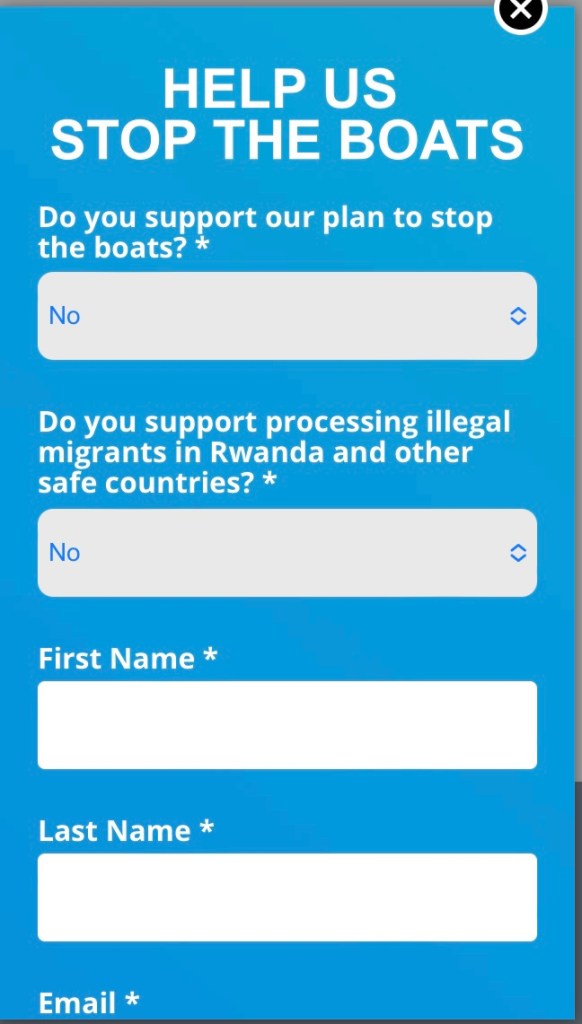
Clicking on either of the red buttons in those screenshots results in a pop-up form, on which one can say whether or not one supports the Tory plans (in the screenshot below, I’ve selected “no”)
One is then required to give one’s name, email address and postcode, and there is a tick box against text saying “I agree to the Conservative Party, and the wider Conservative Party, using the information I provide to keep me updated via email about the Party’s campaigns and opportunities to get involved”
There are two things to note.
First, the form appears to submit whether one ticks the “I agree” box or not.
Second, and in any case, none of the links to “how we use your data”, or the “privacy policy”, or the “terms and conditions” works.
So anyone submitting their special category data (information about one’s views on a political party’s policies on immigration is personal data revealing political opinions, and so Article 9 UK GDPR applies) has no idea whatsoever how it will subsequently be processed by the Tories.
I suppose there is an argument that anyone who happens upon this page, and chooses to submit the form, has a good idea what is going on (although that is by no means certain, and people could quite plausibly think that it provides an opportunity to provide views contrary to the Tories’). In any event, it would seem potentially to meet to definition of “plugging” (political lobbying under the guide of research) which ICO deals with in its direct marketing guidance.
Also in any event, the absence of any workable links to privacy notice information means, unavoidably, that the lawfulness of any subsequent processing is vitiated.
It’s the sort of thing I would hope the ICO is alive to (I’ve seen people on social media saying they have complained to ICO). But I won’t hold my breath on that – many years ago I wrote about how such data abuse was rife across the political spectrum – but little if anything has changed.
And finally, the most remarkable thing of all is that I’ve written a whole post on what is a pressing and high-profile issue without once mentioning Gary Lineker.
The views in this post (and indeed most posts on this blog) are my personal ones, and do not represent the views of any organisation I am involved with.
The Information Commissioner’s Office (ICO) has just announced that it has served a fine (strictly, a monetary penalty notice) of £80,000, under the Privacy and Electronic Communications (EC Directive) Regulations 2003 (PECR), on a company which sent a large number of particularly tasteless SMSs during the pandemic, of this sort
“Get Debt FREE during the Lockdown! Write off 95% of ALL DEBTS with ALL charges and fees FROZEN. Government backed. Click [here] Stop 2optout”
(In passing, I’m rather surprised the ICO’s announcement gave hyperlinks to the offending, albeit broken, URLs.)
In that accompanying announcement, the ICO’s Head of Investigations is quoted as saying
The company director failed to cooperate with our investigations through concealing his identity by using false company details on his websites; changing the wording on the text messages; and, changing his company’s registered address after becoming aware of our investigation.
and we are told that the director
tried to evade the ICO investigations with different tactics since 2019, but investigators were determined to bring this company to account for plaguing people’s lives with thousands of spam messages
What is interesting in this context is that the ICO’s powers to issue fines for serious contraventions were added to, in 2018, to allow them also to fine company directors themselves (where the contravention was with the consent of connivance of the director, or attributable to any neglect on their part).
I asked the ICO if they had a comment on why no director fine was issued here, but they only wished to say
The action we have taken is proportionate and appropriate in the circumstances of this case.
This is fair enough: there may be facts which are not public, and I don’t criticise what is a sound piece of enforcement against unlawful marketing communications.
However, as far as I am aware, since the ICO acquired the powers to fine directors (and similar officers) under PECR they have not exercised those powers once. This is odd – they had long lobbied for the powers, and when the change in the law was being proposed, the then Commissioner Elizabeth Denham told The Register “It should have a real deterrent effect”. Maybe there are legal issues with actually ascribing liability to directors, or practical issues with tracking and pinning them down to try to enforce against them. If so, and if the 2018 change in the law has not had that “real deterrent effect”, is the ICO letting government know?
The views in this post (and indeed most posts on this blog) are my personal ones, and do not represent the views of any organisation I am involved with.
Has the former LibDem Campaigns guru been engaging in unsolicited electronic marketing?
If I want to market my product or service to you as an individual, the general rule is that I cannot do so by email unless I have your prior consent informing me that you wish to receive it. This applies to me (if, say, I’m promoting this blog by email), it applies to any business, it applies to political parties, and it also applies to Baron Rennard of Wavertree, when he is promoting his new memoirs. However, a recent media story about the Lord Rennard’s promotional activities suggests he may not be aware of his legal obligations here, and for someone who has held senior roles within the Liberal Democrats, someone renowned as a “formidable and widely respected practitioner of political campaigning”, this is rather concerning.
The law (regulation 22 of the Privacy and Electronic Communications (EC Directive) Regulations 2003 (as amended)) outlaws the sending of unsolicited email marketing to individuals, unless the recipient has previously consented to receive the marketing (the exception to the general rule is that email marketing can be sent if the sender has obtained the recipient’s email address “in the course of the sale or negotiations for the sale of a product or service to that recipient” and if it is explained to the recipient that they can opt out – this is often known as the “soft opt-in“).
Lord Rennard is reported as saying
I have emailed people from my address book, or using publicly available email addresses, about the publication of a volume of memoirs
But just because one already holds someone’s email address, or just because an email address is in the public domain, this does not justify or permit the sending of unsolicited marketing. The European Directive which the PEC Regulations implement makes clear that people have a right to respect for their correspondence within the context of electronic communications, and that this right is a part of the fundamental rights to respect for protection of personal data, and respect for a private and family life. It may be a lot to expect the average person sending an email promoting a book to know this, but when the sender is someone whose reputation is in part based on his skills as a political campaigner, we should surely expect better (I say “in part” because, of course, the Lord Rennard is known for other things as well).
At a time when the use of digital data for political campaigning purposes is under intense scrutiny, it will be interesting to see what the Information Commissioner (who is said to be investigating Rennard’s marketing exercise) says. It might not seem the most serious of issues, but it encapsulates a lot.
The views in this post (and indeed all posts on this blog) are my personal ones, and do not represent the views of any organisation I am involved with.
Wetherspoons delete their entire customer email database. Deliberately.
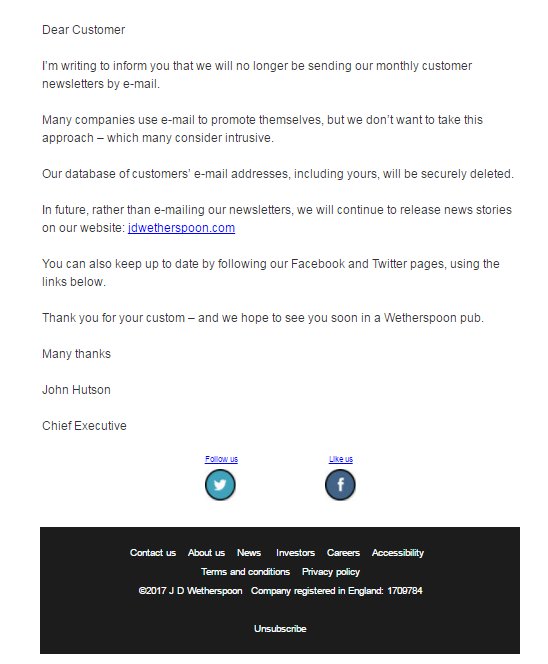
In a very interesting development, the pub chain JD Wetherspoon have announced that they are ceasing sending monthly newsletters by email, and are deleting their database of customer email addresses.
Although the only initial evidence of this was the screenshot of the email communication (above), the company have confirmed to me on their Twitter account that the email is genuine.
Wetherspoons say the reason for the deletion is that they feel that email marketing of this kind is “too intrusive”, and that, instead of communicating marketing by email, they will “continue to release news stories on [their] website” and customers will be able to keep up to date by following them on Facebook and Twitter.
This is interesting for a couple of reasons. Firstly, companies such as Flybe and Honda have recently discovered that an email marketing database can be a liability if it is not clear whether the customers in question have consented to receive marketing emails (which is a requirement under the Privacy and Electronic Communications ((EC Directive) Regulations 2003 (PECR)). In March Flybe received a monetary penalty of £70,000 from the Information Commissioner’s Office (ICO) after sending more than 3.3 million emails with the title ‘Are your details correct?’ to people who had previously told them they didn’t want to receive marketing emails. These, said the ICO, were themselves marketing emails, and the sending of them was a serious contravention of PECR. Honda, less egregiously, sent 289,790 emails when they did not know whether or not the recipients had consented to receive marketing emails. This also, said ICO, was unlawful marketing, as the burden of proof was on Honda to show that they had recipients’ consent to send the emails, and they could not. The result was a £13,000 monetary penalty.
There is no reason to think Wetherspoons were concerned about the data quality (in terms of whether people had consented to marketing) of their own email marketing database, but it is clear from the Flybe and Honda cases that a bloated database with email details of people who have not consented to marketing (or where it is unclear whether they have) is potentially a liability under PECR (and related data protection law). It is a liability both because any marketing emails sent are likely to be unlawful (and potentially attract a monetary penalty) but also because, if it cannot be used for marketing, what purpose does it serve? If none, then it constitutes a huge amount of personal data, held for no ostensible purpose, which would be in contravention of the fifth principle in schedule 1 to the Data Protection Act 1998.
For this reason, I can understand why some companies might take a commercial and risk-based decision not to retain email databases – if something brings no value, and significant risk, then why keep it?
But there is another reason Wetherspoons’ rationale is interesting: they are clearly aiming now to use social media channels to market their products. Normally, one thinks of advertising on social media as not aimed at or delivered to individuals, but as technology has advanced, so has the ability for social media marketing to become increasingly targeted. In May this year it was announced that the ICO were undertaking “a wide assessment of the data-protection risks arising from the use of data analytics”. This was on the back of reports that adverts on Facebook were being targeted by political groups towards people on the basis of data scraped from Facebook and other social media. Although we don’t know what the outcome of this investigation by the ICO will be (and I understand some of the allegations are strongly denied by entities alleged to be involved) what it does show is that stopping your e-marketing on one channel won’t necessarily stop you having privacy and data protection challenges on another.
The views in this post (and indeed all posts on this blog) are my personal ones, and do not represent the views of any organisation I am involved with.
Pre-ticked consent boxes and unsolicited emails from the Consumers’ Association
Which?, the brand name of the Consumers’ Association, publishes a monthly magazine. In an era of social media, and online reviews, its mix of consumer news and product ratings might seem rather old-fashioned, but it is still (according to its own figures1) Britain’s best-selling monthly magazine. Its rigidly paywalled website means that one must generally subscribe to get at the magazine’s contents. That’s fair enough (although after my grandmother died several years ago, we found piles of unread, unopened even, copies of Which? She had apparently signed up to a regular Direct Debit payment, probably to receive a “free gift”, and had never cancelled it: so one might draw one’s own conclusion about how many of Which?’s readers are regular subscribers for similar reasons).
In line with its general “locked-down” approach, Which?’s recent report into the sale of personal data was, except for snippets, not easy to access, but it got a fair bit of media coverage. Intrigued, I bit: I subscribed to the magazine. This post is not about the report, however, although the contents of the report drive the irony of what happened next.
As I went through the online sign-up process, I arrived at that familiar type of page where the subject of future marketing is broached. Which? had headlined their report “How your data could end up in the hands of scammers” so it struck me as amusing, but also irritating, that the marketing options section of the sign-in process came with a pre-ticked box:
As guidance from the Information Commissioner’s Office makes clear, pre-ticked boxes are not a good way to get consent from someone to future marketing:
Some organisations provide pre-ticked opt-in boxes, and rely on the user to untick it if they don’t want to consent. In effect, this is more like an opt-out box, as it assumes consent unless the user clicks the box. A pre-ticked box will not automatically be enough to demonstrate consent, as it will be harder to show that the presence of the tick represents a positive, informed choice by the user.
The Article 29 Working Party goes further, saying in its opinion on unsolicited communications for marketing purposes that inferring consent to marketing from the use of pre-ticked boxes is not compatible with the data protection directive. By extension, therefore, any marketing subsequently sent on the basis of a pre-ticked box will be a contravention of the data protection directive (and, in the UK, the Data Protection Act 1998) and the ePrivacy directive (in the UK, the Privacy and Electronic Communications (EC Directive) Regulations 2003 (PECR)).
Nothwithstanding this, I certainly did not want to consent to receive subsequent marketing, so, as well as making a smart-arse tweet, I unticked the box. However, to my consternation, if not my huge surprise, I have subsequently received several marketing emails from Which? They do not have my consent to send these, so they are manifestly in contravention of regulation 22 of PECR.
It’s not clear how this has happened. Could it be a deliberate tactic by Which? to ignore subscribers’ wishes? One presumes not: Which? says it “exists to make individuals as powerful as the organisations they deal with in their daily live” – deliberately ignoring clear expressions regarding consent would hardly sit well with that mission statement. So is it a general website glitch – which means that those expressions are lost in the sign-up process? If so, how many individuals are affected? Or is it just a one-off glitch, affecting only me?
Let’s hope it’s the last. Because the ignoring or overriding of expressions of consent, and the use of pre-ticked boxes for gathering consent, are some of the key things which fuel trade in and disrespect for personal data. The fact that I’ve experience this issue with a charity which exists to represent consumers, as a result of my wish to read their report into misuse of personal data, is shoddy, to say the least.
I approached Which? for a comment, and a spokesman said:
We have noted all of your comments relating to new Which? members signing up, including correspondence received after sign-up, and we are considering these in relation to our process.
I appreciate the response, although I’m not sure it really addresses my concerns.
1Which? Annual Report 2015/2016
The views in this post (and indeed all posts on this blog) are my personal ones, and do not represent the views of any organisation I am involved with.
What’s behind the increasing practice of electronic receipts?
I’m good at a few things in life, OK at a few more, and pretty terrible at a lot. Into the last category falls car maintenance. Nonetheless, as a safety-conscious person I understand its importance. And so it was that I found myself in a local branch of a major retailer of car parts the other day buying a replacement headlamp bulb, and asking for it to be fitted (by the very helpful Louise – sorry Louise, I won’t be submitting the online customer feedback, for reasons which will probably become clear in this post). I paid for the service, and was then asked
Can I just have your email address to send the receipt?
Er, no.
I’d heard about this practice, but, oddly, this was the first time I’d encountered it. It was immediately obvious to me what was going on, or at least what I assumed was/is going on, but I thought it might be helpful to draw attention to it.
The law (regulation 22 of the Privacy and Electronic Communications (EC Directive) Regulations 2003 (as amended)) outlaws the sending of unsolicited email marketing to individuals, unless the recipient has previously consented to receive the marketing. As much as this law is regularly flouted, it is both clear and strict. It is, however, subject to an important caveat – email marketing can be sent if the sender has obtained the recipient’s email address “in the course of the sale or negotiations for the sale of a product or service to that recipient”.
This is known as the “soft opt-in” and it seems clear to me that the practice of sending e-receipts is tied up with the gathering of email addresses for the purposes of sending marketing using the soft opt-in provisions. As much as we might be told how helpful it is for our own records management to have electronic copies of receipts, there is something in it for retailers, and that something is the perceived right to send electronic marketing.
I should add, though, that soft opt-in is subject to further qualifications – the marketing must be in respect of “similar products and services only”, and, crucially, at the point when the contact details are collected, the intended recipient must be given the chance to say “no” to the marketing. (See the guidance from the Information Commissioner’s Office for further details).
I wasn’t given the chance to say “no”, but I chose not to give my details. If I had given those details, and if I had then received email marketing, it would have been sent unlawfully. I would have known that, but a lot of people wouldn’t, and, importantly, it’s quite difficult to prove (or remember) whether one was given “a simple means of refusing” marketing at the time the sale was made. So it’s a relatively low-risk tactic for marketers.
So my advice is to say no to e-receipts, demand a paper one, and if you do want to retain a record, why not just photograph the receipt when you get home?
The views in this post (and indeed all posts on this blog) are my personal ones, and do not represent the views of any organisation I am involved with.
Only very recently I wrote about how the Liberal Democrats had been found by the Information Commissioner’s Officer (ICO) to have been in breach of their obligations under anti-spam laws (or, correctly, the ICO had determined it was “unlikely” the Lib Dems had complied with the law). This was because they had sent me unsolicited emails promoting their party without my consent, in contravention of the Privacy and Electronic Communications (EC Directive) Regulations 2003 (PECR). The ICO told me that “we have written to the organisation to remind them of their obligations under the PECR and ensure that valid consent is obtained from individuals”.
Well, the reminder hasn’t worked: today I went on the Lib Dem site and noticed the invitation to agree that “The NHS needs an extra £8bn”. Who could disagree? There was a box to enter my email address and “back our campaign”. Which campaign did they mean? Who knows? I assumed the campaign to promote NHS funding, but there was no privacy notice at all (at least on the mobile site). I entered an email address, because I certainly agree with a campaign that the NHS needs an extra £8bn pounds, but what I certainly didn’t do was consent to receive email marketing.
But of course I did…within eight hours I received an email from someone called Olly Grender asking me to donate to the Lib Dems. Why on earth would I want to do that? And a few hours later I got an email from Nick Clegg himself, reiterating Olly’s message. Both emails were manifestly, shamelessly, sent in contravention of PECR, only a couple of weeks after the ICO assured me they were going to “remind” the Lib Dems of the law.
Surely the lesson is the same one the cynics have told us over the years – don’t believe what politicians tell you.
And of course, only this week there was a further example, with the notorious Telegraph “business leaders” letter. The open letter published by the paper, purporting to come from 5000 small business owners, had in fact been written by Conservative Campaign Headquarters, and signatories were merely people who had filled in a form on the Conservative party website agreeing to sign the letter but who were informed in a privacy notice that “We will not share your details with anyone outside the Conservative Party”. But share they did, and so it was that multiple duplicate signatories, and signatories who were by no means small business owners, found their way into the public domain. Whether any of them will complain to the ICO will probably determine the extent to which this might have been a contravention, not of PECR (this wasn’t unsolicited marketing), but of the Data Protection Act 1998, and the Conservatives’ obligation to process personal data fairly and lawfully. But whatever the outcome, it’s another example of the abuse of web forms, and the harvesting of email addresses, for the promotion of party political aims.
I will be referring the Lib Dems matter back to the ICO, and inviting them again (they declined last time) to take enforcement action for repeat and apparently deliberate, or reckless, contraventions of their legal obligations under PECR.
The views in this post (and indeed all posts on this blog) are my personal ones, and do not represent the views of any organisation I am involved with.
A few months ago, when I entered my email address on the Liberal Democrats’ website to say that I agreed with the statement
Girls should never be cut. We must end FGM
I hoped I wouldn’t subsequently receive spam emails promoting the party. However I had no way of knowing because there was no obvious statement explaining what would happen. But, furthermore, I had clearly not given specific consent to receive such emails.
Nonetheless, I did get them, and continue to do so – emails purportedly from Nick Clegg, from Paddy Ashdown and from others, promoting their party and sometimes soliciting donations.
I happen to think the compiling of a marketing database by use of serious and emotive subjects such as female genital mutilation is extraordinarily tasteless. It’s also manifestly unlawful in terms of Lib Dems’ obligations under the Privacy and Electronic Communications (EC Directive) Regulations 2003 (PECR), which require specific consent to have been given before marketing emails can be sent to individuals.
On the lawfulness point I am pleased to say the Information Commissioner’s Office (ICO) agrees with me. Having considered my complaint they have said:
I have reviewed your correspondence and the organisations website, and it appears that their current practices would fail to comply with the requirements of the PECR. This is because consent is not knowingly given, clear and specific….As such, we have written to the organisation to remind them of their obligations under the PECR and ensure that valid consent is obtained from individuals.
Great. I’m glad they agree – casual disregard of PECR seems to be rife throughout politics. As I’ve written recently, the Labour Party, UKIP and Plaid Cymru have also spammed my dedicated email account. But I also asked the ICO to consider taking enforcement action (as is my right under regulation 32 of PECR). Disappointingly, they have declined to do so, saying:
enforcement action is not taken routinely and it is our decision whether to take it. We cannot take enforcement action in every case that is reported to us
It’s also disappointing that they don’t say why this is their decision. I know they cannot take enforcement action in every case reported to them, which is why I requested it in this specific case.
However, I will be interested to see whether the outcome of this case changes the Lib Dems’ approach. Maybe it will, but, as I say, they are by no means the only offenders, and enforcement action by the ICO might just have helped to address this wider problem.
The views in this post (and indeed all posts on this blog) are my personal ones, and do not represent the views of any organisation I am involved with.






 informationrightsandwrongs