Tag Archives: PECR

What’s happening with changes to anti-spam laws?

In October last year the Department for Culture Media and Sport (DCMS) announced a consultation to lower, or even remove, the threshold for the serving financial penalties on those who unlawfully send electronic direct marketing. I wrote at the time that

There appears to be little resistance (as yet, at least) to the idea of lowering or removing the penalty threshold. Given that, and given the ICO’s apparent willingness to take on the spammers, we may well see a real and significant attack on the scourge

The Information Commissioner’s Office (ICO) and DCMS both seemed at the time to be keen to effect the necessary legislative changes to amend the Privacy and Electronic Communications (EC Directive) Regulations 2003 (PECR) so that, per the mechanism at section 55A of the Data Protection Act 1998 (DPA), adopted by PECR by virtue of regulation 31, either a serious contravention alone of PECR, or a serious contravention likely to cause annoyance, inconvenience or anxiety, could give rise to a monetary penalty without the need to show – as now – likely substantial damage or substantial distress.

However, today, the Information Commissioner himself, Christopher Graham, gave vent to frustrations about delay in bringing about these changes:

Time and time again the Government talks about changing the law and clamping down on this problem, but so far it’s just that – talk. Today they are holding yet another roundtable to discuss the issue, and we seem to be going round in circles. The Government need to lay the order, change the law and bring in a reform that would make a real difference

So what has happened? Have representatives of direct marketing companies lobbied against the proposals? It would be interesting to know who was at today’s “roundtable” and what was said. But there was certainly an interesting tweet from journalist Roddy Mansfield. One hopes a report will emerge, and some record of the meeting.

One wonders why – if they are – marketing industry bodies might object to the proposed changes. The financial penalty provisions would only come into play if marketers failed to comply with the law. Spammers would get punished – the responsible companies would not.

The views in this post (and indeed all posts on this blog) are my personal ones, and do not represent the views of any organisation I am involved with.

1 Comment

Filed under Data Protection, Information Commissioner, marketing, monetary penalty notice, PECR, spam texts

Labour’s “HowManyOfMe” – legitimate use of the electoral register?

Is Labour’s shiny new web widget “HowManyOfMe” compliant with the party’s obligations under electoral and ePrivacy law?

Regulations 102 and 106 of the Representation of the People (England and Wales) Regulations 2001 (as amended)mean that registered political parties can apply for a copy of the full electoral register, but they can only supply, disclose or make use of the information therein for “electoral purposes”. As far as I can see “electoral purposes” is nowhere defined, and, accordingly, I suspect it permits relatively broad interpretation, but, nevertheless, it clearly limits the use to which a political party can make use of electoral registration information.

With this in mind, it is worth considering whether the apparent use of such information by the Labour Party, in a new website widget, is a use which can be described as “for electoral purposes”. The widget in question invites people to submit their name (or indeed anyone else’s), email address and postcode and it will tell you how many voters in the country have that name. Thus, I find that there are 393 voters who have the name “Christopher Graham”. The widget then encourages users to register to vote. In small print underneath it says

in case you’re interested, this tool uses an aggregate figure from the electoral register and we’ve taken steps to protect the privacy of individuals

Well, I am interested. I’m interested to know whether this use of the electoral register is purely for electoral purposes. If it is, if its purpose is to encourage people to register to vote, then why does it need an email address? The widget goes on to say

The Labour Party and its elected representatives may contact you about issues we think you may be interested in or with campaign updates. You may unsubscribe at any point. You can see our privacy policy here.

But if they are using the electoral register to encourage people to give up email addresses which may then receive political marketing, surely this is stretching the use of “for electoral purposes” too far? Moreover, and despite the small print privacy notice, and the almost-hidden link to a generic privacy policy, any emails received by individuals will be likely to be sent in contravention of Labour’s obligations under The Privacy and Electronic Communications (EC Directive) Regulations 2003 (PECR), which give effect to the UK’s obligations under Directive 2002/58/EC. This is because regulation 22 of PECR prohibits, in terms, the sending of electronic direct marketing (and promotion of a political party constitutes such marketing) without the prior consent of the recipient. Consent, the Directive tells us, must be “a freely given specific and informed indication of the user’s wishes”.  A vague description, as the widget here gives us, of what may happen if one submits an email address, and a statement about unsubscribing, do not legitimise any subsequent sending of direct marketing.

The email address I used is one I reserve for catching spammers; I’ve not received anything yet, but I expect to do so. I would be prepared to argue that any email I receive cannot be said to relate to the electoral purpose which permit use of the electoral register, and will be sent in contravention of PECR.  As I said recently, one of the key battlegrounds in the 2015 general election will be online, and unless action is taken to restrain abuse of people’s personal information, things will get nasty.

1The legislation.gov.uk doesn’t provide updated (“consolidated”) versions of secondary legislation, so there’s no point in linking to their version of the regulations.

The views in this post (and indeed all posts on this blog) are my personal ones, and do not represent the views of any organisation I am involved with.
4 Comments

Filed under consent, Data Protection, marketing, PECR, privacy notice

Online privacy – a general election battleground

It’s becoming increasingly clear that one of the key battlegrounds in the 2015 General Election will be online. The BBC’s Ross Hawkins reports that the Conservatives are spending large amounts each month on Facebook advertising, and Labour and UKIP, while not having the means to spend as much, are ramping up their online campaigning. But, as Hawkins says

the aim is not to persuade people to nod thoughtfully while they stare at a screen. They want consumers of their online media to make donations or, even better, to get their friends’ support or to knock on doors in marginal constituencies…[but] for all the novelties of online marketing, email remains king. Those Tory Facebook invoices show that most of the money was spent encouraging Conservative supporters to hand over their email addresses. Labour and the Conservatives send emails to supporters, and journalists, that appear to come from their front benchers, pleading for donations

I know this well, because in July last year, after growing weary of blogging about questionable compliance with ePrivacy laws by all the major parties and achieving nothing, I set a honey trap: I submitted an email address to the Conservative, Labour, LibDem, Green, UKIP, SNP and Plaid Cymru websites. In each case I was apparently agreeing with a proposition (such as the particularly egregious LibDem FGM example)  giving no consent to reuse, and in each case there was no clear privacy notice which accorded with the Information Commissioner’s Office’s Privacy Notices Code of Practice (I do not, and nor does the ICO, at least if one refers to that Code, accept that a generic website privacy policy is sufficient in case like this). Since then, the fictional, and trusting but naive, Pam Catchers (geddit??!!) has received over 60 emails, from all parties contacted. A lot of them begin, “Friend, …” and exhort Pam to perform various types of activism. Of course, as a fictional character, Pam might have trouble enforcing her rights, or complaining to the ICO, but the fact is that this sort of bad, and illegal, practice, is rife.

To be honest, I thought Pam would receive more than this number of unsolicited emails (but I’m probably more cynical than her). But the point is that each of these emails was sent in breach of the parties’ obligations under the Privacy and Electronic Communications (EC Directive) Regulations 2003 (PECR) which demands that recipients of electronic direct marketing communications must have given explicit consent prior to the sending. By extension, therefore, the parties are also in breach of the Data Protection Act 1998 (DPA), which, when requiring “fair” processing of personal data, makes clear that a valid privacy notice must be given in order to achieve this.

The ICO makes clear that promotion by a political party can constitute direct marketing, and has previously taken enforcement action to try to ensure compliance. It has even produced guidance for parties about their PECR and DPA obligations. This says

In recent years we have investigated complaints about political parties and referendum campaigners using direct marketing, and on occasion we have used our enforcement powers to prevent them doing the same thing again. Failure to comply with an enforcement notice is a criminal offence.

But by “recent” I think they are referring at least six years back.

A data controller’s compliance, or lack thereof, with data protection laws in one area is likely to be indicative of its attitude to compliance elsewhere. Surely the time has come for the ICO at least to remind politicians that online privacy rights are not to be treated with contempt?

The views in this post (and indeed all posts on this blog) are my personal ones, and do not represent the views of any organisation I am involved with.

2 Comments

Filed under consent, Data Protection, enforcement, Information Commissioner, marketing, PECR, privacy notice

No harm done

Why does nobody listen to me?

Quite a few media outlets and commentators have picked up on the consultation by the Department for Culture, Media and Sport I blogged about recently. The consultation is about the possibility of legislative change to make it easier for the Information Commissioner’s Office (ICO)(ICO) to “fine” (in reality, serve a civil monetary penalty notice) on people or organisations who commit serious contraventions of ePrivacy law in sending unsolicited electronic marketing messages (aka spam calls, texts, emails etc).

However, almost every report I have seen has missed a crucial point. So, we have The Register saying “ICO to fine UNBIDDEN MARKETEERS who cause ‘ANXIETY’…Inconvenience, annoyance also pass the watchdog’s stress test”, and Pinsent Masons, Out-Law.com saying “Unsolicited marketing causing ‘annoyance, inconvenience or anxiety’ could result in ICO fine”. We even have 11KBW’s formidable Christopher Knight saying

the DCMS has just launched a consultation exercise on amending PECR with a view to altering the test from “substantial damage or distress” to causing “annoyance, inconvenience or anxiety”

But none of these spot that the preferred option of DCMS, and the ICO is actually to go further, and give the ICO the power to serve a monetary penalty notice even when no harm has been shown at all

Remove the existing legal threshold of “substantial damage and distress” (this is the preferred option of both ICO and DCMS. There would be no need to prove “substantial damage and distress”, or any other threshold such as ‘annoyance, inconvenience or anxiety’…

So yes, this is a blog post purely to moan about the fact that people haven’t read my previous post. It’s my blog and I’ll cry if I want to.

UPDATE:

Chris Knight is so formidable that he’s both updated the Panopticon post and pointed out the oddness of option 3 being preferred when nearly all of the consultation paper is predicated on option 2 being victorious.

Leave a comment

Filed under Information Commissioner, marketing, monetary penalty notice, PECR, spam texts

DCMS consulting on lower threshold for “fining” spammers

UPDATE: 08.11.14

Rich Greenhill has spotted another odd feature of this consultation. Options one and two both use the formulation “the contravention was deliberate or the person knew or ought to have known that there was a risk that the contravention would occur”, however, option three omits the words “…or ought to have known”. This is surely a typo, because if it were a deliberate omission it would effectively mean that penalties could not be imposed for negligent contraventions (only deliberate or wilful contraventions would qualify). I understand Rich has asked DCMS to clarify this, and will update as and when he hears anything.

END UPDATE

UPDATE: 04.11.14

An interesting development of this story was how many media outlets and commentators reported that the consultation was about lowering the threshold to “likely to cause annoyance, inconvenience or anxiety”, ignoring in the process that the preferred option of DCMS and ICO was for no harm threshold at all. Christopher Knight, on 11KBW’s Panopticon blog kindly amended his piece when I drew this point to his attention. He did, however observe that most of the consultation paper, and DCMS’s website, appeared predicated on the assumption that the lower-harm threshold was at issue. Today, Rich Greenhill informs us all that he has spoken to DCMS, and that their preference is indeed for a “no harm” approach: “Just spoke to DCMS: govt prefers PECR Option 3 (zero harm), its PR is *wrong*”. How very odd.

END UPDATE

The Department of Culture, Media and Sport (DCMS) has announced a consultation on lowering the threshold for the imposing of financial sanctions on those who unlawfully send electronic direct marketing. They’ve called it a “Nuisance calls consultation”, which, although they explain that it applies equally to nuisance text messages, emails etc., doesn’t adequately describe what could be an important development in electronic privacy regulation.

When, a year ago, the First-tier Tribunal (FTT) upheld the appeal by spam texter Christopher Niebel against the £300,000 monetary penalty notice (MPN) served on him by the Information Commissioner’s Office (ICO), it put the latter in an awkward position. And when the Upper Tribunal dismissed the ICO’s subsequent appeal, there was binding authority on the limits to the ICO’s power to serve MPNs for serious breaches of the Privacy and Electronic Communications (EC Directive) Regulations 2003 (PECR). There was no dispute that, per the mechanism at section 55A of the Data Protection Act 1998 (DPA), adopted by PECR by virtue of regulation 31, Niebel’s contraventions were serious and deliberate, but what was at issue was whether they were “of a kind likely to cause substantial damage or substantial distress”. The FTT held that they were not – no substantial damage would be likely to arise and when it came to distress

the effect of the contravention is likely to be widespread irritation but not widespread distress…we cannot construct a logical likelihood of substantial distress as a result of the contravention.

When the Upper Tribunal agreed with the FTT, and the ICO’s Head of Enforcement said it had “largely [rendered] our power to issue fines for breaches of PECR involving spam texts redundant” it seemed clear that, for the time being at least, there was in effect a green light for spam texters, and, by extension, other spam electronic marketers. The DCMS consultation is in response to calls from the ICO, and others, such as the All Party Parliamentary Group (APPG) on Nuisance Calls, the Direct Marketing Association and Which for a change in the law.

The consultation proposes three options – 1) do nothing, 2) lower the threshold from “likely to cause substantial damage or substantial distress” to “likely to cause annoyance, inconvenience or anxiety”, or 3) remove the threshold altogether, so any serious and deliberate (or reckless) contravention of the PECR provisions would attract the possibility of a monetary penalty. The third option is the one favoured by DCMS and the ICO.

If either of the second or third options is ultimately enacted, this could, I feel, lead to a significant reduction in the prevalence of spam marketing. The consultation document notes that (despite the fact that the MPN was overturned on appeal) the number of unsolicited spam SMS text message sent reduced by a significant number after the Niebel MPN was served. A robust and prominent campaign of enforcement under a legislative scheme which makes it much easier to impose penalties to a maximum of £500,000, and much more difficult to appeal them, could put many spammers out of business, and discourage others. This will be subject, of course, both to the willingness and the resources of the ICO. The consultation document notes that there might be “an expectation that [MPNs] would be issued by the ICO in many more cases than its resources permit” but the ICO has said (according to the document) that it is “ready and equipped to investigate and progress a significant number of additional cases with a view to taking greater enforcement action including issuing more CMPs”.

There appears to be little resistance (as yet, at least) to the idea of lowering or removing the penalty threshold. Given that, and given the ICO’s apparent willingness to take on the spammers, we may well see a real and significant attack on the scourge. Of course, this only applies to identifiable spammers in the domestic jurisdiction – let’s hope it doesn’t just drive an increase in non-traceable, overseas spam.


3 Comments

Filed under Data Protection, enforcement, Information Commissioner, Information Tribunal, marketing, monetary penalty notice, nuisance calls, PECR, spam texts, Upper Tribunal

Green light for spam texters – for now

The ICO has effectively conceded he has no current powers to issue monetary penalties on spam texters.

In June this year the Upper Tribunal dismissed the appeal by the Information Commissioner’s Office (ICO) against the quashing of a £300,000 monetary penalty notice (the MPN) served on spam texter Christopher Niebel. The MPN had been issued pursuant to the ICO’s powers under section 55A of the Data Protection Act 1998 to serve such a notice if there has been a serious contravention of the Privacy and Electronic Communications (EC Directive) Regulations 2003 (PECR) of a kind likely to cause substantial damage or substantial distress. The Upper Tribunal held that the First-tier Tribunal had not erred in law in finding that the ICO’s relevant interpretation of “distress” was unsustainable:

the tribunal took issue with the Commissioner’s guidance as to the meaning of “distress” and, in my opinion rightly so. According to that guidance, “Distress is any injury to feelings, harm or anxiety suffered by an individual” (at paragraph [12], emphasis added). The tribunal’s conclusion was that if this “involves the proposition that it is not possible to have ‘any injury to feelings’ which falls short of ‘distress’ then, it seems to us, that the definition is at odds with common experience and with the ordinary use of English [¶60]

As the law required evidence that Niebel’s company’s sending of spam texts had been of a kind likely to cause substantial distress, and as the ICO’s evidence did not match up to this, the MPN had been rightly quashed. Implicitly, the Upper Tribunal was suggesting that further MPNs of this kind would also not be sustainable, and, explicitly, it questioned whether, if Parliament wanted to give the ICO powers to financially punish spam texters, it would require a change in the law

[a] more profitable course of action, is for the statutory test to be revisited…a statutory test that was formulated in terms of e.g. annoyance, inconvenience and/or irritation, rather than “substantial damage or substantial distress”, might well have resulted in a different outcome.

To no real surprise, since the ICO lost this appeal, no further MPNs have been issued for spam texting (some have been served for spam telephone calls). Now the ICO, in a blog post by their Head of Enforcement Steve Eckersley has effectively conceded that the result of the Niebel litigation has been to remove their powers to serve MPNs for spam texts, saying it had “largely [rendered] our power to issue fines for breaches of PECR involving spam texts redundant”. And Eckersley picks up the call for a law change, confirming that there will be a consultation later this year (whether any of this will see results this side of the general election, however, is another question).  This call echoes one made by the Information Commissioner himself, who said in February

We have just got to lower that hurdle because I think if you ask most people they would say silent calls and unsolicited spam texts are one of the great curses of the age – and if the Information Commissioner can’t protect you it’s a poor lookout.
There are, of course, other strings to the ICO bow, and Eckersley refers to some of them
we are using our existing powers to hold companies to account and to disrupt their unlawful activities….and we are obtaining undertakings from and issuing enforcement notices, effectively cease-and-desist orders, to companies that breach PECR.
This sounds good, but leaves me rather puzzled: as the ICO has confirmed to me, no enforcement notices have been served and only one undertaking obtained, against companies or individuals who have sent spam texts in breach of PECR. Enforcement notices are a strong power – breach of one is a criminal offence – and only require the ICO to consider whether the PECR contravention has caused or is likely to cause any person damage or distress, not “substantial damage or substantial distress”. This lower threshold should make it much more difficult for enforcement to be resisted. Maybe some enforcement notices are on their way? One rather hopes so, because, for the moment, it looks like spam texters have received a green light.
EDITED TO ADD:
Tim Turner points out to me that a conviction for breach of an enforcement notice is not a recordable offence it will not make its way on to the Police National Computer, and will not therefore generally result in disclosure for, e.g. employment purposes. Tim’s view, and it is a compelling one, is that for a lot of spammers the threat of a minor conviction for breach of a legal notice is not one which is likely to dissuade them from their practice.

7 Comments

Filed under Data Protection, enforcement, Information Commissioner, Information Tribunal, marketing, monetary penalty notice, nuisance calls, PECR, Upper Tribunal

Lib Dems in breach of ePrivacy laws?

As I’ve written on several occasions recently, the sending of direct marketing emails without the consent of the recipient is, as a general principle, unlawful under European and domestic law.

The Information Commissioner’s Office (ICO) guidance makes clear that promotion of a political party, campaign or candidate is “direct marketing” for the purposes of the Privacy and Electronic Communication (EC Directive) Regulations 2003 (PECR):

We take a broad view of what constitutes marketing and are satisfied that it is not only the offer for sale of goods or services but also includes the promotion of the aims and ideals of any organisation including political campaigns.
On 20 July I noted this on the Liberal Democrats’ home page
 
libdem
A campaign to end Female Genital Mutilation is a worthy one (and not a party political issue) and one I’m happy to put my name to. However, I did have my suspicions, so set up a new email address, entered that into the box, and clicked “I agree”. There was no indication of what would happen with my email address once I had done this, although there was, at the very foot of the page, a small unobtrusive link to a “privacy policy” (of which more later).
 
What did happen was, firstly, and straight away, I received the following email
receipt1
 which was fair enough. At the foot of that email was this message
receipt
again, fair enough, and that should be the end of my engagement with the Lib Dems.
  
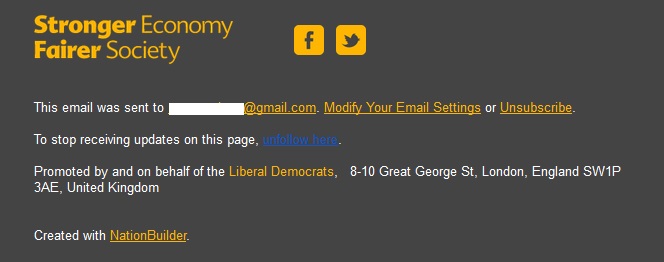
But, you will perhaps be unsurprised to hear, it wasn’t. Two days later I received this, from Lynn Featherstone MP
featherstone
which at least was on the subject of FGM, but I was surprised she considered herself my “friend”. And two days after that I found I’d made another friend:
nick
So, a few days after I’d expressed my support for a non-party-political campaign, I was on first name terms with a political party leader, who was sending me an unsolicited marketing email. Which takes us back to PECR, and consent, and my myriad previous blog posts.
 
I thought I’d check exactly what the Lib Dems website privacy policy says. Of course there’s the usual guff about taking privacy seriously, but it goes on to say
If you provide your email address…we may use the email address to send you further information in the future. You may at any point request not to receive such information any more.
And there it is, in clear terms – a statement of non-compliance with the law. They cannot, under regulation 22(2) of PECR, infer consent to receive marketing emails merely because someone has provided an email address. I will be complaining to the Lib Dems, and, if necessary, the Information Commissioner’s Office.

2 Comments

Filed under consent, Data Protection, Information Commissioner, marketing, PECR, privacy notice

ICO responds to my concerns about PECR compliance

In assessing one’s own compliance with the law, or in advising a client on the law, or in pontificating on one’s blog about the law, one is well advised to refer not only to the law itself (whether in the form of legislation or precedent at common law), but also codes of practice, and guidance. When the law in question is the Privacy and Electronic Communications (EC Directive) Regulations 2003 (PECR), which are enforced and overseen by the Information Commissioner’s Office (ICO), it is natural that one would refer – in addition to PECR themselves, and the European Directive 2002/58/EC to which PECR give domestic effect – to the ICO’s own PECR guidance, and, particularly when it comes to electronic marketing, the guidance on Direct Marketing.

So, when the latter guidance says

Organisations must give the customer the chance to opt out – both when they first collect the details, and in every email or text. Organisations should not assume that all customers will be happy to get marketing texts or emails in future…It must be simple to opt out. When first collecting a customer’s details, this should be part of the same process (eg online forms should include a prominent opt-out box…

it would be reasonable to assume that an organisation which did not do this would be, at least if not in direct breach of PECR, sailing close to the wind. The relevant regulation (22(2)) of PECR says that

a person shall neither transmit, nor instigate the transmission of, unsolicited communications for the purposes of direct marketing by means of electronic mail unless the recipient of the electronic mail has previously notified the sender that he consents for the time being to such communications being sent by, or at the instigation of, the sender

and recital 40 of the originating Directive says that electronic marketing requires that prior, explicit consent be given before electronic marketing can take place.

One could reasonably argue that, until such unsolicited electronic marketing takes place, there is no active breach of PECR, but it should surely be conceded that any practice of collecting email addresses, by – say – a political party, in circumstances where explicit consent to receiving subsequent electronic political marketing, is questionable.

I have blogged a number of times in recent weeks about such harvesting of email addresses, and it was prompted by a “widget” on the Labour Party website. I asked the ICO for a statement specifically about that “widget”, and this is what their spokesman said:

In general terms, if an organisation wishes to retain individuals’ contact details it should make them aware of this before their information is collected.  This appears to be the case in the NHS baby number service. We also advise organisations that web pages should explain how personal information will be used, and this can be via a link to the organisation’s privacy policy. We would also want to ensure that individuals can unsubscribe from emails if they receive them, as appears to be the situation here. 

We have published detailed guidance for political parties for campaigning or promotional purposes. On 1 May 2014, the Information Commissioner wrote to the main UK political parties reminding them of the need to follow data protection and electronic marketing rules. Political campaigning is an area that attracts close public scrutiny. We shall continue to encourage political parties to demonstrate best practice and be open and upfront with people when explaining how their personal details will be used

Now, this is a reasonable and accurate statement about the collection of personal data and compliance with the first Data Protection Principle in Schedule One of the Data Protection Act 1998 – tell people what you are gathering their data for, and how it will be used, and you will probably have broadly complied with the duty to process personal data “fairly”.

However, it seems to overlook – with its reference to “general terms” – the specific requirements of PECR. It seems clear to me that any subsequent email from Labour will have been sent because they have inferred, rather than having received notification of, (explicit) consent.

PECR is not my strongest area. Seriously – am I missing something?

4 Comments

Filed under consent, Data Protection, Information Commissioner, marketing, PECR

Big Political Data

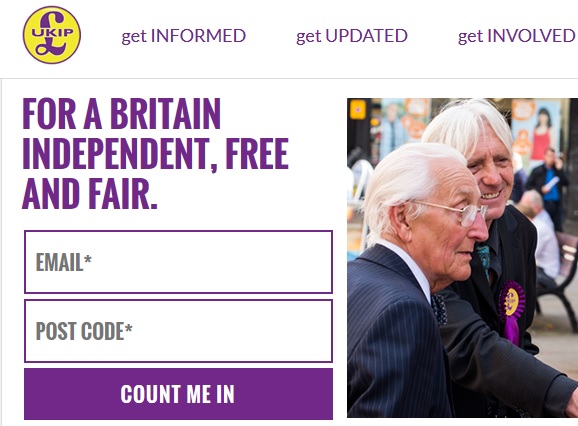
I’ve written over the past few months about questionable compliance by the Conservative, Labour, Liberal Democratic and Scottish National Parties with their obligations under the Data Protection Act 1998 and the Privacy and Electronic Communications (EC Directive) Regulations 2003. And, as I sat down to write this post, I thought I’d check a couple of other parties’ sites, and, sure enough, similar issues are raised by the UKIP and Plaid Cymru sites

ukipplaid

No one except a few enthusiasts in this area of law/compliance seems particularly concerned, and I will, no doubt, eventually get fed up with the dead horse I am flogging. However, a fascinating article in The Telegraph by James Kirkup casts a light on just why political parties might be so keen to harvest personal data, and not be transparent about their uses of it.

Kirkup points out how parties have begun an

extraordinarily extensive – and expensive – programme of opinion polls and focus groups generating huge volumes of data about voters’ views and preferences…Traditional polls and focus groups have changed little in the past two decades. They help parties discover what voters think, what they want to hear, and how best to say it to them. That is the first stage of campaigning. The second is to identify precisely which voters you need to speak to. With finite time and resources, parties cannot afford to waste effort either preaching to the converted or trying to win over diehard opponents who will never change sides. The party that finds the waverers in the middle gains a crucial advantage.

It seems clear to me that the tricks, and opacity, which are used to get people to give up their personal information, are part of this drive to amass more and more data for political purposes. It’s unethical, it’s probably unlawful, but few seem to care, and no one, including the Information Commissioner’s Office (which has, in the past taken robust action against dodgy marketing practices in party politics) has seemed prepared so far to do anything to prevent it. However, the ICO has good guidance for the parties on this, and in May this year, issued a warning to play by the marketing rules in the run-up to local and European elections. Let’s hope this warning, and the threat of enforcement action, extends to the bigger stage of the national elections next year.


2 Comments

Filed under Confidentiality, consent, Data Protection, Information Commissioner, marketing, PECR, Privacy

Political attitudes to ePrivacy – this goes deep

With the rushing through of privacy-intrusive legislation under highly questionable procedures, it almost seems wrong to bang on about political parties and their approach to ePrivacy and marketing, but a) much better people have written on the #DRIP bill, and b) I think the two issues are not entirely unrelated.

Last week I was taking issue with Labour’s social media campaign which invited people to submit their email address to get a number relating to when they were born under the NHS.

Today, prompted by a twitter exchange with the excellent Lib Dem councillor James Baker, in which I observed that politicians and political parties seem to be exploiting people’s interest in discrete policy issues to harvest emails, I looked at the Liberal Democrats’ home page. It really couldn’t have illustrated my point any better. People are invited to “agree” that they’re against female genital mutilation, by submitting their email address.

libdem

There’s no information whatsoever about what will happen to your email address once you submit it. So, just as Labour were, but even more clearly here, the Lib Dems are in breach of the The Privacy and Electronic Communications (EC Directive) Regulations 2003 and the Data Protection Act 1998. James says he’ll contact HQ to make them aware. But how on earth are they not already aware? The specific laws have been in place for eleven years, but the principles are much older – be fair and transparent with people’s private information. And it is not fair (in fact it’s pretty damn reprehensible) to use such a bleakly emotive subject as FGM to harvest emails (which is unavoidably the conclusion I arrive at when wondering what the purpose of the page is).

So, in the space of a few months I’ve written about the Conservatives, Labour and the Lib Dems breaching eprivacy laws. If they’re unconcerned about or – to be overly charitable – ignorant of these laws, then is it any wonder that they railroad each other into passing “emergency” laws (which are anything but) with huge implications for our privacy?

UPDATE: 13.07.14

Alistair Sloan draws attention to the Scottish National Party’s website, which is similarly harvesting emails with no adequate notification of the purposes of future use. The practice is rife, and, as Tim Turner says in the comments below, the Information Commissioner’s Office needs to take action.

snp

7 Comments

Filed under consent, Data Protection, PECR, Privacy, transparency