Tag Archives: police

Chief Constable in contempt over body-worn-video footage disclosure failures

The Court of Appeal has handed down an extraordinary judgment (Buzzard-Quashie v Chief Constable of Northamptonshire Police [2025] EWCA Civ 1397) in which the Chief Constable of Northamptonshire was forced to admit civil contempt of court, after camera footage, which the police force had repeatedly insisted, including before the lower courts, and also in response to an express order of the county court, did not exist, was found to exist just before the appeal hearing.

The appellant/applicant, Ms Buzzard-Quashie, had been arrested and initially charged with an offence in 2021. The arrest had involved three officers, all of whom had deployed body-worn-video cameras. Ms Buzzard-Quashie had complained about the arrest very shortly afterwards, and had sought copies of the footage. Although the charge was dropped, the force made only “piecemeal” disclosure, before determining that there was no further footage, or what there had been, had been destroyed.

At that point, she complained to the Information Commissioner’s Office, who told her that it had told the force “to revisit the way it handled your request and provide you with a comprehensive disclosure of the personal data to which you would be entitled as soon as possible”. (Here, the court – I believe – slightly misrepresents this as an “order” by the ICO. The ICO has the power to make an order, by way of an enforcement notice, but it does not appear to have issued a notice (and it would be highly unusual for it to do so in a case like this).)

The force did not do what the ICO had told it to do, so Ms Buzzard-Quashie issued proceedings in the Brentford County Court and obtained an order requiring the force to deliver up to her any footage in its possession or, if none was available or disclosable, to provide a statement from an officer “of a rank no lower than Inspector” explaining why it could not. It also required the force to pay her costs.

Remarkably, the force did not comply with any element of this order. This failure led to Ms Buzzard-Quashie initiating contempt proceedings in the High Court. At that hearing the Chief Constable, in evidence, maintained that that a full search had already been performed; all the footage had been produced; no other footage existed; and he was not in contempt. The judge found that Ms Buzzard-Quashie had not succeeded in establishing to the criminal standard that the Chief Constable was in contempt.

Upon appeal, and just before the hearing, primarily through the efforts of Ms Buzzard-Quashie and her lawyers (acting pro bono), the force was compelled to admit that footage did still exist: its searches had been manifestly inadequate.

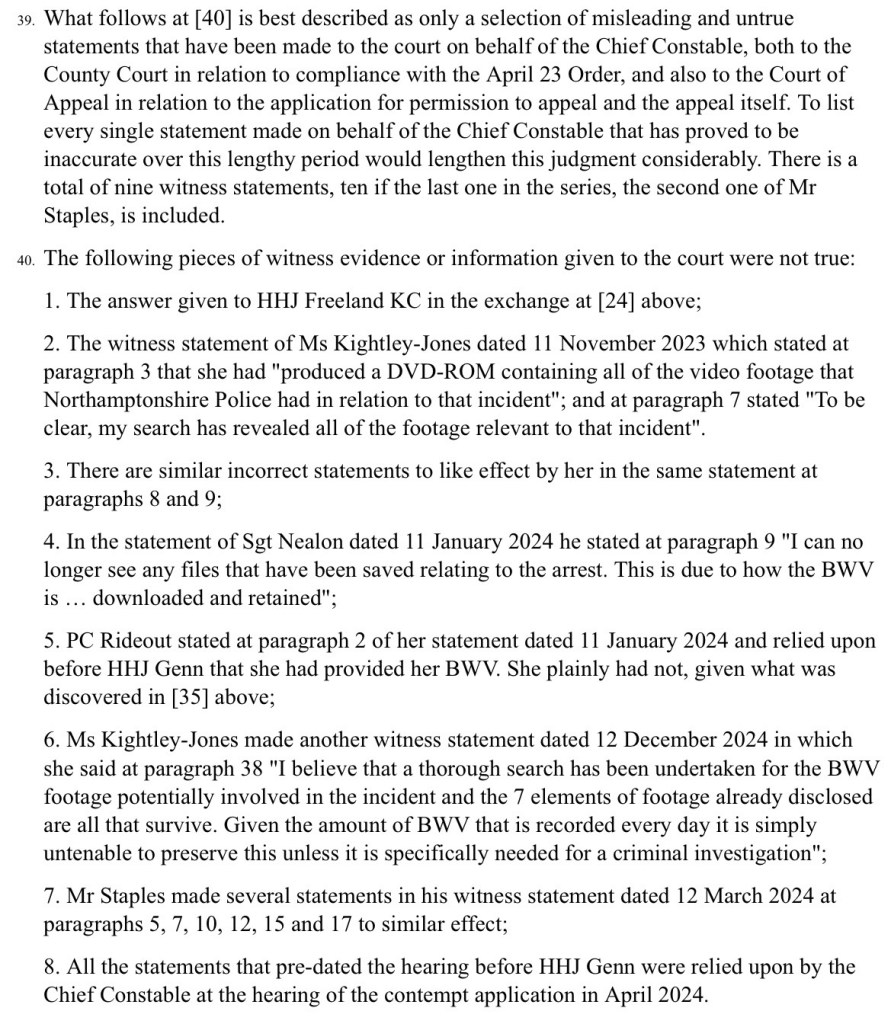
The CoA found that eight pieces of information and evidence (and this was “only a selection”) had not been true, and that “the Chief Constable had not only failed to comply with the [County Court] Order in both substance and form, but had advanced a wholly erroneous factual case before that court, and before this court as well”. Ms Buzzard-Quashie clearly succeeded in her appeal.

The judgment records that the issue of sanction for the contempt found “must wait until the next round of the process”, which presumably will be a further (or perhaps remitted) hearing.

There are any number of issues arising from this. It is, for example, notable that the data protection officer for the force was involved in the searches (and, indeed, she gave the initial statement that the County Court had ordered be given by an Inspector or above).

But a standout point for me is how incredibly difficult it was for Ms Buzzard-Quashie to vindicate her rights: the police force, for whatever reason, felt able to disregard both the statutory regulator and an order of a court. She and her pro bono lawyers showed admirable tenacity and skill, but those features (and that pro bono support) are not available to everyone. One welcomes the fact that all three judges noted her efforts and those of the lawyers.

The force has referred itself to the Independent Office of Police Conduct, and the Court of Appeal has reinforced that by making the referral part of its own order.

In this post I’ve tried to summarise the judgment, but I would strongly encourage its reading. The screenshot here is merely part of the damning findings.
The views in this post (and indeed most posts on blog) are my personal ones, and do not represent the views of any organisation I am involved with.

Leave a comment

Filed under access to information, Body worn video, Data Protection, Information Commissioner, judgments, police, subject access

Retaining data for journalistic purposes?

This is a quite extraordinary data protection story, by Jamie Roberton and Amelia Jenne of Channel 4 News , involving a mother of a woman who died in suspicious circumstances.

It appears that a “Victims’ Right to Review” exercise was undertaken by Gloucestershire Police, at the request of the family of Danielle Charters-Christie, who was found dead inside the caravan that she shared with her partner – who had been accused of domestic abuse – in Gloucestershire on 26 February 2021.

Officers then physically handed a 74-page document to Danielle’s mother, and the contents of it were subsequently reported by Channel 4 News. But, now, the police say that the Review report was “inadvertently released”, are demanding that Danielle’s mother destroy it, and have referred her apparent refusal to do so to the Information Commissioner’s Office as a potential offence under s170(3) of the Data Protection Act 2018.

That provision creates an offence of “knowingly,…after obtaining personal data, [retaining] it without the consent of the person who was the controller in relation to the personal data when it was obtained”.

But here’s a thing: it is a defence, under s170(3)(c) for a person charged with the offence to show that they acted (and here, the retention of the data would be the “action”) for the purposes of journalism, with a view to the publication by a person of any journalistic material, and in the reasonable belief that in the particular circumstances the retaining was justified as being in the public interest.

The ICO is tasked as a prosecutor for various data protection offences, including the one at s170 DPA. No doubt whoever at the ICO is handed this file will be having close regard to whether this statutory defence would apply, but will also, in line with the ICO’s duty as a prosecutor, to consider evidential factors, but also whether a prosecution would be in the public interest.

At the same time, of course, the ICO has civil enforcement powers, and might well be considering what were the circumstances under which the police, as a controller, wrongly disclosed personal data in such apparently serious circumstances.

The views in this post (and indeed most posts on blog) are my personal ones, and do not represent the views of any organisation I am involved with.

Leave a comment

Filed under Data Protection Act 2018, Information Commissioner, law enforcement, offences, police

You must be taking the PSNI

[Reposted from LinkedIn]

The Information Commissioner’s Office has fined the Police Service of Northern Ireland £750,000 for the failings that led to the public disclosure of the surnames, initials, ranks and roles of all 9,483 PSNI officers and staff, putting countless people’s lives at risk from dissident republicans. The fine would have been £5.6m if the ICO’s “public sector approach” had not been applied.

The disclosure was made in a spreadsheet attached to a Freedom of Information Act response. The spreadsheet was intended to disclose some information, but also contained a hidden tab, where the offending information was situated.

Eleven years ago I was asked to write a piece in The Guardian about the risks of hidden data in spreadsheets. At the time, as many of you will remember, these sort of incidents were prevalent in councils and the NHS. I called for the ICO to do more to warn, and, in fairness, they did. But the fact that this sort of incident was allowed to happen is shocking: the ICO notice points out that there PSNI would regularly create pivot tables to prepare information for disclosure, where the risk of data being hidden (but easily revealed) is particularly high.

The ICO announcement is unusual in that it also allows the Chief Constable of PSNI to comment, and – extraordinarily – to express that he is “extremely disappointed at the level of the fine” (despite the massive reduction over what it would have been if he was in charge of a private sector organisation).

Chief Constable Boucher – you got off lightly.

The views in this post (and indeed most posts on this blog) are my personal ones, and do not represent the views of any organisation I am involved with.

Leave a comment

Filed under Data Protection, fines, Freedom of Information, Information Commissioner, personal data breach, police, UK GDPR

Immunity from suit in data protection (and other) claims

[reposted from LinkedIn]

All too often, in my experience, public authorities might inadvertently disclose confidential information about one person to someone with whom that person is in dispute, or from whom that person is in danger. Typical examples are when a council discloses information about one resident to a neighbour, or when the police disclose information about a vulnerable person to their abusive partner.

This can also happen during the process of court proceedings.

There is a long-standing – and complex – common law concept of “immunity from suit”, which, in the very simplest and most general of terms, will prevent someone from being sued for something they say in court.

This judgment involves a fascinating, but headache-inducing, analysis of the different types of immunity from suit – witness immunity at court, advocate’s immunity at court, witness immunity before court, advocate’s immunity before court and legal proceedings immunity before court (which may apply to lawyers, police officers or administrative staff preparing a case for trial).

The background facts are grim: a woman fleeing from domestic violence was forced to flee from safe homes because twice her addresses were inadvertently disclosed (or at least indicated) to the perpetrator, against whom criminal proceedings were being brought – once by the police and once by the CPS.

The woman brought claims against both public authorities under the Human Rights Act 1998, the Data Protection Act 2018 and in misuse of private information. However, the defendants initially succeeded in striking the claims out/getting summary judgment (one part of the claim against the police was permitted to continue).

Mr Justice Richie upheld the appeal against the strike out/summary judgment, with rather a tour de force run through of the history and authorities on immunity (para 66 begins with the words “I start 439 years ago”).

In very short summary, he held that strike out/summary judgment had been inappropriate, because “the movement in the last 25 years in the appellate case law has been away from absolutism, towards careful consideration of whether the facts of each case actually do fit with the claimed ‘immunity’ by reference to whether the long-established justifications for the immunity apply” (at 106). In the examples here, it was at least arguable that immunity was being claimed not over evidence in the case, but “extraneous or peripheral or administrative matters”. The judge should have applied a balancing exercise to the facts to decide whether immunity applied: she had failed to do so, and had not been entitled to determine that there was no arguable claim

The views in this post (and indeed most posts on this blog) are my personal ones, and do not represent the views of any organisation I am involved with.

Leave a comment

Filed under compensation, damages, Data Protection Act 2018, human rights, judgments, LinkedIn Post, litigation, misuse of private information, police

A sad procedural judgment

In 1973, Pat Campbell, a Catholic factory worker from Banbridge, Northern Ireland, was shot and killed in front of his wife and children, at their family home.

No one was ever convicted of Pat Campbell’s murder, but for many years it has been believed that the killer was senior Ulster Volunteer Force member Robin “The Jackal” Jackson. Jackson – suspected of being responsible for, but never convicted of, at least 50 killings during the Troubles – was also suspected of having links with British military intelligence agencies.

In 2022 Pat Campbell’s widow reached a settlement with the Police Service of Northern Ireland, or PSNI (successor to the Royal Ulster Constabulary, or RUC) of a civil claim for damages, in which she alleged negligence and misfeasance in public office. The BBC reported at the time that “a former RUC officer and two ex-military intelligence officers were set to give evidence about Jackson’s alleged role”.

In the same year as Pat Campbell was murdered, a British intelligence officer wrote a report which is understood to have proposed increasing the RUC’s special branch’s intelligence gathers capabilities.

In 2021 journalist Phil Miller took a case under the Freedom of Information Act 2000 (FOIA) to the Information Tribunal, seeking disclosure by the PSNI of the Morton Report. However, the Tribunal upheld the Information Commissioner’s decision that PSNI were entitled to withhold the report because of the FOIA absolute exemption in relation to information supplied to a public authority by the Security Service.

Mrs Campbell, herself, however, still sought to get hold of the Morton Report. I know this because of a sad procedural judgment from the Information Tribunal.

She is identified as the appellant in case EA/2023/0276, an appeal from ICO decision notice IC-173342-D4D8. But as the judgment explains, she has since died, and the Tribunal has accordingly struck out the proceedings, under rule 8(2) of the procedure Rules, for want of jurisdiction. This is because, although The Law Reform (Miscellaneous Provisions) Act 1934 permits a “cause of action” to proceed after a claimant has died, for the benefit of the deceased’s estate, the Tribunal held, applying the same approach the Upper Tribunal took in a previous case in relation to data protection rights, a FOIA appeal is not a “cause of action” (Letang v Cooper [1965] 1 QB 232 applied). Instead, “‘[the] procedure is no more than a statutory appeal route, a procedural mechanism, for challenging’, in this case, the issue of the decision notice by the Information Commissioner”.

It seems doubtful, in any case, that Mrs Campbell would have succeeded: the exemption at section 23 is effectively insuperable.

But, of course, the PSNI has discretion to disclose information. As the ICO’s decision notice notes, the PSNI previously decided to disclose a redacted version of the 1980 Walker Report on RUC Special Branch informant handling, after the Committee on Administration of Justice took another FOIA case to the Information Tribunal.

There is no reason to suggest the same would happen if another case involving a request for the Morton Report reached the Tribunal again, but someone might consider it worth trying.

The views in this post (and indeed most posts on this blog) are my personal ones, and do not represent the views of any organisation I am involved with.

Leave a comment

Filed under access to information, Freedom of Information, Information Commissioner, Information Tribunal, police

John Edwards evidence to the Angiolini inquiry

On 29 February Lady Elish Angiolini published the first report from her inquiry into how off-duty Metropolitan police officer Wayne Couzens was able to abduct, rape and murder Sarah Everard.

Information Commissioner John Edwards contributed to the inquiry, and his evidence is cited at 4.320 (the paragraph is quoted below). It deals with the profoundly important (and perennially misunderstood) issue of data-sharing within and between police forces.

Although for obvious reasons the identity and content of some witness evidence to the inquiry is being kept anonymous, there should be no obvious reason that Mr Edwards’s is, and I hope that the Information Commissioner’s Office will, in addition to publishing his press statement, also publish any written evidence he submitted. It would also be good to know the details of the work Mr Edwards says his office is doing, and continuing, with the police, in this context.

In discussions with senior leaders of relevant organisations, the Inquiry was told that gaps in information-sharing between human resources, recruitment, professional
standards and vetting teams – and, indeed, between forces themselves – were a
significant barrier to capturing a clear picture of officers. The Inquiry heard from different sources, including senior leaders, that there are significant barriers to
information-sharing. Some cite data privacy and protection laws as a reason not to
share information. However, in a discussion with the Information Commissioner, John Edwards, the Inquiry was assured that data protection law recognises that there are legitimate reasons for information-sharing, particularly given the powers attributed to police officers. Indeed, Mr Edwards suggested that data protection law is widely misunderstood and misconstrued, and highlighted a failure of training in this regard.

The views in this post (and indeed most posts on this blog) are my personal ones, and do not represent the views of any organisation I am involved with.

Leave a comment

Filed under access to information, Data Protection, data sharing, Information Commissioner, police

PSNI data breaches and questions over ICO’s investigations retention policy

I’ve been running this blog for about 15 years now. I’m not a records manager, but I recognise that information has a lifecycle. Maybe I could weed some older posts, but the thing is, I occasionally find some of the old posts useful. For instance when news broke of recent nasty data breaches involving police forces (including the Police Service of Northern Ireland, or “PSNI”) and freedom of Information disclosures, I was able to point to a ten-year-old post on this blog which illustrated that concerns about such disclosures have been around for a long time.

So I was rather surprised to see the Information Commissioner’s Office (ICO) saying – in response to claims from two former anti-terrorist officers that the recent incidents were part of a pattern of serious mistakes, and that their information had previously been compromised (albeit not by PSNI itself) – that

Having checked with relevant teams, we do not appear to have record of an investigation regarding this data controller for the time frame noted. This may be due to our retention policy

The retention policy in question says (at page 28) that information in relation to regulatory investigations will normally be retain for five or six years, but that in civil enforcement cases where no action was taken information will be destroyed after two years.

There is nothing inherently “wrong” about this; unless there is a statutory requirement to retain information it will fall to each public body to determine what is an appropriate retention period. However, the ICO elsewhere emphasises the need to consider patterns in compliance. The regulatory action policy, for instance, says that an organisation’s “prior regulatory history” including the “pattern…of complaints” might be an aggravating factor when it comes to taking enforcement action, and that “as issues or patterns of issues escalate in frequency or severity then we will issue more significant powers in response”. But the retention policy means that, unless formal action has been taken against an organisation, such patterns might only be able to be taken into account when they involve incidents occurring within the previous two years. Is that sufficient or adequate?

I would suggest not. The policy’s version history illustrates that it is regularly reviewed (including an annual review). I would hope that the next review consider whether there is compelling evidence to suggest that retaining investigation information for longer than two years is warranted, especially in light of recent events.

Leave a comment

Filed under access to information, adequacy, Data Protection, Information Commissioner, retention, security

ICO: powers to enforce over dead people’s information?

The Information Commissioner’s Office (ICO) has announced that it will not be taking action against Lancashire Police in relation to their disclosure of private information during their investigation into the tragic case of Nicola Bulley.

This is unsurprising, and, objectively, reassuring, because if the ICO had brought enforcement proceedings it would almost certainly have been unlawful to do so. In blunt terms, the ICO’s relevant powers are under laws which deal with “personal data” (data relating to a living individual) and when the police disclosed information about Nicola, she was not living.

There is no discretion in these matters, and no grey areas – a dead person (in the UK, at least) does not have data protection rights because information relating to a dead person is, simply, not personal data. Even if the police thought, at the time of the disclosure, that Nicola was alive, it appears that, as a matter of fact, she was not. (I note that the ICO says it will be able to provide further details about its decision following the inquest into Nicola’s death, so it is just possible that there is further information which might elucidate the position.)

Unless the ICO was going to try to take enforcement action in relation to a general policy, or the operation of a general policy, about disclosure of information about missing people (for instance under Article 24 of the UK GDPR), then there was simply no legal power to take action in respect of this specific incident.

That is not to say that the ICO was not entitled to comment on the general issues, or publish the guidance it has published, but it seems to be either an empty statement to say “we don’t consider this case requires enforcement action”, or a statement that reveals a failure to apply core legal principles to the situation.

The views in this post (and indeed most posts on this blog) are my personal ones, and do not represent the views of any organisation I am involved with.

Leave a comment

Filed under Data Protection, enforcement, Information Commissioner, personal data, police

Dashcams and domestic purposes

What do people use dashcams and cameras on cycle helmets for? I’m sure that some (especially in the latter group) use them to capture footage of interesting journeys they have made. But a considerable proportion of users – surely – use them in the event that the user is involved in a road traffic incident. Indeed the “National Dash Cam Safety Portal”, although provided by a commercial organisation selling cameras, is operated in partnership with, and enables upload of footage to, police forces in England and Wales, and its FAQ clearly inform people of the evidential nature and implications of such footage. And a recent piece on the “Honest John” website suggests that one in four dashcam submissions result in a prosecution. Whatever the intentions were of the people who used those dashcams to record that footage, it is undeniable that the outcome of the processing of personal data involved had a significant effect on the rights of those whose data was processed.

Article 2 of the UK GDPR says that the law’s scope does not extend to processing of personal data “by a natural person in the course of a purely personal or household activity”, and the case law of the Court of Justice of the European Union (at least insofar as such case law decided before 1 January 2021 is retained domestic law – unless departed from by the Court of Appeal or the Supreme Court) makes clear that use of recording cameras which capture footage containing personal data outwith the orbit of one’s property cannot claim this “purely personal or household activity” exemption (see, in particular the Ryneš case).

Yet the position taken by the authorities in the UK (primarily by the Information Commissioner’s Office (ICO)) largely fails to address the difficult issues arising. Because if the use of dashcams and helmet cams, when they result in the processing of personal data which is not exempt under under the “purely personal and household exemption, is subject to data protection law, then those operating them are, in principle at least, obliged to comply with all the relevant provisions of the UK GDPR, including: compliance with the Article 5 principles; providing Article 13 notices to data subjects; complying with data subject request for access, erasure, etc. (under Articles 15, 17).

But the ICO, whose CCTV guidance deals well with the issues to the extent that domestic CCTV is in issue, implies that use of dashcams etc, except in a work context, is not subject to the UK GDPR. For instance, its FAQs on registering as a data protection fee payer say “the use of the dashcam in or on your vehicle for work purposes will not be considered as ‘domestic’ and therefore not exempt from data protection laws”. It is very difficult to reconcile the ICO’s position here with the case law as exemplified in Ryneš.

And what raises interesting questions for me is the evidential status of this dashcam and helmet cam footage, when used in prosecutions. Although English law has traditionally tended to take the approach that evidence should be admitted where it is relevant, rather than excluding it on the grounds that it has been improperly obtained (the latter being a species of the US “fruit of the poisoned tree” doctrine), it is surely better for a court not to be faced with a situation where evidence may have been obtained in circumstances involving illegality.

If this was a passing issue, perhaps there would not need to be too much concern. However, it is clear that use of mobile video recording devices (and use of footage in criminal, and indeed civil, proceedings) is increasing and will continue to do so, at the same time as access to such devices, and the possibility for their covert or surreptitious use, also increases. It is, no doubt, a tremendously tricky area to regulate, or event to contemplate regulating, but that is no reason for the ICO to duck the issue.

The views in this post (and indeed most posts on this blog) are my personal ones, and do not represent the views of any organisation I am involved with.

Leave a comment

Filed under CCTV, crime, Data Protection, Information Commissioner, police

An Uber-reaction in The Times

“Uber gives police private data on drivers and passengers” announces The Times(£) this morning.

In this post, much to my surprise (I have never taken an Uber, and don’t intend to – I don’t like their business model), I come to the defence of Uber.

A closer read of the Times piece reveals that what is being referred to, in documents filed with the High Court, in proceedings regarding TfL’s refusal to renew Uber’s licence, is requests to Uber from the police to disclose personal data for the purposes of the prevention and detection of crime or the apprehension or prosecution of offenders.

Such requests are commonly made to thousands of public authorities and private companies. They used to be known in data protection and police circles as “section 29 requests”, after the relevant section of the now-repealed Data Protection Act 1998. The term was a bit misleading: section 29, now replaced effectively by paragraph 2 of Schedule 2 to the Data Protection Act 2018, has the effect of disapplying the provisions of data protection law which would otherwise prevent the disclosure of personal data to the police (or others), and where not disclosing would be likely to prejudice the purposes of the prevention and detection of crime or the apprehension or prosecution of offenders. This is a necessary provision of data protection law, and provided that (as with all provisions) it is applied correctly and proportionately, it works very well: it gives controller the power to disclose personal data to the police where it is necessary for criminal justice.

If Uber are dealing with police requests appropriately, it is for the public good that personal data which assists the police to investigate drug transporting and human trafficking is made available to them.

In fact, I strongly suspect that The Times will receive such requests from the police. When the requests are related to the paper’s journalistic activities they are probably, and probably rightfully, refused, but they may well get requests in respect of their employees’ data, and I would be very surprised if they don’t sometimes – as a responsible company – comply with these.

Transport for London certainly receives such requests. Indeed, as a public authority, under its transparency measures, it has habitually made statistics on this public. The most recent publication I can find shows that 2012 to 2017 TfL received an average of approximately 10,000 requests each year.

Will The Times now report that TfL is handing over to the police thousands of pieces of intelligence on members of the public each year?

Leave a comment

Filed under Data Protection, Data Protection Act 2018, data sharing, police