Category Archives: marketing

O’Carroll v Meta – what now for targeted adverts on Facebook

Following the news that claimant Tanya O’Carroll and defendant Meta have settled ahead of what was likely to be a landmark data protection case, what are the implications?

Ms O’Carroll argued that advertising served to her on Facebook, because it was targeted at her, met the definition of “direct marketing” under section 122(5) of the Data Protection Act 2018 (“the communication (by whatever means) of advertising or marketing material which is directed to particular individuals”) and thus the processing of her personal data for the purposes of serving that direct marketing was subject to the absolute right to object under Article 21(2) and (3) UK GDPR.

Meta had disputed that the advertising was direct marketing.

The “mutually agreed statement” from Ms O’Carroll says “In agreeing to conclude the case, Meta Platforms, Inc. has agreed that it will not display any direct marketing ads to me on Facebook, will not process my data for direct marketing purposes and will not undertake such processing (including any profiling) to the extent it is related to such direct marketing”.

One concludes from this that Meta will, at least insofar as the UK GDPR applies to its processing, now comply with any Article 21(2) objection, and, indeed, that is how it is being reported.

But will the upshot of this be that Meta will introduce ad-free services in the UK, but for a charge (because its advertising revenues will be likely to drop if people object to targeted ads)? It is indicating so, with a statement saying “Facebook and Instagram cost a significant amount of money to build and maintain, and these services are free for British consumers because of personalised advertising. Like many internet services, we are exploring the option of offering people based in the UK a subscription and will share further information in due course”.

The ICO intervened in the case, and have uploaded a summary of their arguments, which were supportive of Ms O’Carroll’s case, and her lawyers AWO Agency have also posted an article on the news.

The views in this post (and indeed most posts on blog) are my personal ones, and do not represent the views of any organisation I am involved with.

Leave a comment

Filed under Data Protection, Data Protection Act 2018, facebook, Information Commissioner, marketing, Meta, Right to object, UK GDPR

Cookies, compliance and individuated consent

[reposted from my LinkedIn account]

Much will be written about the recent High Court judgment on cookies, direct marketing and consent, in RTM v Bonne Terre & Anor, but treat it all (including, of course, this, with caution).

This was a damages claim by a person with a gambling disorder. The claim was, in terms, that the defendant’s tracking of his online activities, and associated serving of direct marketing, were unlawful, because they lacked his operative consent, and they led to damage because they caused him to gamble well beyond his means. The judgment was only on liability, and at the time of writing this post there has been no ruling on remedy, or quantum of damages.

The domestic courts are not regulators – they decide individual cases, and where a damages claim is made by an individual any judicial analysis is likely to be highly fact specific. That is certainly the case here, and paragraphs 179-181 are key:

such points of criticism as can be made of [the defendant’s] privacy policies and consenting mechanisms…are not made wholesale or in a vacuum. Nor are they concerned with any broader question about best practice at the time, nor with the wisdom of relying on this evidential base in general for the presence of the consents in turn relied on for the lawfulness of the processing undertaken. Such general matters are the proper domain of the regulators.

In this case, the defendant could not defeat a challenge that in the case of this claimant its policies and consenting mechanisms were insufficient:

If challenged by an individual data subject, a data controller has to be able to demonstrate the consenting it relies on in a particular case. And if that challenge is put in front of a court, a court must decide on the balance of probabilities, and within the full factual matrix placed before it, whether the data controller had a lawful consent basis for processing the data in question or not.

Does this mean that a controller has to get some sort of separate, individuated consent for every data subject? Of course not: but that does not mean that a controller whose policies and consenting mechanisms are adequate in the vast majority of cases is fully insulated from a specific challenge from someone who could not give operative consent:

In the overwhelming majority of cases – perhaps nearly always – a data controller providing careful consenting mechanisms and good quality, accessible, privacy information will not face a consent challenge. Such data controllers will have equipped almost all of their data subjects to make autonomous decisions about the consents they give and to take such control as they wish of their personal data…But all of that is consistent with an ineradicable minimum of cases where the best processes and the most robust evidential provisions do not, in fact, establish the necessary presence of autonomous decision-making, because there is specific evidence to the contrary.

This is, one feels, correct as a matter of law, but it is hardly a happy situation for those tasked with assessing legal risk.

And the judgment should (but of course won’t) silence those who promise, or announce, “full compliance” with data protection and electronic marketing law.

The views in this post (and indeed most posts on this blog) are my personal ones, and do not represent the views of any organisation I am involved with.

Leave a comment

Filed under adtech, consent, cookies, Data Protection, GDPR, judgments, marketing, PECR, Uncategorized

Soft opt in marketing for non-profits

Why can’t charities send speculative promotional emails and text messages to customers and enquirers, in circumstances where commercial organisations can? And should the law be changed?

Regulation 22 of the Privacy and Electronic Communications (EC Directive) Regulations 2003 (PECR) deals with circumstances under which a person can send an unsolicited direct marketing communication by email, or text message.

In simple and general terms, a person cannot send an unsolicited direct marketing email or text message to an individual’s private email account, unless the individual has consented to receive it. “Consent”, here, has the stringent requirements imposed by Article 4(11) and Article 7 of the UK GDPR.

(The actual law is more complex – it talks of an “individual subscriber”. This is the person who is a party to a contract with a provider of public electronic communications (for which, read “email” and “text message”) services for the supply of such services. So, if you have signed up for, say, a gmail account, you have a contract with Google, and you are – if you are an individual – an individual subscriber.)

The exception to the requirement to have the recipient’s consent is at regulation 22(3) of PECR, which says that the sender of the marketing communication does not need the prior consent of the recipient where the sender: obtained the contact details of the recipient of that electronic mail in the course of the sale or negotiations for the sale of a product or service to that recipient; the direct marketing is in respect of the sender’s similar products and services only; and the recipient has been given a simple means of refusing the use of their contact details for the purposes of such direct marketing, at the time that the details were initially collected, and at the time of each subsequent communication.

This exception to the general “consent required” rule has long (and probably unhelpfully) been known as the “soft opt in”.

The notable requirement for the soft opt in is, though, that the recipient’s contact details must have been collected in the course of the sale or negotiations for the sale of a product or service.

There are various types of non-profit organisation which may well correspond with, and wish to send promotional emails and text messages to individuals, but which don’t as a rule sell products or services. Perhaps the most obvious of these are charities, but political parties also fall into the type.

The Information Commissioner’s Office (ICO) has long held that promotional communications sent by such non-profits do constitute “marketing” (and the Information Tribunal upheld this approach as far back as in 2006, when the SNP appealed enforcement action by the ICO). (I happen to think that there’s still an interesting argument to be had about what “marketing” means in the PECR and data protection scheme, and at one end of that argument would be a submission that it implies a commercial relationship between the parties. However, no one has yet taken the issue – as far as I’m aware – to an appellate court.)

But the combined effect of regulation 22(3) and the interpretation of “marketing” as covering promotional emails and text messages by charities, means that those charities (and political parties etc.) can’t send soft opt in communications.

The Data Protection and Digital Information Bill, which tripped and fell yards from the finishing line, when Mr Sunak, in a strategic master stroke, called the general election early, proposed, in clause 115, to extend the soft opt in where the direct marketing was “solely for the purpose of furthering a charitable, political or other non-commercial objective” of the sender.

Will the new Labour administration’s proposed Digital Information and Smart Data Bill revive the clause? The government’s background paper on the legislative agenda in the King’s Speech doesn’t refer to it, but that may be because it’s seen as a relatively minor issue. But, in fact, for many charities, the issue carries very significant implications for their operations and their ability effectively to fundraise.

It should be revived, and it should be enacted.

The views in this post (and indeed most posts on this blog) are my personal ones, and do not represent the views of any organisation I am involved with.

2 Comments

Filed under charities, Data Protection Bill, Information Commissioner, marketing, PECR, political parties

Can you stop election candidates sending you post?

During every recent general election campaign I can remember, there have been social media posts where people complain that they’ve received campaign material sent to them, by name, in the post. Electoral law (whether one likes it or not) permits a candidate to send, free of charge, one such item of post regardless of whether the recipient has objected to postal marketing, in general or specific terms. This right is contained in section 91 of The Representation of the People Act 1983. So, if you don’t like it, lobby your new MP in a few weeks’ time to get it changed.

Given that it’s always a topic of contention, I welcome the Information Commissioner’s Office’s publishing of guidance (including on the “one item of post” point) for the public on “The General Election and my personal data – what should I expect?

What the guidance does not address, however, is a conflict of laws point. Article 21(2-3) of the UK GDPR create an absolute right to object to direct marketing and a consequent absolute obligation on a person not to process personal data for direct marketing purposes upon receipt of an objection. So how does this talk with the right given to electoral candidates to send one such communication?

Tim Turner has written on this point, in his “DPO Daily”, and says “I don’t think the Representation of the People Act trumps the DP opt-out right”, but – on this rare occasion – I think I disagree with him. This is because section 3(1) of the Retained EU Law (Revocation and Reform) Act 2023 provides that retained direct EU legislation – such as the UK GDPR – must be read and given effect in a way which is compatible with all domestic enactments, and, insofar as it is incompatible with them, those domestic enactments prevail.

So, the short answer to the title of this blog is “no” (although they can only send you just one personally addressed item).

The views in this post (and indeed most posts on this blog) are my personal ones, and do not represent the views of any organisation I am involved with.
Leave a comment

Filed under Data Protection, elections, Information Commissioner, marketing, political parties, UK GDPR

HMRC sending spam

Have HMRC jumped the gun, and assumed that they can now (in advance of the Data Protection and Digital Information (No.2) Bill being passed) rely on the soft opt-in for email marketing?

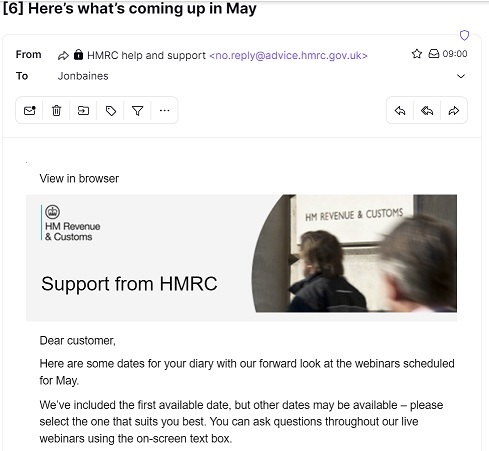
In common with many other poor souls, I have in recent years had to submit a self-assessment tax return to HMRC. Let’s just say that, unless they’re going to announce a rebate, I don’t relish hearing from them. So I was rather surprised to receive an email from “HMRC Help and Support” recently, telling me “what’s coming up in May” and inviting me to attend webinars. A snippet of the email is here

This certainly wasn’t solicited. And, at least if you follow the approach of the Information Commissioner’s Office (ICO) was direct marketing by electronic means (“Direct marketing covers the promotion of aims and ideals as well as the sale of products and services. This means that the rules will cover not only commercial organisations but also not-for-profit organisations“).

The only lawful way that a person can send unsolicited direct electronic marketing to an individual subscriber like me, is if the recipient has consented to receive it (I hadn’t), or if the person obtained the contact details of the recipient in the course of the sale or negotiations for the sale of a product or service to that recipient (see regulation 22 of the Privacy and Electronic Marketing (EC Directive) Regulations 2003 (“PECR”)). But HMRC cannot avail themselves of the latter (commonly known as the “soft opt-in”), because they have not sold me (or negotiated with me for the sale) of a product or service. The ICO also deals with this in its guidance: “Not-for-profit organisations should take particular care when communicating by text or email. This is because the ‘soft opt-in’ exception only applies to commercial marketing of products or services“.

I raised a complaint (twice) directly with HMRC’s Data Protection Officer who (in responses that seemed oddly, let’s say, robotic) told me how to unsubscribe, and pointed me to HMRC’s privacy notice.

It seems to me that HMRC might be taking a calculated risk though: the Data Protection and Digital Information (No.2) Bill, currently making its way through Parliament, proposes (at clause 82) to extend the soft opt-in to “non-commercial objectives”. If it passes, then we must expect much more of This Type Of Thing from government.

If I’m correct in this, though, I wonder if, when calculating that calculated risk, HMRC calculated the risk of some calculated individual (me, perhaps) complaining to the ICO?

The views in this post (and indeed most posts on this blog) are my personal ones, and do not represent the views of any organisation I am involved with.

Leave a comment

Filed under Data Protection Bill, HMRC, Information Commissioner, marketing, PECR, spam

Where’s the Tories’ privacy notice? (just don’t mention the footballer)

The Conservative Party, no doubt scrabbling to gather perceived support for its contentious immigration policies and measures is running a web and social media campaign. The web page encourages those visiting it to “back our plan and send a message” to other parties:

Further down the page visitors are invited to “send Labour a message”

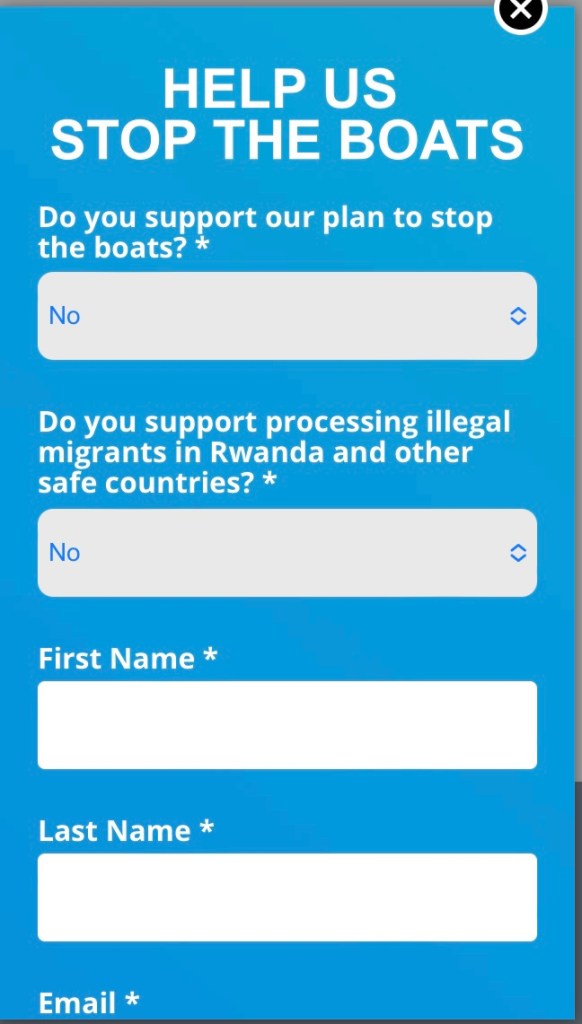
Clicking on either of the red buttons in those screenshots results in a pop-up form, on which one can say whether or not one supports the Tory plans (in the screenshot below, I’ve selected “no”)

One is then required to give one’s name, email address and postcode, and there is a tick box against text saying “I agree to the Conservative Party, and the wider Conservative Party, using the information I provide to keep me updated via email about the Party’s campaigns and opportunities to get involved”

There are two things to note.

First, the form appears to submit whether one ticks the “I agree” box or not.

Second, and in any case, none of the links to “how we use your data”, or the “privacy policy”, or the “terms and conditions” works.

So anyone submitting their special category data (information about one’s views on a political party’s policies on immigration is personal data revealing political opinions, and so Article 9 UK GDPR applies) has no idea whatsoever how it will subsequently be processed by the Tories.

I suppose there is an argument that anyone who happens upon this page, and chooses to submit the form, has a good idea what is going on (although that is by no means certain, and people could quite plausibly think that it provides an opportunity to provide views contrary to the Tories’). In any event, it would seem potentially to meet to definition of “plugging” (political lobbying under the guide of research) which ICO deals with in its direct marketing guidance.

Also in any event, the absence of any workable links to privacy notice information means, unavoidably, that the lawfulness of any subsequent processing is vitiated.

It’s the sort of thing I would hope the ICO is alive to (I’ve seen people on social media saying they have complained to ICO). But I won’t hold my breath on that – many years ago I wrote about how such data abuse was rife across the political spectrum – but little if anything has changed.

And finally, the most remarkable thing of all is that I’ve written a whole post on what is a pressing and high-profile issue without once mentioning Gary Lineker.

The views in this post (and indeed most posts on this blog) are my personal ones, and do not represent the views of any organisation I am involved with.

Leave a comment

Filed under Data Protection, Information Commissioner, marketing, PECR, privacy notice, social media, spam, UK GDPR

ICO calls for global cookie standards (but why not enforce the law?)

The outgoing UK Information Commissioner, Elizabeth Denham, is calling on G7 countries to adopt her office’s new “vision” for websites and cookie consent.

Her challenge to fellow G7 data protection and privacy authorities has been issued at a virtual meeting taking place on 7 and 8 September, where they will be joined by the Organisation for Economic Cooperation and Development (OECD) and the World Economic Forum (WEF).

Denham says “There are nearly two billion websites out there taking account of the world’s privacy preferences. No single country can tackle this issue alone. That is why I am calling on my G7 colleagues to use our convening power. Together we can engage with technology firms and standards organisations to develop a coordinated approach to this challenge”.

What is not clear is whether her vision is, or can be, underpinned by legal provisions, or whether it will need to take the form of a non-enforceable set of standards and protocols. The proposal is said to mean that “web browsers, software applications and device settings [should] allow people to set lasting privacy preferences of their choosing, rather than having to do that through pop-ups every time they visit a website”. The most obvious way of doing this would be through a user’s own browser settings. However, previous attempts to introduce something similar – notably the “Do Not Track” protocol – foundered on the lack of adoption and the lack of legal enforceability.

Also unaddressed, at least in the advance communications, is why, if cookie compliance is a priority area for the Information Commissioner, there has been no enforcement action under the existing legal framework (which consists primarily of the Privacy and Electronic Communications (EC Directive) Regulations 2003 (or “PECR”)). Those current laws state that a website operator must seek consent for the placing of all cookies unless they are essential for the website to function. Although many website operators try hard to comply, there are countless examples of ones who don’t, but who suffer no penalty.

Denham says that “no single country can tackle this alone”, but it is not clear why such a single country can’t at least take steps towards tackling it on domestic grounds. It is open to her to take action against domestic website operators who flout the law, and there is a good argument that such action would do more to encourage proper compliance than will the promotion or adoption of non-binding international standards.

The views in this post (and indeed most posts on this blog) are my personal ones, and do not represent the views of any organisation I am involved with.

Leave a comment

Filed under cookies, Data Protection, Information Commissioner, marketing, PECR

Some PECR figures in light of a new monetary penalty notice

Presented without comment.

21,166,574 unsolicited direct marketing messages

£100,000 monetary penalty

Only £1k in the bank at the last filings

Zero chance of recovery?

The views in this post (and indeed most posts on this blog) are my personal ones, and do not represent the views of any organisation I am involved with.

Leave a comment

Filed under Data Protection, enforcement, Information Commissioner, marketing, monetary penalty notice, PECR

GDPR doesn’t always mean “opt in”

TL;DR – the law says that when you’re buying something from them companies only have to offer you an opt out from marketing. GDPR hasn’t changed this.

I see a lot of criticism of companies on social media by people who accuse the former of not complying with the General Data Protection Regulation (GDPR). Here’s an example:

But the criticism is generally misguided. GDPR does not itself deal directly with direct marketing (other than to provide for an unqualified right to opt out of it (at Article 21(3)) and a statement in one of the recitals to the effect that the processing of personal data for the purposes of direct marketing may be regarded as carried out for a legitimate interest).

The operative law in the UK regarding electronic direct marketing is, and remains, The Privacy and Electronic Communications (EC Directive) Regulations 2003 (which implement a 2002 European Directive).

These provide that one cannot send direct marketing to an individual subscriber* by unsolicited “electronic mail” (which these days largely boils down to email and SMS) unless the recipient has consented or unless the sender

has obtained the contact details of the recipient of that electronic mail in the course of the sale or negotiations for the sale of a product or service to that recipient…the direct marketing is in respect of that person’s similar products and services only…and the recipient has been given a simple means of refusing (free of charge except for the costs of the transmission of the refusal) the use of his contact details for the purposes of such direct marketing, at the time that the details were initially collected, and, where he did not initially refuse the use of the details, at the time of each subsequent communication.

In plain language, this means that when you buy, or enter into negotiations to buy, a product or service from someone, the seller only has to offer an “opt out” option for subsequent electronic marketing. Nothing in GDPR changes this.

*”individual subscriber” means the person who is a party to a contract with a provider of public electronic communications services for the supply of such services- in effect, this is likely to be someone using their personal email address, and not a work one).

The views in this post (and indeed all posts on this blog) are my personal ones, and do not represent the views of any organisation I am involved with.

2 Comments

Filed under consent, Data Protection, GDPR, marketing, PECR

The “GDPR consent” email I’d like to receive

“Dear Jon

You know us. We’re that firm you placed an order with a few months ago. You may remember that at the time we took your order we explained we were going to send occasional marketing emails to you about similar products and services, but you could opt out then, and at any subsequent point.

We know that since 2003 (with the Privacy and Electronic Communications Regulations) (PECR) it’s been unlawful to send unsolicited marketing emails except in circumstances like those above.

We’re contacting you now because we’ve noticed a lot of competitors (and other firms) who are either utterly confused or utterly misrepresenting a new law (separate to PECR) called the General Data Protection Regulation (GDPR). They’re claiming it means they have to contact you to reconfirm your consent to receive marketing emails.

GDPR actually says nothing of the sort. It does explain what “consent” means in data protection terms in a slightly more strict way, but for companies like us, who’ve respected our customers and prospective customers all along, it makes no difference.

In fact, the emails you’re getting from those companies, asking you to “reconsent”, are probably actually direct marketing emails themselves. And if the companies don’t already have your consent to send them they may well be breaking the law in sending them. If you think we’re exaggerating, look at the fine the Information Commissioner’s Office (ICO) levied on Honda last year.

In fact, you’d do well to look at the ICO’s website – it’s got some good stuff on this, both for customers like you, and for companies who are confused by this.

It all really boils down to treating customers well, and not assuming you can send direct electronic marketing without actually looking at what the law says.

So yes, this is a marketing email, and yes, it is lawful, and yes, it is more than a little pompous.”

The views in this post (and indeed all posts on this blog) are my personal ones, and do not represent the views of any organisation I am involved with.

12 Comments

Filed under consent, GDPR, Information Commissioner, marketing, PECR, spam