Category Archives: Information Commissioner

Arbitrary criminality and data protection

It shouldn’t be too controversial to state that to commit a criminal offence is a serious matter: although there are – obviously – different levels of severity, certain acts or omissions are so injurious to society as a whole that they warrant prosecution.

The majority of infringements of data protection law are not criminal offences, but, rather, contravention of civil law. But there are a few offences in the statutory scheme. Section 132 of the Data Protection Act 2018 (DPA) is one such. It says that it is an offence for the Information Commissioner, or a member of his staff, to disclose information

which—

(a)has been obtained by, or provided to, the Commissioner in the course of, or for the purposes of, the discharging of the Commissioner’s functions,

(b)relates to an identified or identifiable individual or business, and

(c)is not available to the public from other sources at the time of the disclosure and has not previously been available to the public from other sources,

However, it will not be an offence if the disclosure is made with “lawful authority”, and a disclosure is made with lawful authority only if and to the extent that

(a)the disclosure was made with the consent of the individual or of the person for the time being carrying on the business,

(b)the information was obtained or provided as described in subsection (1)(a) for the purpose of its being made available to the public (in whatever manner),

(c)the disclosure was made for the purposes of, and is necessary for, the discharge of one or more of the Commissioner’s functions,

(d)the disclosure was made for the purposes of, and is necessary for, the discharge of an EU obligation,

(e)the disclosure was made for the purposes of criminal or civil proceedings, however arising, or

(f)having regard to the rights, freedoms and legitimate interests of any person, the disclosure was necessary in the public interest.

This means that, for instance, if an individual or a business has given (willingly or under compulsion) information to the Commissioner for the purposes of a regulatory investigation, and the information is not already public, then the Commissioner must not disclose it, unless he has lawful authority to do so.

Where, also for instance, the Commissioner publishes a legal decision notice, or monetary penalty notice, or the like, this will ordinarily contain information of this kind, but the Commissioner can point to the lawful authority he has under section 132(2)(c) – namely that the disclosure was made for the purposes of, and is necessary for, the discharge of one or more of the Commissioner’s functions. No offence committed.

But section 132 is why the Commissioner’s Office might refuse, under the Freedom of Information Act 2000 (FOIA), to disclose information it has received from an individual or business. For instance, a notification report a controller has submitted pursuant to its “personal data breach” obligations under Article 33 UK GDPR. Here is an example. The ICO withholds the “breach report” in question, citing the exemption at section 44, because of the offence provisions at section 132 DPA.

Whether this is an over-cautious stance is one thing, but it is understandable.

What puzzles me, though, is the inconsistency, because elsewhere, in very similar circumstances, in response to a FOIA request, the ICO has disclosed a personal data report (albeit with redactions). Here, also.

If the Commissioner’s staff in the first example feel that they would commit an offence by disclosing the report, do the staff dealing with the second or third examples not feel that they would also?

One thing that should certainly not happen is claiming exemptions because it is easier to do so than not. I am not saying that has happened here, but there certainly seems to be inconsistency. And inconsistency, or uncertainty, about whether a regulator and his staff might commit a criminal offence is not a good situation.

The views in this post (and indeed most posts on this blog) are my personal ones, and do not represent the views of any organisation I am involved with.

Leave a comment

Filed under access to information, crime, Data Protection, Data Protection Act 2018, Freedom of Information, Information Commissioner

An open complaint to the ICO about MailOnline cookies

***UPDATE at 8 November***

There is no update. Nothing from the ICO at all, other than, at four weeks – after chasing – a message saying it’s taking six to eight weeks to allocate cases.

It’s now more than eight weeks.

***END UPDATE***

Dear Mr Edwards

In June this year Stephen Bonner told MLex that websites which

don’t have “reject all” on your top level [cookie banner]…are breaking the law. ..There is no excuse for that. The ICO is paying attention in this area and will absolutely issue fines if we see organizations are not taking that seriously and taking steps.

Subsequently, your office said to law firm Mishcon de Reya

Having a ‘reject all’ button on a cookies banner that is just as prominent as an ‘accept all’ button helps people to more easily exercise their information rights. The ICO is closely monitoring how cookie banners are used in the UK and invites industry to review their cookies compliance now. If the ICO finds that cookies banners breach the law, it will seriously consider using the full range of its powers, including fines.

Then, on 9 August, in conjunction with the Competition and Markets Authority, your office stated

One clear example of often harmful design are cookie consent banners. A website’s cookie banner should make it as easy to reject non-essential cookies as it is to accept them. Users should be able to make an informed choice on whether they want to give consent for their personal information to be used, for example, to profile them for targeted advertising. The ICO will be assessing cookie banners of the most frequently used websites in the UK, and taking action where harmful design is affecting consumers.

In view of all of these statements, I wish to complain, under Article 77 UK GDPR, and simultaneously request, under regulation 32 of the Privacy and Electronic Communications (EC Directive) Regulations 2003 (“PECR”), that you exercise your enforcement functions, in relation to the use of cookies and similar technology by Associated Newspapers Limited, or alternatively DMG Media (whichever is applicable) as controller of, and person responsible for confidentiality of communications on, the “MailOnline” website at https://www.dailymail.co.uk/home/index.html (the “Website”).

The Website presents a visitor using the Safari browser on an iPhone 11 Pro with a “cookie banner” (see attached screenshot) which does not offer visitors a “reject all” option.

Furthermore, the whole set-up is opaque. If one clicks “Cookie Settings” one is faced with an initially straightforward set of options (one of them set by default to accept cookies for personalised advertising on the basis of “legitimate interest”, which is clearly not compliant with regulation 6 of PECR). However, if one then clicks on the tab for “Vendors”, one is faced with a frankly farcically long list of such “vendors”, and options, many of them set by default to “legitimate interest”. I consider myself reasonably knowledgeable in this area, but it is far from clear what is actually going on, other than to say it plainly appears to be falling short of compliance with regulation 6, and, to the extent my personal data is being processed, the processing plainly appears to be in contravention of the UK GDPR, for want – at least – of fairness, lawful basis and transparency.

It is worth noting that much of MailOnline’s content is likely to be of interest to and accessed by children (particularly its sports and “celebrity news” content), even if the publisher does not actively target children. You state, in your guidance

if children are likely to access your service you will need to ensure that both the information you provide and the consent mechanism you use are appropriate for children.

But the complexity and opacity of the Website’s cookie use means that it is largely incomprehensible to adults, let alone children.

It is, obviously, not for me to specify how you undertake an investigation of my complaint, but you must, of course, by reference to Article 57(1)(f) UK GDPR, investigate to the “extent appropriate”. Given the clear messages your office has delivered about cookie banners and the like, and given the weight of evidence as to non-compliance, I would suggest an investigation to the extent appropriate must – at the very least – result in a clear finding as to legality, with reasons, and recommendations for the investigated party.

I cannot claim to be distressed by the infringements I allege, but I do claim to be irritated, and to have, cumulatively, been put to excess time and effort repeatedly trying to “opt out” of receiving cookies on the Website and understand what sort of processing is being undertaken, and what sort of confidentiality of communications exists on it.

Of course the Website here is not the only example of apparent non-compliance: poor practice is rife. Arguably, it is rife because of a prolonged unwillingness by your office and your predecessors to take firm action. However, if you would like me to refer to other examples, or require any further information, please don’t hesitate to ask.

Yours sincerely

Jon Baines

The views in this post (and indeed most posts on this blog) are my personal ones, and do not represent the views of any organisation I am involved with.

Leave a comment

Filed under adtech, consent, cookies, Data Protection, Information Commissioner, PECR, UK GDPR

ICO breaching section 45 FOI code which it has a duty to promote

Under section 45 of the Freedom of Information Act 2000 (FOIA), the Minister for the Cabinet Office is required to issue a Code of Practice providing guidance to public authorities as to the practice which it would, in his opinion, be desirable for them to follow. A Code of Good Practice, if you will. The Information Commissioner’s Office (ICO) says, about the most recent version of the section 45 Code, that it

should be used as a handbook which sets out best practice to help you with the day to day handling of requests. Adhering to the Code will result in positive benefits for your authority, and in practical terms, offer good customer service.

And under section 47(1)(b) of FOIA the ICO has a duty to perform his functions so as to promote the observance of the Code.

Paragraph 8.5 of the Code says that

Public authorities with over 100 Full Time Equivalent (FTE) employees should, as a matter of best practice, publish details of their performance on handling requests for information under [FOIA…and] should do so on a quarterly basis…

However, the ICO themselves do not do, indeed never have done, this.

I recently made a FOIA request to the ICO, in which I queried the absence of they published statistics under paragraph 8.5 of the Code, and asked for disclosure of the last two years’ statistics. The response revealed statistics that are not particularly interesting, other than that they show that the ICO has made commendable improvements in its own compliance, following the dip which coincided with the pandemic. But all that was said about the proactive publication point was

We are not presently publishing our quarterly stats

No explanation as to why, and the fact that it appears expressly contrary to the ICO’s duty under section 47 to promote observance of the Code.

The ICO has, in recent months, indicated a willingness to get a bit tougher on public authorities don’t comply with FOIA, but if it does not itself comply, the effect of such tougher enforcement is greatly weakened.

The views in this post (and indeed most posts on this blog) are my personal ones, and do not represent the views of any organisation I am involved with.

Leave a comment

Filed under Freedom of Information, Information Commissioner

“Text pests” and data protection criminal offences

The modern digital economy allows us to order goods (and have them delivered) with a few taps on our phones. But the infrastructure behind locating, packaging and delivering those goods necessitates that a chain of people have access to the specific of our orders, and, in some cases, our contact details. A consequence of this appears to be an extraordinary prevalence of customers receiving unwanted contact as a result: research commissioned by the Information Commissioner’s Office (ICO) indicates that 29% of 18-34-year-olds have received unwanted contact after giving their personal details to a business.

It is to the ICO’s credit that it is looking at this issue, and calling for evidence of what it correctly calls this “illegal behaviour”. But I found it surprising that the ICO did not explain, in its communications, that if someone obtains a customer’s contact details from a business, and uses it for personal purposes which are different from (and not approved by) the business, they are very likely to be committing the criminal offence of unlawfully obtaining personal data without the consent of the controller, under section 170(1)(a) of the Data Protection Act 2018 (DPA).

The ICO says it will be contacting

some of the major customer-facing employers in the country to emphasise their legal responsibilities as well as to learn more about what safeguards they have in place

Which is all fine, but maybe a quicker and more effective action would be to remind those employers in turn to make their staff aware that using customer data for such purposes may well see them ending up with a criminal record.

Under section 197 of the DPA prosecutions for section 170 offences can only be brought, in England, Wales and Northern Ireland at least, by the ICO itself (or with the permission of the Director of Public Prosecutions or equivalent). One wonders if the sheer numbers of incidents where customer data is being obtained and misused in this way means that the ICO’s criminal prosecution team simply doesn’t have the capacity to deal with it. If so, maybe Parliament needs to look at giving the CPS a role, or even whether private prosecutions could be allowed.

Leave a comment

Filed under crime, Data Protection, Data Protection Act 2018, Information Commissioner

PSNI data breaches and questions over ICO’s investigations retention policy

I’ve been running this blog for about 15 years now. I’m not a records manager, but I recognise that information has a lifecycle. Maybe I could weed some older posts, but the thing is, I occasionally find some of the old posts useful. For instance when news broke of recent nasty data breaches involving police forces (including the Police Service of Northern Ireland, or “PSNI”) and freedom of Information disclosures, I was able to point to a ten-year-old post on this blog which illustrated that concerns about such disclosures have been around for a long time.

So I was rather surprised to see the Information Commissioner’s Office (ICO) saying – in response to claims from two former anti-terrorist officers that the recent incidents were part of a pattern of serious mistakes, and that their information had previously been compromised (albeit not by PSNI itself) – that

Having checked with relevant teams, we do not appear to have record of an investigation regarding this data controller for the time frame noted. This may be due to our retention policy

The retention policy in question says (at page 28) that information in relation to regulatory investigations will normally be retain for five or six years, but that in civil enforcement cases where no action was taken information will be destroyed after two years.

There is nothing inherently “wrong” about this; unless there is a statutory requirement to retain information it will fall to each public body to determine what is an appropriate retention period. However, the ICO elsewhere emphasises the need to consider patterns in compliance. The regulatory action policy, for instance, says that an organisation’s “prior regulatory history” including the “pattern…of complaints” might be an aggravating factor when it comes to taking enforcement action, and that “as issues or patterns of issues escalate in frequency or severity then we will issue more significant powers in response”. But the retention policy means that, unless formal action has been taken against an organisation, such patterns might only be able to be taken into account when they involve incidents occurring within the previous two years. Is that sufficient or adequate?

I would suggest not. The policy’s version history illustrates that it is regularly reviewed (including an annual review). I would hope that the next review consider whether there is compelling evidence to suggest that retaining investigation information for longer than two years is warranted, especially in light of recent events.

Leave a comment

Filed under access to information, adequacy, Data Protection, Information Commissioner, retention, security

ICO failing to inform complainants of investigation outcomes

I’d like you to imagine two people (Person A and Person B). Both receive an unsolicited direct marketing call to their personal mobile phone, in which the caller says the recipient’s name (e.g. “am I speaking to Jon Baines?”) Both are registered with the Telephone Preference Service. Both are aggrieved at receiving the unlawful call.

Person A knows nothing much about electronic marketing laws, and nothing much about data protection law. But, to them, quite reasonably, the call would seem to offend their data protection rights (the caller has their name, and their number). They do know that the Information Commissioner enforces the data protection laws.

Person B knows a lot about electronic marketing and data protection law. They know that the unsolicited direct marketing call was not just an infringement of the Privacy and Electronic Communications (EC Directive) Regulations 2003, but also involved the processing of their personal data, thus engaging the UK GDPR.

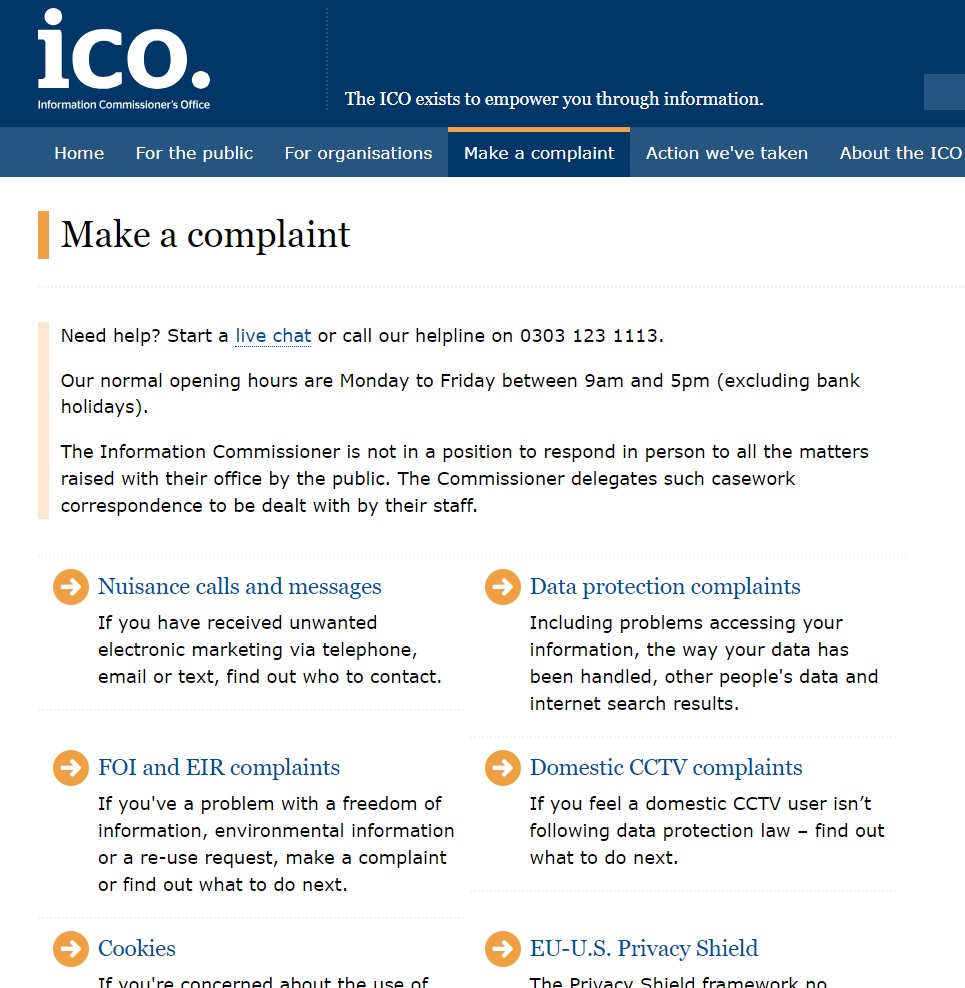
Both decide to complain to the Information Commissioner’s Office (ICO). Both see this page on the ICO website


They see a page for reporting Nuisance calls and messages, and, so, fill in the form on that page.

And never hear anything more.

Why? Because, as the subsequent page says “We will use the information you provide to help us investigate and take action against those responsible. We don’t respond to complaints individually” (emphasis added).

But isn’t this a problem? If Person A’s and Person B’s complaints are (as they seem to be) “hybrid” PECR and UK GDPR complaints, then Article 57(1)(f) of the latter requires the ICO to

handle complaints lodged by a data subject…and investigate, to the extent appropriate, the subject matter of the complaint and inform the complainant of the progress and the outcome of the investigation within a reasonable period (emphasis added)

What Article 57(1)(f) and the words “investigate, to the extent appropriate” mean, has been the subject of quite a bit of litigation in recent years (the basic summary of which is that the ICO has broad discretion as to how to investigate, and even a mere decision to cease handling a complaint will be likely to suffice (see Killock & Veale & others v Information Commissioner (GI/113/2021 & others)).

But nowhere has anyone suggested that ICO can simply decide not to “inform the complainant of the progress and the outcome of the investigation”, in hybrid complaints like the Person A’s and Person B’s would be.

Yet that is what undoubtedly happens in many cases. And – it strikes me – it has happened to me countless times (I have complained about many, many unsolicited calls over the years, but never heard anything of the progress and outcome). Maybe you might say that I (who, after all, have found time to think about and write this post) can’t play the innocent. But I strongly believe that there are lots of Person As (and a fair few Person Bs) who would, if they knew that – to the extent theirs is a UK GDPR complaint –  the law obliges the ICO to investigate and inform them of the progress and the outcome of that investigation, rightly feel aggrieved to have heard nothing.

This isn’t just academic: unsolicited direct marketing is the one area that the ICO still sees as worthy of fines (all but two of the twenty-three fines in the last year have been under that regime). So a complaint about such a practice is potentially a serious matter. Sometimes, a single complaint about such marketing has resulted in a large fine for the miscreant, yet – to the extent that the issue is also a UK GDPR one – the complainant themselves often never hears directly about the complaint.

In addition to the Killock & Veale case, there have been a number of cases looking at the limits to (and discretion regarding) ICO’s investigation of complaints. As far as I know no one has actually yet raised what seems to be a plain failure to investigate and inform in these “hybrid” PECR and UK GDPR cases.

The views in this post (and indeed most posts on this blog) are my personal ones, and do not represent the views of any organisation I am involved with.

Leave a comment

Filed under Data Protection, Information Commissioner, PECR, UK GDPR

Has the Information Commissioner’s Office lost its FOI purposes?

When Parliament passed the Data Protection Act 1984 it created a role of a regulator for that new data protection law. Section 3(1)(a) said that

For the purposes of this Act there shall be…an officer known as the Data Protection Registrar

The office remained in this form until the passing of the Data Protection Act 1998, section 6(1) of which provided that

The office originally established by section 3(1)(a) of the Data Protection Act 1984 as the office of Data Protection Registrar shall continue to exist for the purposes of this Act but shall be known as the office of Data Protection Commissioner

The advent of the Freedom of Information Act 2000 necessitated a change, so as to create a role of regulator for that Act. Paragraph 13(2) of Schedule 2 to the Freedom of Information Act 2000 amended section 6(1) of the Data Protection Act 1998 so it read

For the purposes of this Act and of the Freedom of Information Act 2000 there shall be an officer known as the Information Commissioner

So, at this point, and indeed, until 25 May 2018, there was an Information Commissioner “for the purposes of” the Data Protection Act 1998, and “for the purposes of” the Freedom of Information Act 2000.

25 May 2018 marked, of course the date from which (by effect of its Article 99) Regulation (EU) 2016/679 of the European Parliament and of the Council of 27 April 2016 on the protection of natural persons with regard to the processing of personal data and on the free movement of such data, or “GDPR“, applied.

Also on 25 May 2018, by effect of the Data Protection Act 2018 (Commencement No. 1 and Transitional and Saving Provisions) Regulations 2018, section 114 of the Data Protection Act 2018 commenced. This provided (and provides)

There is to continue to be an Information Commissioner.

However, paragraph 44 of schedule 19 to the Data Protection Act 2018 (commenced also by effect of the Data Protection Act 2018 (Commencement No. 1 and Transitional and Saving Provisions) Regulations 2018) repealed the “FOIA purpose” provisions of section 6(1) of the Data Protection Act 1998 (which, to recall, said that “for the purposes of…the Freedom of Information Act 2000 there shall be an officer known as the Information Commissioner“). At the same time, paragraph 59 of schedule 19 to the Data Protection Act 2018 repealed section 18(1) (which had provided that “The Data Protection Commissioner shall be known instead as the Information Commissioner“).

So, the Information Commissioner is no longer described, in statute, as an officer which shall be for the purposes of the Freedom of Information Act 2000.

Probably nothing turns on this. Elsewhere in the Freedom of Information Act 2000 it is clear that the Information Commissioner has various functions, powers and duties, which are not removed by the repeal (and subsequent absence of) the “FOIA purpose” provisions. However, the repeal (and absence) do raise some interesting questions. If Parliament thought it right previously to say that, for the purposes of the Freedom of Information Act 2000 there should have been an Information Commissioner, why does it now think it right not to? No such questions arise when it comes to the data protection laws, because section 114 and schedule 12 of the Data Protection Act 2018, and Articles 57 and 58 of the UK GDPR, clearly define the purposes (for those laws) of the Information Commissioner.

Maybe all of this rather painful crashing through the thickets of the information rights laws is just an excuse for me to build up to a punchline of “what’s the purpose of the Information Commissioner?” But I don’t think that is solely what I’m getting at: the implied uncoupling of the office from its purposes seems odd, and something that could easily have been avoided (or could easily be remedied). If I’m wrong, or am missing something – and I very much invite comment and correction – then I’ll happily withdraw/update this post.

Please note that links to statutes here on the legislation.gov.uk website are generally to versions as they were originally enacted.

The views in this post (and indeed most posts on this blog) are my personal ones, and do not represent the views of any organisation I am involved with.

Leave a comment

Filed under Data Protection, Data Protection Act 2018, Freedom of Information, GDPR, Information Commissioner

Has ICO “no fines” policy been introduced without proper debate?

At the NADPO annual conference last year Information Commissioner John Edwards discussed his policy of reserving fines under UK GDPR to public bodies only for the most egregious cases. The policy had been announced a few months earlier in an open letter (interestingly addressed to “public sector colleagues”).

Since then, it seems that fines (other than for Privacy and Electronic Communications Regulations (PECR) matters) are – in general – almost off the Information Commissioner’s agenda. Just this week a reprimand – only – was issued to a video sharing platform (the contents of which tend towards the conspiratorial, and the users of which might have particular concerns about exposure) which suffered an exfiltration attack involving 345000 user names, email addresses and passwords.

Earlier this year I made a Freedom of Information request for the evidential basis for Edwards’ policy. The response placed primary focus on a paper entitled “An Introduction to Outcome Based Cooperative Regulation (OBCR)” by Christopher Hodges, from the Centre for Socio-Legal Studies at Oxford. Hodges is also Chair of the government’s Regulatory Horizons Council.

The paper does not present empirical evidence of the effects of fines (or the effects of not-fining) but proposes a staged model (OBCR) of cooperation between businesses (not, one notes, public bodies) and regulators to achieve common purposes and outcomes. OBCR, it says, enables organisations to “opt for basing their activities around demonstrating they can be trusted”. The stages proposed involve agreement amongst all stakeholders of purposes, objectives and desired outcomes, as well as evidence and metrics to identify those outcomes.

But what was notable about Edwards’ policy, was that it arrived without fanfare, and – apparently – without consultation or indeed any involvement of stakeholders. If the aim of OBCR is cooperation, one might reasonably question whether such a failure to consult vitiates, or at least hobbles, the policy from the start.

And, to the extent that the judiciary is one of those stakeholders, it would appear from the judgment of Upper Tribunal Judge Mitchell, in the first GDPR/UK GDPR fining case (concerning the very first GDPR fine in the UK) to reach the appellate courts, that there is not a consensus on the lack of utility of fines. At paragraph 178, when discussing the fact that fines (which are, by section 155 Data Protection Act 2018, “penalty” notices) the judge says

There is clearly also a dissuasive aspect to [monetary penalty notices]. I do not think it can be sensibly disputed that, in general, the prospect of significant financial penalties for breach of data protection requirements makes a controller or processor more likely to eschew a lackadaisical approach to data protection compliance and less likely to take deliberate action in breach of data protection requirements.

This is a statement which should carry some weight, and, to the extent that it is an expression on regulatory theory (which I think it is) it illustrates why a policy such as John Edwards has adopted requires (indeed, required) more of a public debate that it appears to have had.

As the issuing of fines inevitably involves an exercise of discretion, it is essentially impossible to say how many fines have not been issued which would have been, but for the Edwards policy (although it might be possible to look at whether there has – which I suspect there has – been a corresponding increase in “reprimands”, and draw conclusions from that). Nonetheless, some recipients of fines from before the policy was introduced might well reasonably ask themselves whether, had Edwards’ policy been in place at the time, they would have escaped the penalty, and why, through an accident of timing, they were financially punished when others are not. Similarly, those companies which may still receive fines, including under the PECR regime, yet which can convincingly argue that they wish to, and can, demonstrate they can be trusted, might also reasonably asked why they are not being given the opportunity to do so.

The views in this post (and indeed most posts on this blog) are my personal ones, and do not represent the views of any organisation I am involved with.

Leave a comment

Filed under Data Protection, Data Protection Act 2018, fines, GDPR, Information Commissioner, monetary penalty notice, PECR, rule of law, UK GDPR

ICO guidance on domestic CCTV – more hindrance than help

An article in the Mail on the use of connected doorbells has led me again to one of the oddest pages on the ICO’s website, on the use of domestic CCTV. Odd, because (behoven to the outdated, and frankly somewhat silly, decision of the CJEU in the 2014 Ryneš case) it approaches the issue on the basis that if a camera captures footage outside the curtilage of one’s home, then the home owner cannot avail themselves of the carve-out from the UK GDPR (at Article 2(2)) for “processing of personal data by an individual in the course of a purely personal or household activity”. But the law says nothing at all about the location or visual range of cameras – it is all about the processing purposes.

Also odd is that the ICO goes on to say that people operating CCTV that captures footage beyond their home’s curtilage will be required to comply with data subject rights (such as providing a privacy notice, and responding to access/erasure/stop requests). But, says the ICO, “we probably won’t do anything if people ignore us”:

You can complain to us when a user of domestic CCTV doesn’t follow the rules. We can send a letter asking them to resolve things, eg put up the appropriate signage or respond to data protection requests. 

There is a limited amount of action the ICO can take after this point to make the person comply. It is highly unlikely the ICO will consider it fair or balanced to take enforcement action against a domestic CCTV user.

But oddest of all, the ICO says:

“These rules only apply to fixed cameras. They do not cover roaming cameras, such as drones or dashboard cameras (dashcams) as long as the drone or dashcam is used only for your domestic or household purposes”

I simply don’t understand this distinction between fixed cameras and “roaming” cameras, despite the fact that the ICO states that “data protection law” says this. I’m unaware of any law that provides a basis for the assertion (if anyone knows, please let me know). I would, in fact, be prepared to mount an argument that “roaming” cameras are more, or have the potential to be more, intrusive on others’ rights than fixed cameras.

The Article 2(2) “purely personal or household activity” carve-out is a complex provision, and one that has got the ICO into choppy waters in the past (see the trenchant criticism of Tugendhat J in the “Solicitors from Hell” litigation, at paras 93-101, which considered the similar carve-out under the prior law). There are some very interesting questions and arguments to be considered (especially when the gloss provided by recital 18 is taken into account, with its reference to online personal or household activities also being outwith the material scope of the law). However, the ICO’s guidance here will likely serve only to confuse most householders, and – I suspect – has the potential in some cases to escalate private disputes.

The views in this post (and indeed most posts on this blog) are my personal ones, and do not represent the views of any organisation I am involved with.

Leave a comment

Filed under CCTV, GDPR, Information Commissioner, material scope, privacy notice, surveillance, UK GDPR

Labour’s Grubby Data Grab

Nine years ago (I’ve been doing this a long time) I wrote about the Labour Party harvesting details by hosting a page inviting people to find out “what baby number” they were in relation to the NHS. At that time, no privacy notice information was given at all. Fast forward to today, and Labour is once again hosting a similar page. This time, there is a bit more explanatory information, but it’s far from reassuring.

As an aside, I note that, when a person inputs their date of birth, what the website does is simply calculate, by reference to broad census data, approximately how many babies would have been born since the NHS started and that birth date. So the idea that this gives a “baby number” is ridiculous from the outset.

In any event, the person is then required to give their first name, email address and postcode.

(There is also an odd option to “find out the baby number” of a relative, or friend, by giving that person’s date of birth. Here, the person completing the form is only required to give their own email address and postcode (not their own first name).)

The person completing the form then has the option to agree or not agree to be kept “updated via email on the latest campaigns, events and opportunities to get involved”. This initially seems acceptable when it comes to compliance with the emarketing rules in the Privacy and Electronic Communications (EC Directive) Regulations 2003, so perhaps an improvement on how things were nine years ago. However, in smaller print, the person is then told that “We may use the information you provide, such as name and postcode, to match the data provided to your electoral register record held on our electoral database, which could inform future communications you receive from us”. So it appears that, even if one declines to receive future emails, the party may still try to match one’s details with those on the electoral register and may still send “future communications” (although query how accurate – or even feasible – this will be: how many Johns, say, potentially live in postcode SK9 5AF?).

This suggests that some sort of profiling is going on, but it is all a bit unclear, and opaque, which are not words that really should be associated with the processing of personal data by a political party. But if one clicks the link to “know more about how we use your information” the first thing one encounters is a cookie banner with no option but to accept cookies (which will, it is said, help the party make its website better). Such a banner is, of course, not lawful, and – if the ICO is to be believed – puts the party at current risk of enforcement action. If, teeth gritted, one clicks through the banner, one is faced with a privacy notice which, dear readers, I think needs to be the subject of a further blog (maybe with a comparative analysis of other parties’ notices). Suffice to say that the Labour Party appears to be doing one heck of a lot of profiling, and “estimation” of political opinions, from a range of statutory and/or public information sources.

For now, the TL;DR of this post is that the “NHS Baby Number” schtick from the Labour Party seems to be as much of a (although maybe a different) grubby data grab as it was nine years ago when I last wrote about it. There’s a lot that the ICO could, and should, do about it, but nothing was done then, and – I fear – nothing will be done now.

The views in this post (and indeed most posts on this blog) are my personal ones, and do not represent the views of any organisation I am involved with.

Leave a comment

Filed under fairness, Information Commissioner, PECR, political parties, privacy notice, profiling