Category Archives: PECR

Labour’s Grubby Data Grab

Nine years ago (I’ve been doing this a long time) I wrote about the Labour Party harvesting details by hosting a page inviting people to find out “what baby number” they were in relation to the NHS. At that time, no privacy notice information was given at all. Fast forward to today, and Labour is once again hosting a similar page. This time, there is a bit more explanatory information, but it’s far from reassuring.

As an aside, I note that, when a person inputs their date of birth, what the website does is simply calculate, by reference to broad census data, approximately how many babies would have been born since the NHS started and that birth date. So the idea that this gives a “baby number” is ridiculous from the outset.

In any event, the person is then required to give their first name, email address and postcode.

(There is also an odd option to “find out the baby number” of a relative, or friend, by giving that person’s date of birth. Here, the person completing the form is only required to give their own email address and postcode (not their own first name).)

The person completing the form then has the option to agree or not agree to be kept “updated via email on the latest campaigns, events and opportunities to get involved”. This initially seems acceptable when it comes to compliance with the emarketing rules in the Privacy and Electronic Communications (EC Directive) Regulations 2003, so perhaps an improvement on how things were nine years ago. However, in smaller print, the person is then told that “We may use the information you provide, such as name and postcode, to match the data provided to your electoral register record held on our electoral database, which could inform future communications you receive from us”. So it appears that, even if one declines to receive future emails, the party may still try to match one’s details with those on the electoral register and may still send “future communications” (although query how accurate – or even feasible – this will be: how many Johns, say, potentially live in postcode SK9 5AF?).

This suggests that some sort of profiling is going on, but it is all a bit unclear, and opaque, which are not words that really should be associated with the processing of personal data by a political party. But if one clicks the link to “know more about how we use your information” the first thing one encounters is a cookie banner with no option but to accept cookies (which will, it is said, help the party make its website better). Such a banner is, of course, not lawful, and – if the ICO is to be believed – puts the party at current risk of enforcement action. If, teeth gritted, one clicks through the banner, one is faced with a privacy notice which, dear readers, I think needs to be the subject of a further blog (maybe with a comparative analysis of other parties’ notices). Suffice to say that the Labour Party appears to be doing one heck of a lot of profiling, and “estimation” of political opinions, from a range of statutory and/or public information sources.

For now, the TL;DR of this post is that the “NHS Baby Number” schtick from the Labour Party seems to be as much of a (although maybe a different) grubby data grab as it was nine years ago when I last wrote about it. There’s a lot that the ICO could, and should, do about it, but nothing was done then, and – I fear – nothing will be done now.

The views in this post (and indeed most posts on this blog) are my personal ones, and do not represent the views of any organisation I am involved with.
Leave a comment

Filed under fairness, Information Commissioner, PECR, political parties, privacy notice, profiling

HMRC sending spam

Have HMRC jumped the gun, and assumed that they can now (in advance of the Data Protection and Digital Information (No.2) Bill being passed) rely on the soft opt-in for email marketing?

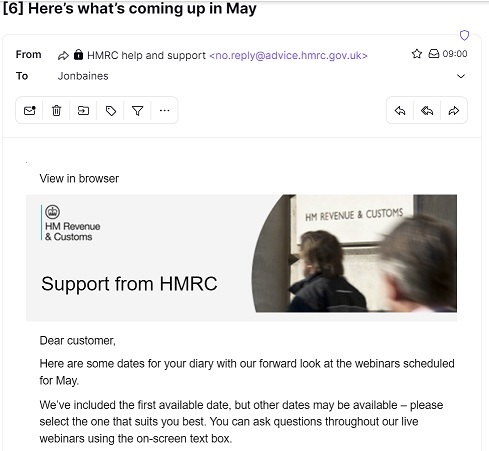
In common with many other poor souls, I have in recent years had to submit a self-assessment tax return to HMRC. Let’s just say that, unless they’re going to announce a rebate, I don’t relish hearing from them. So I was rather surprised to receive an email from “HMRC Help and Support” recently, telling me “what’s coming up in May” and inviting me to attend webinars. A snippet of the email is here

This certainly wasn’t solicited. And, at least if you follow the approach of the Information Commissioner’s Office (ICO) was direct marketing by electronic means (“Direct marketing covers the promotion of aims and ideals as well as the sale of products and services. This means that the rules will cover not only commercial organisations but also not-for-profit organisations“).

The only lawful way that a person can send unsolicited direct electronic marketing to an individual subscriber like me, is if the recipient has consented to receive it (I hadn’t), or if the person obtained the contact details of the recipient in the course of the sale or negotiations for the sale of a product or service to that recipient (see regulation 22 of the Privacy and Electronic Marketing (EC Directive) Regulations 2003 (“PECR”)). But HMRC cannot avail themselves of the latter (commonly known as the “soft opt-in”), because they have not sold me (or negotiated with me for the sale) of a product or service. The ICO also deals with this in its guidance: “Not-for-profit organisations should take particular care when communicating by text or email. This is because the ‘soft opt-in’ exception only applies to commercial marketing of products or services“.

I raised a complaint (twice) directly with HMRC’s Data Protection Officer who (in responses that seemed oddly, let’s say, robotic) told me how to unsubscribe, and pointed me to HMRC’s privacy notice.

It seems to me that HMRC might be taking a calculated risk though: the Data Protection and Digital Information (No.2) Bill, currently making its way through Parliament, proposes (at clause 82) to extend the soft opt-in to “non-commercial objectives”. If it passes, then we must expect much more of This Type Of Thing from government.

If I’m correct in this, though, I wonder if, when calculating that calculated risk, HMRC calculated the risk of some calculated individual (me, perhaps) complaining to the ICO?

The views in this post (and indeed most posts on this blog) are my personal ones, and do not represent the views of any organisation I am involved with.

Leave a comment

Filed under Data Protection Bill, HMRC, Information Commissioner, marketing, PECR, spam

Where’s the Tories’ privacy notice? (just don’t mention the footballer)

The Conservative Party, no doubt scrabbling to gather perceived support for its contentious immigration policies and measures is running a web and social media campaign. The web page encourages those visiting it to “back our plan and send a message” to other parties:

Further down the page visitors are invited to “send Labour a message”

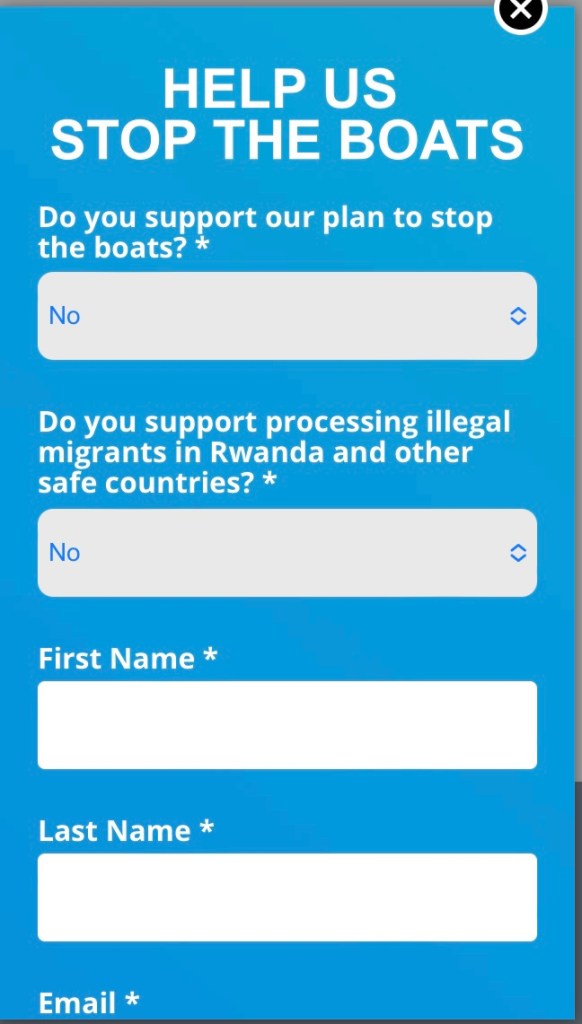
Clicking on either of the red buttons in those screenshots results in a pop-up form, on which one can say whether or not one supports the Tory plans (in the screenshot below, I’ve selected “no”)

One is then required to give one’s name, email address and postcode, and there is a tick box against text saying “I agree to the Conservative Party, and the wider Conservative Party, using the information I provide to keep me updated via email about the Party’s campaigns and opportunities to get involved”

There are two things to note.

First, the form appears to submit whether one ticks the “I agree” box or not.

Second, and in any case, none of the links to “how we use your data”, or the “privacy policy”, or the “terms and conditions” works.

So anyone submitting their special category data (information about one’s views on a political party’s policies on immigration is personal data revealing political opinions, and so Article 9 UK GDPR applies) has no idea whatsoever how it will subsequently be processed by the Tories.

I suppose there is an argument that anyone who happens upon this page, and chooses to submit the form, has a good idea what is going on (although that is by no means certain, and people could quite plausibly think that it provides an opportunity to provide views contrary to the Tories’). In any event, it would seem potentially to meet to definition of “plugging” (political lobbying under the guide of research) which ICO deals with in its direct marketing guidance.

Also in any event, the absence of any workable links to privacy notice information means, unavoidably, that the lawfulness of any subsequent processing is vitiated.

It’s the sort of thing I would hope the ICO is alive to (I’ve seen people on social media saying they have complained to ICO). But I won’t hold my breath on that – many years ago I wrote about how such data abuse was rife across the political spectrum – but little if anything has changed.

And finally, the most remarkable thing of all is that I’ve written a whole post on what is a pressing and high-profile issue without once mentioning Gary Lineker.

The views in this post (and indeed most posts on this blog) are my personal ones, and do not represent the views of any organisation I am involved with.
Leave a comment

Filed under Data Protection, Information Commissioner, marketing, PECR, privacy notice, social media, spam, UK GDPR

Breaking the code

Bletchley Park’s use of adtech means you can’t opt out of non-essential cookies and still access the website

I found this ironically sad.

Visit Bletchley Park’s website and one is presented with a cookie banner. If you’re like me you will deselect all but essential cookies – so no “preferences”, “statistics” or “marketing”

Regulation 6 of the Privacy and Electronic Marketing (EC Directive) Regulations 2003 (PECR) is behind this.

As much as one might find cookie banners annoying, they are a result of cookies being inherently intrusive. They are code placed on one’s terminal equipment; sometimes they are essential for a website’s functioning (in which case they can be placed without consent) and sometimes they are merely useful (but not essential) for the user or the operator – perhaps to get analytics, or remember preferences, or deliver targeted advertising (in which case user consent is required).

The problem with the Bletchley site is that if one refuses “non-essential” cookies (I tried on Edge, Chrome and Safari mobile), they turn out to be rather essential, because what one is left is this

I only spent a few minutes trying to work out if it was some clever puzzle you had to crack to gain access before I realised it was just poor configuration.

So, in fact, the non-essential cookies are actually essential.

I’m sure someone with some expertise in code can sort it out. It can’t be beyond the wit of those running Bletchley Park to configure a website so that it functions properly without interfering with visitors’ computers.

The views in this post (and indeed most posts on this blog) are my personal ones, and do not represent the views of any organisation I am involved with.

Leave a comment

Filed under adtech, cookies, not-entirely-serious, PECR

Data Protection reform bill – all that? or not all that?

I’ve written an “initial thoughts” analysis on the Mishcon de Reya website of the some of the key provisions of the Data Protection and Digital Information Bill:

The Data Protection and Digital Information Bill – an (mishcon.com)

Leave a comment

Filed under adequacy, Data Protection, Data Protection Act 2018, Data Protection Bill, DPO, GDPR, Information Commissioner, PECR, UK GDPR

Data reform – hot news or hot air?

I’ve written a piece for the Mishcon de Reya website on the some of the key proposals (for our client-base) in today’s data protection reform announcement.

Data protection law reform – major changes, but the (mishcon.com)

Leave a comment

Filed under adequacy, consent, cookies, Data Protection, Data Protection Act 2018, DPO, GDPR, Information Commissioner, international transfers, nuisance calls, PECR, UK GDPR

Ineffectual powers

The Information Commissioner’s Office (ICO) has just announced that it has served a fine (strictly, a monetary penalty notice) of £80,000, under the Privacy and Electronic Communications (EC Directive) Regulations 2003 (PECR), on a company which sent a large number of particularly tasteless SMSs during the pandemic, of this sort

“Get Debt FREE during the Lockdown! Write off 95% of ALL DEBTS with ALL charges and fees FROZEN. Government backed. Click [here] Stop 2optout”

(In passing, I’m rather surprised the ICO’s announcement gave hyperlinks to the offending, albeit broken, URLs.)

In that accompanying announcement, the ICO’s Head of Investigations is quoted as saying

The company director failed to cooperate with our investigations through concealing his identity by using false company details on his websites; changing the wording on the text messages; and, changing his company’s registered address after becoming aware of our investigation.

and we are told that the director

tried to evade the ICO investigations with different tactics since 2019, but investigators were determined to bring this company to account for plaguing people’s lives with thousands of spam messages

What is interesting in this context is that the ICO’s powers to issue fines for serious contraventions were added to, in 2018, to allow them also to fine company directors themselves (where the contravention was with the consent of connivance of the director, or attributable to any neglect on their part).

I asked the ICO if they had a comment on why no director fine was issued here, but they only wished to say

The action we have taken is proportionate and appropriate in the circumstances of this case.

This is fair enough: there may be facts which are not public, and I don’t criticise what is a sound piece of enforcement against unlawful marketing communications.

However, as far as I am aware, since the ICO acquired the powers to fine directors (and similar officers) under PECR they have not exercised those powers once. This is odd – they had long lobbied for the powers, and when the change in the law was being proposed, the then Commissioner Elizabeth Denham told The Register “It should have a real deterrent effect”. Maybe there are legal issues with actually ascribing liability to directors, or practical issues with tracking and pinning them down to try to enforce against them. If so, and if the 2018 change in the law has not had that “real deterrent effect”, is the ICO letting government know?

The views in this post (and indeed most posts on this blog) are my personal ones, and do not represent the views of any organisation I am involved with.

Leave a comment

Filed under Information Commissioner, monetary penalty notice, PECR, spam texts

COVID booster messages and the law

GET BOOSTED NOW Every adult needs a COVID-19 booster vaccine to protect against Omicron. Get your COVID-19 vaccine or booster. See NHS website for details

On Boxing Day, this wording appears to have been sent as an SMS in effect to every mobile telephone number in the UK. The relevant government web page explains that the message is part of the national “Get Boosted Now” campaign to protect against the Omicron variant of COVID-19. The web page also thanks the Mobile Network Operators for “their assistance in helping deliver the vitally important Get Boosted Now message”.

It is inevitable that questions may get raised raised about the legality of the SMSs under data protection law. What is important to note is that, although – to the extent that the sending involved the processing of personal data – the GDPR may apply (or, rather, the UK GDPR) the relevant law is actually the Privacy and Electronic Communications (EC Directive) Regulations 2003 (“PECR”). Under the doctrine of lex specialis where two laws govern the same situation, the more specific rules will prevail over more general rules. Put another way, if the more specific PECR can justify the sending of the SMSs, then the sending will also be justified under the more general provisions of UK GDPR.

Regulation 16A of PECR (inserted by a 2015 amendment), provides that where a “relevant communications provider” (in this case a Mobile Network Operator) is notified by a government minister (or certain other persons, such as chief constables) that an “emergency” has occurred, is occurring or is about to occur, and that it is expedient to use an emergency alert service, then the usual restrictions on the processing of traffic and location data can be disregarded. In this instance, given the wording on the government website, one assumes that such a notification was indeed made by a government minister under regulation 16A. (These are different emergency alerts to those proposed to be able to be sent under the National Emergency Alert system from 2022 which will not directly involve the mobile network operators.)

“Emergency” is not defined in PECR, so presumably will take its definition here from section 1(1)(a) of the Civil Contingencies Act 2004 – “an event or situation which threatens serious damage to human welfare in a place in the United Kingdom”.

The effect of this is that, if the SMSs are legal under PECR, they will also be legal under Article 6(1)(c) and 6(1)(e) of the UK GDPR (on the grounds that processing is necessary for compliance with a legal obligation to which the controller is subject, and/or necessary for the performance of a task carried out in the public interest).

There is an interesting side note as to whether, even though the SMSs count as emergency alerts, they might also be seen as direct marketing messages under regulations 22 and 23 of PECR, thus requiring the content of the recipient before they could be sent. Under the current guidance from the Information Commissioner (ICO), one might argue that they would be. “Direct marketing” is defined in the Data Protection Act 2018 as “the communication (by whatever means) of advertising or marketing material which is directed to particular individuals” and the ICO defines it further by saying that this “covers any advertising or marketing material, not just commercial marketing. All promotional material falls within this definition, including material promoting the aims of not-for-profit organisations”. Following that line of thought, it is possible that the Omicron SMSs were both emergency alerts and direct marketing messages. This would be an odd state of affairs (and one doubts very much that a judge – or the ICO, if challenged on this – would actually agree with its own guidance and say that these SMSs were indeed direct marketing messages). The ICO is in the process of updating its direct marketing guidance, and might be well advised to consider the issue of emergency alerts (which aren’t covered in the current consultation document).

[Edited to add: I don’t think what I say above necessarily covers all the legal issues, and no doubt there are aspects of this that could have been done better, but I doubt very much there is any substantive legal challenge which can be made.]

The views in this post (and indeed most posts on this blog) are my personal ones, and do not represent the views of any organisation I am involved with.

Leave a comment

Filed under communications data, consent, Data Protection, Data Protection Act 2018, GDPR, Information Commissioner, PECR, UK GDPR

ICO calls for global cookie standards (but why not enforce the law?)

The outgoing UK Information Commissioner, Elizabeth Denham, is calling on G7 countries to adopt her office’s new “vision” for websites and cookie consent.

Her challenge to fellow G7 data protection and privacy authorities has been issued at a virtual meeting taking place on 7 and 8 September, where they will be joined by the Organisation for Economic Cooperation and Development (OECD) and the World Economic Forum (WEF).

Denham says “There are nearly two billion websites out there taking account of the world’s privacy preferences. No single country can tackle this issue alone. That is why I am calling on my G7 colleagues to use our convening power. Together we can engage with technology firms and standards organisations to develop a coordinated approach to this challenge”.

What is not clear is whether her vision is, or can be, underpinned by legal provisions, or whether it will need to take the form of a non-enforceable set of standards and protocols. The proposal is said to mean that “web browsers, software applications and device settings [should] allow people to set lasting privacy preferences of their choosing, rather than having to do that through pop-ups every time they visit a website”. The most obvious way of doing this would be through a user’s own browser settings. However, previous attempts to introduce something similar – notably the “Do Not Track” protocol – foundered on the lack of adoption and the lack of legal enforceability.

Also unaddressed, at least in the advance communications, is why, if cookie compliance is a priority area for the Information Commissioner, there has been no enforcement action under the existing legal framework (which consists primarily of the Privacy and Electronic Communications (EC Directive) Regulations 2003 (or “PECR”)). Those current laws state that a website operator must seek consent for the placing of all cookies unless they are essential for the website to function. Although many website operators try hard to comply, there are countless examples of ones who don’t, but who suffer no penalty.

Denham says that “no single country can tackle this alone”, but it is not clear why such a single country can’t at least take steps towards tackling it on domestic grounds. It is open to her to take action against domestic website operators who flout the law, and there is a good argument that such action would do more to encourage proper compliance than will the promotion or adoption of non-binding international standards.

The views in this post (and indeed most posts on this blog) are my personal ones, and do not represent the views of any organisation I am involved with.

Leave a comment

Filed under cookies, Data Protection, Information Commissioner, marketing, PECR

Some PECR figures in light of a new monetary penalty notice

Presented without comment.

21,166,574 unsolicited direct marketing messages

£100,000 monetary penalty

Only £1k in the bank at the last filings

Zero chance of recovery?

The views in this post (and indeed most posts on this blog) are my personal ones, and do not represent the views of any organisation I am involved with.

Leave a comment

Filed under Data Protection, enforcement, Information Commissioner, marketing, monetary penalty notice, PECR