Tag Archives: data protection

ICO guidance on domestic CCTV – more hindrance than help

An article in the Mail on the use of connected doorbells has led me again to one of the oddest pages on the ICO’s website, on the use of domestic CCTV. Odd, because (behoven to the outdated, and frankly somewhat silly, decision of the CJEU in the 2014 Ryneš case) it approaches the issue on the basis that if a camera captures footage outside the curtilage of one’s home, then the home owner cannot avail themselves of the carve-out from the UK GDPR (at Article 2(2)) for “processing of personal data by an individual in the course of a purely personal or household activity”. But the law says nothing at all about the location or visual range of cameras – it is all about the processing purposes.

Also odd is that the ICO goes on to say that people operating CCTV that captures footage beyond their home’s curtilage will be required to comply with data subject rights (such as providing a privacy notice, and responding to access/erasure/stop requests). But, says the ICO, “we probably won’t do anything if people ignore us”:

You can complain to us when a user of domestic CCTV doesn’t follow the rules. We can send a letter asking them to resolve things, eg put up the appropriate signage or respond to data protection requests. 

There is a limited amount of action the ICO can take after this point to make the person comply. It is highly unlikely the ICO will consider it fair or balanced to take enforcement action against a domestic CCTV user.

But oddest of all, the ICO says:

“These rules only apply to fixed cameras. They do not cover roaming cameras, such as drones or dashboard cameras (dashcams) as long as the drone or dashcam is used only for your domestic or household purposes”

I simply don’t understand this distinction between fixed cameras and “roaming” cameras, despite the fact that the ICO states that “data protection law” says this. I’m unaware of any law that provides a basis for the assertion (if anyone knows, please let me know). I would, in fact, be prepared to mount an argument that “roaming” cameras are more, or have the potential to be more, intrusive on others’ rights than fixed cameras.

The Article 2(2) “purely personal or household activity” carve-out is a complex provision, and one that has got the ICO into choppy waters in the past (see the trenchant criticism of Tugendhat J in the “Solicitors from Hell” litigation, at paras 93-101, which considered the similar carve-out under the prior law). There are some very interesting questions and arguments to be considered (especially when the gloss provided by recital 18 is taken into account, with its reference to online personal or household activities also being outwith the material scope of the law). However, the ICO’s guidance here will likely serve only to confuse most householders, and – I suspect – has the potential in some cases to escalate private disputes.

The views in this post (and indeed most posts on this blog) are my personal ones, and do not represent the views of any organisation I am involved with.

Leave a comment

Filed under CCTV, GDPR, Information Commissioner, material scope, privacy notice, surveillance, UK GDPR

Labour’s Grubby Data Grab

Nine years ago (I’ve been doing this a long time) I wrote about the Labour Party harvesting details by hosting a page inviting people to find out “what baby number” they were in relation to the NHS. At that time, no privacy notice information was given at all. Fast forward to today, and Labour is once again hosting a similar page. This time, there is a bit more explanatory information, but it’s far from reassuring.

As an aside, I note that, when a person inputs their date of birth, what the website does is simply calculate, by reference to broad census data, approximately how many babies would have been born since the NHS started and that birth date. So the idea that this gives a “baby number” is ridiculous from the outset.

In any event, the person is then required to give their first name, email address and postcode.

(There is also an odd option to “find out the baby number” of a relative, or friend, by giving that person’s date of birth. Here, the person completing the form is only required to give their own email address and postcode (not their own first name).)

The person completing the form then has the option to agree or not agree to be kept “updated via email on the latest campaigns, events and opportunities to get involved”. This initially seems acceptable when it comes to compliance with the emarketing rules in the Privacy and Electronic Communications (EC Directive) Regulations 2003, so perhaps an improvement on how things were nine years ago. However, in smaller print, the person is then told that “We may use the information you provide, such as name and postcode, to match the data provided to your electoral register record held on our electoral database, which could inform future communications you receive from us”. So it appears that, even if one declines to receive future emails, the party may still try to match one’s details with those on the electoral register and may still send “future communications” (although query how accurate – or even feasible – this will be: how many Johns, say, potentially live in postcode SK9 5AF?).

This suggests that some sort of profiling is going on, but it is all a bit unclear, and opaque, which are not words that really should be associated with the processing of personal data by a political party. But if one clicks the link to “know more about how we use your information” the first thing one encounters is a cookie banner with no option but to accept cookies (which will, it is said, help the party make its website better). Such a banner is, of course, not lawful, and – if the ICO is to be believed – puts the party at current risk of enforcement action. If, teeth gritted, one clicks through the banner, one is faced with a privacy notice which, dear readers, I think needs to be the subject of a further blog (maybe with a comparative analysis of other parties’ notices). Suffice to say that the Labour Party appears to be doing one heck of a lot of profiling, and “estimation” of political opinions, from a range of statutory and/or public information sources.

For now, the TL;DR of this post is that the “NHS Baby Number” schtick from the Labour Party seems to be as much of a (although maybe a different) grubby data grab as it was nine years ago when I last wrote about it. There’s a lot that the ICO could, and should, do about it, but nothing was done then, and – I fear – nothing will be done now.

The views in this post (and indeed most posts on this blog) are my personal ones, and do not represent the views of any organisation I am involved with.

Leave a comment

Filed under fairness, Information Commissioner, PECR, political parties, privacy notice, profiling

Typo in the GDPR

A small thing, to please small minds.

As I was looking at the excellent version of the UK GDPR on the Mishcon de Reya website (plaudits, and a salary increase, for the person who created it), I noticed odd wording at Article 23(1)(e)

…including monetary, budgetary and taxation a matters, public health…

“taxation a matters”? Oh dear – salary decrease for whoever typed that?

However, I then saw that the version of the UK GDPR on the legislation.gov.uk pages has the same odd wording.

At that point, my national pride was concerned. Did the UK screw up its retention of the EU GDPR? But no – pride restored! plaudits restored! salary increase merited! The silly old drafters of the original GDPR had done the original typo, which has carried through. The Official Journal of the European Union bears the original sin

I surely can’t be the first person to have noticed this. But a cursory Google search didn’t show anyone else mentioning it. So I’m going to claim it. With all the associated plaudits.

Leave a comment

Filed under accuracy, Data Protection, GDPR, UK GDPR

ICO: powers to enforce over dead people’s information?

The Information Commissioner’s Office (ICO) has announced that it will not be taking action against Lancashire Police in relation to their disclosure of private information during their investigation into the tragic case of Nicola Bulley.

This is unsurprising, and, objectively, reassuring, because if the ICO had brought enforcement proceedings it would almost certainly have been unlawful to do so. In blunt terms, the ICO’s relevant powers are under laws which deal with “personal data” (data relating to a living individual) and when the police disclosed information about Nicola, she was not living.

There is no discretion in these matters, and no grey areas – a dead person (in the UK, at least) does not have data protection rights because information relating to a dead person is, simply, not personal data. Even if the police thought, at the time of the disclosure, that Nicola was alive, it appears that, as a matter of fact, she was not. (I note that the ICO says it will be able to provide further details about its decision following the inquest into Nicola’s death, so it is just possible that there is further information which might elucidate the position.)

Unless the ICO was going to try to take enforcement action in relation to a general policy, or the operation of a general policy, about disclosure of information about missing people (for instance under Article 24 of the UK GDPR), then there was simply no legal power to take action in respect of this specific incident.

That is not to say that the ICO was not entitled to comment on the general issues, or publish the guidance it has published, but it seems to be either an empty statement to say “we don’t consider this case requires enforcement action”, or a statement that reveals a failure to apply core legal principles to the situation.

The views in this post (and indeed most posts on this blog) are my personal ones, and do not represent the views of any organisation I am involved with.
Leave a comment

Filed under Data Protection, enforcement, Information Commissioner, personal data, police

SRA, data protection and the solicitors roll

In August 2022 the Solicitors Regulation Authority (SRA) announced plans to change its rules and reinstate the annual “keeping of the roll” exercise. Until 2014, all solicitors without practising certificates were required to complete an application each year and pay an administration fee if they wished to remain on the roll. This requirement was dispensed with in 2014 in part because the annual process was seen as burdensome for solicitors.

One of the justifications now for reintroducing the keeping of the roll is given by the SRA as

There are also requirements under the General Data Protection Regulation (GDPR) 2016 [sic] and the seven principles that govern the holding and retention of data. Under GDPR we have responsibility as a data controller to ensure we maintain accurate data relating to individuals and we are processing it fairly and lawfully.

What is slightly odd is that when, in 2014, the SRA proposed to scrap the keeping of the roll, it was not troubled by the observations of the then Information Commissioner about the importance of accuracy and privacy of information. In its reply to the then Commissioner’s consultation response it said that it had “fully considered the issues” and

We consider that the availability of the SRA’s online system, mySRA, to non- practising solicitors as a means of keeping their details up to date, serves to mitigate the possibility of data become inaccurate…To further mitigate the risk of deterioration of the information held on the roll, the SRA can include reminders to keep contact details up to date in standard communications sent to solicitors.

If that was the position in 2014, it is difficult to understand why it is any different today. The data protection principles – including the “accuracy principle” – in the UK GDPR (not in fact the “GDPR 2016” that the SRA refers to) are effectively identical to those in the prior Data Protection Act 1998.

If the SRA was not concerned by data protection considerations in 2014 but is so now, one might argue that it should explain why. The Information Commissioner does not appear to have responded to the consultation this time around, so there is no indication that his views swayed the SRA.

If the SRA was concerned about the risk of administrative fines (potentially larger under the UK GDPR than under the Data Protection Act 1998) it should have reassured itself that any such fines must be proportionate (Article 83(1) UK GDPR) and by the fact that the Commissioner has repeatedly stressed that he is not in the business of handing out fines for minor infringements to otherwise responsible data controllers.

I should emphasise that data protection considerations were not the only ones taken into account by the SRA, and I don’t wish to discuss whether, in the round, the decision to reintroduce the keeping of the roll was correct or not (Joshua Rozenberg has written on this, and the effect on him). But I do feel that the arguments around data protection show a confused approach to that particular issue.

The views in this post (and indeed most posts on this blog) are my personal ones, and do not represent the views of any organisation I am involved with.

Leave a comment

Filed under accuracy, Data Protection, Information Commissioner, Let's Blame Data Protection, UK GDPR

Where’s the Tories’ privacy notice? (just don’t mention the footballer)

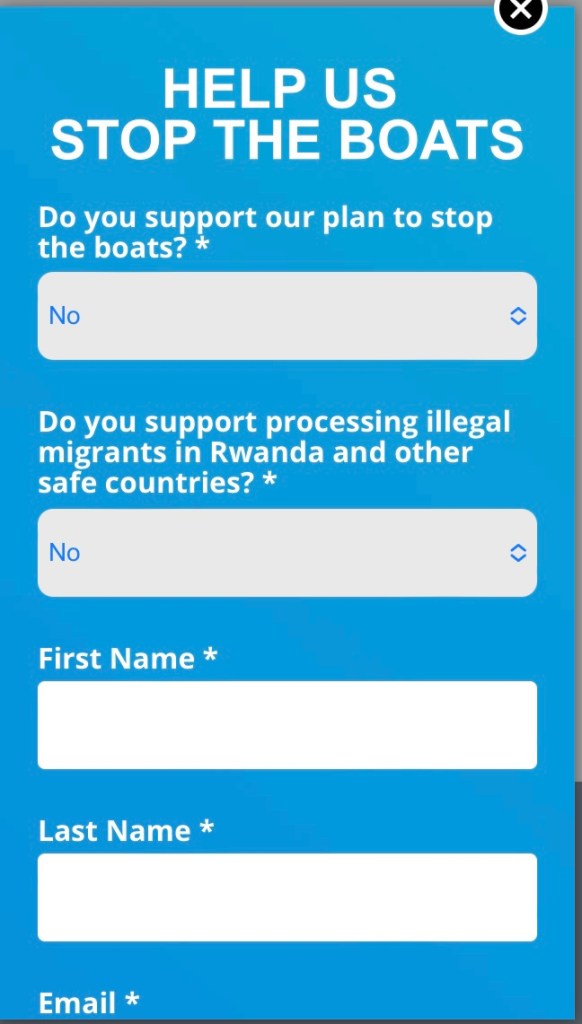
The Conservative Party, no doubt scrabbling to gather perceived support for its contentious immigration policies and measures is running a web and social media campaign. The web page encourages those visiting it to “back our plan and send a message” to other parties:

Further down the page visitors are invited to “send Labour a message”

Clicking on either of the red buttons in those screenshots results in a pop-up form, on which one can say whether or not one supports the Tory plans (in the screenshot below, I’ve selected “no”)

One is then required to give one’s name, email address and postcode, and there is a tick box against text saying “I agree to the Conservative Party, and the wider Conservative Party, using the information I provide to keep me updated via email about the Party’s campaigns and opportunities to get involved”

There are two things to note.

First, the form appears to submit whether one ticks the “I agree” box or not.

Second, and in any case, none of the links to “how we use your data”, or the “privacy policy”, or the “terms and conditions” works.

So anyone submitting their special category data (information about one’s views on a political party’s policies on immigration is personal data revealing political opinions, and so Article 9 UK GDPR applies) has no idea whatsoever how it will subsequently be processed by the Tories.

I suppose there is an argument that anyone who happens upon this page, and chooses to submit the form, has a good idea what is going on (although that is by no means certain, and people could quite plausibly think that it provides an opportunity to provide views contrary to the Tories’). In any event, it would seem potentially to meet to definition of “plugging” (political lobbying under the guide of research) which ICO deals with in its direct marketing guidance.

Also in any event, the absence of any workable links to privacy notice information means, unavoidably, that the lawfulness of any subsequent processing is vitiated.

It’s the sort of thing I would hope the ICO is alive to (I’ve seen people on social media saying they have complained to ICO). But I won’t hold my breath on that – many years ago I wrote about how such data abuse was rife across the political spectrum – but little if anything has changed.

And finally, the most remarkable thing of all is that I’ve written a whole post on what is a pressing and high-profile issue without once mentioning Gary Lineker.

The views in this post (and indeed most posts on this blog) are my personal ones, and do not represent the views of any organisation I am involved with.

Leave a comment

Filed under Data Protection, Information Commissioner, marketing, PECR, privacy notice, social media, spam, UK GDPR

FOI embarrassment

At a recent awards event, recognising high-performing Freedom of Information officers and teams (fantastic idea by the organisers/sponsors, by the way*) I gave a brief talk where I stressed that it was important to recognise how much FOI has achieved in its 23 (or 18**) years, and to remember that every day thousands of disclosures are made by thousands of public authorities. It’s very easy to snipe at bad practice, and I often do, but if we don’t acknowledge the benefits, the real opponents of FOI might start arguing for its repeal.

So. Celebrate success. Accentuate the positive. Eliminate the negative.

However.

Then you see a decision notice from the Information Commissioner (ICO), in which a large London council had refused to disclose, under FOI, information on how many enquiries (MEQs) each of its councillors*** had submitted to the council on behalf of constituents. The reason for refusal was that this was the personal data of the councillors (well, yes) and that disclosure would infringe those councillors’ rights under the data protection law (hell, no).

This isn’t time for legal analysis. It really is as extraordinary as it sounds.

Thankfully, the ICO had no truck with it (and the notice does have legal analysis).

Frankly, though, the council should be ashamed.

______________________

*I have no personal or professional interest

**The Act commenced in 2000, but the main provisions didn’t commence until 2005

***At the end of the notice there is a big hint as to the role of the person who made the request – see if you can guess

.

The views in this post (and indeed most posts on this blog) are my personal ones, and do not represent the views of any organisation I am involved with.

Leave a comment

Filed under access to information, Data Protection, Freedom of Information, Information Commissioner, local government

Monitoring of lawyers by the state

In the Commons on Monday Robert Jenrick, minister for immigration, said, in the context of a debate on the implications of the violent disorder outside a hotel providing refuge for asylum seekers, in Knowsley on 10 February, and in answer to a question about why no “small boats bill” has been introduced into Parliament

this is one of the most litigious areas of public life. It is an area where, I am afraid, human rights lawyers abuse and exploit our laws at times, and where the courts have taken an expansive approach in the past. That is why we must get this right, but we will be bringing forward that legislation very soon

When pressed on his reference to abuse of the law by lawyers, and asked “how many solicitors, advocates and barristers have been reported by the Home Office in the last 12 months to the regulatory authorities”, Mr Jenrick replied

We are monitoring the activities, as it so happens, of a small number of legal practitioners, but it is not appropriate for me to discuss that here.

This is a remarkable statement, both in its lack of detail and in its potential effect. The prospect of the monitoring of lawyers by the state carries chilling implications. It may well be that Mr Jenrick had no intention of making what could be interpreted as an oppressive statement, but words are important, and words said in Parliament carry particular weight.

It may also be that the “monitoring” in question consists of legitimate investigation into potential criminality by that “small number” of lawyers, but if that was the case, why not say so?

But “monitoring”, in itself, must be done in accordance with the law. If it is in the context of a criminal investigation, or surveillance, there are specific laws which may apply.

And to the extent that it involves the processing of personal data of the lawyers in question (which, inevitably, it surely must, when one considers that “processing” means, among other things “collection, recording, organisation, structuring or storage” performed on personal data) the monitoring must comply with applicable data protection laws).

As a fundamental general principle, processing of personal data must be transparent (see Articles 5(1)(a), 13 and 14 UK GDPR, or, for law enforcement processing, section 44 of the Data Protection Act 2018 (DPA), or, for Intelligence Services Processing, section 93 of the DPA.

There are qualifications to and exemptions from this general principle, but, in the absence of circumstances providing such an exemption, a data subject (here, the lawyers who are apparently being monitored) should be made aware of the processing. The information they should receive includes, among other things: the identity and the contact details of the person directing the processing; the legal basis and the purposes of the processing, and; the recipients or categories of recipients of the personal data.

We tend to call the notices we receive under these provisions “privacy notices”. Those of us who have practised data protection law for a long time will remember the term “fair processing notice” which is arguably a better term. Whatever one calls them, though, such notices are a bedrock of the law – without being aware of the processing, and the risks, rules, safeguards and rights in relation to it, data subjects cannot properly exercise their rights.

With all that in mind, has the Home Office – or whoever it is who is directing the monitoring of the “small number of lawyers” – informed them that they are being monitored? If not, why not?

Returning to my earlier comments about the oppressiveness of comments to the effect that, or the giving of a perception that, the coercive powers of the state are being deployed against lawyers by monitoring them, one wonders if the Information Commissioner should take steps to investigate the background to Mr Jenrick’s comments.

The views in this post (and indeed most posts on this blog) are my personal ones, and do not represent the views of any organisation I am involved with.

Leave a comment

Filed under Data Protection, Data Protection Act 2018, Home Office, human rights, Information Commissioner, law enforcement, monitoring, privacy notice, surveillance, transparency

SNP MP private email hack

UPDATE 13.02.23: it’s been drawn to my attention that Mr McDonald says that his private account is “not used for constituency or parliamentary business” END UPDATE

It was reported last week that the email account of Stewart McDonald, an SNP MP, had been compromised in what he described as a “sophisticated and targeted spear phishing hack”. The BBC appeared to agree with him, describing it as a “highly targeted and sophisticated attack”.

Maybe it was, although surely MPs are told to be wary of unexpected email attachments, and not to put enter system passwords when asked to in palpably suspicious circumstances (McDonald had attempted to open a document apparently sent by a member of his staff, with a military update on Ukraine, and clicking on it brought up a login page for the email account he was using).

But what I haven’t seen raised much in the media is the fact that the account which was compromised appears to have been McDonald’s private email account, and that the offending attachment was sent (or was spoofed to make it look like it was sent) from his staffer’s private email account. The reporting has referred to “personal” email account, from which it is reasonable to infer that these are not official accounts (such as McDonald’s one given on his parliamentary page).

Only last year the Information Commissioner presented a report to Parliament on the use of private communications channels in government. Although the report was prompted by concerns about the use of such private channels within the Department for Health and Social Care, it made clear that it had general application in relation to the “adopting [of] new ways of working without sufficient consideration of the risks and issues they may present for information management”. The report stresses throughout the importance of “maintaining the security of personal and official information” and the risks that private channels present to such security.

Did Mr McDonald and his staff read it? If not, this tweet he made only a couple of years ago is ironic, to say the least.

The views in this post (and indeed most posts on this blog) are my personal ones, and do not represent the views of any organisation I am involved with.

Leave a comment

Filed under data security, Information Commissioner, national security, parliament, security

Facial recognition in the school canteen

A piece I wrote for the Mishcon de Reya website on the ICO’s recent letter to North Ayrshire Council on the use of facial recognition technology in schools:

https://www.mishcon.com/news/ico-takes-action-on-facial-recognition-in-schools

Leave a comment

Filed under Biometrics, consent, Facial recognition, Information Commissioner